
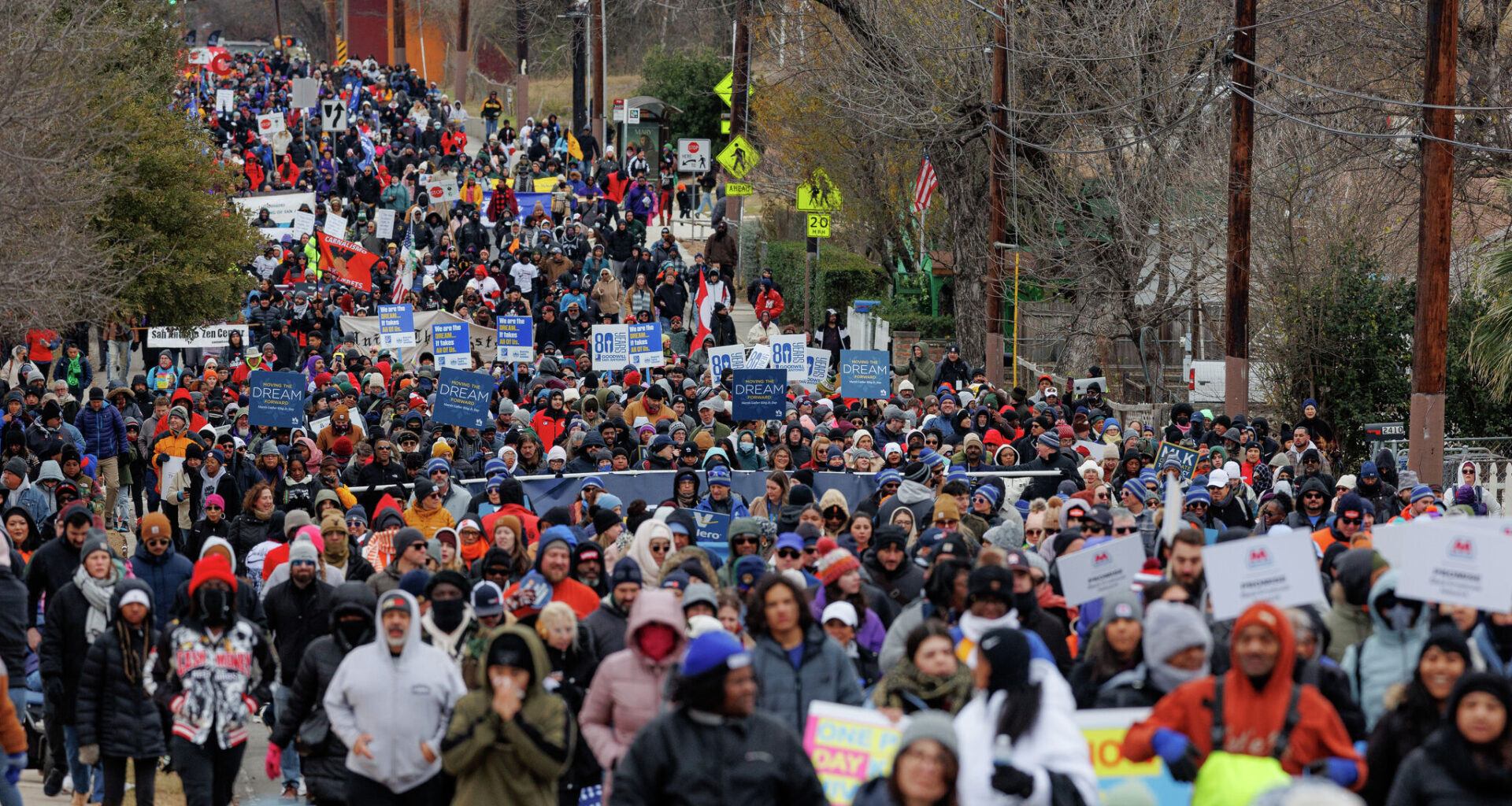
San Antonio’s MLK March is among the largest in the nation.
Sam Owens/San Antonio Express-News
Olympic gold medalist Carl Lewis (center, right) alongside San Antonio Mayor Henry Cisneros (center, left) at the city’s debut MLK March in 1987.
Pat Sullivan/San Antonio Express-News file photo
The front page of the San Antonio Light on Tuesday, Jan. 20, 1987, the day after the city’s first official MLK March. The first march drew around 10,000 people. Today, the crowd tops 300,000, according to organizers.
San Antonio Express-News archives
Marchers make their way to Martin Luther King Plaza during the city’s first official MLK March on Jan. 19, 1987.
Joe Barrera Jr./San Antonio Express-News file photo
Rev. Raymond Callies, shown in November 1987 at Martin Luther King Jr. Plaza, was instrumental in launching the city’s first MLK March earlier that year. The longtime East Side advocate died in 2011.
Al Guzman/San Antonio Express-News file photo
Aaronetta Hamilton Pierce, shown in 2024 at the Jo Long Theatre for Performing Arts at the Carver Community Cultural Center, fought for equality in the 1960s and was the founding chair for the first MLK March in San Antonio in 1987.
Josie Norris/San Antonio Express-News
Participants in San Antonio’s annual MLK March on the city’s East Side on Jan. 16, 2017.
John Davenport/San Antonio Express-News file photo
About 10,000 people participated in the city’s first official Martin Luther King Jr. March in 1987.

Newspaper accounts say about 5,000 people marched from Martin Luther King Jr. Middle School to Martin Luther King Plaza, where they were joined by another 5,000 participants. All gathered around a stage to see Rosa Parks, a Black seamstress in 1950s Alabama when she helped launch the civil rights movement after refusing to give up her bus seat to a white man.
Article continues below this ad
From drawing 10,000 to hundreds of thousands within a few years, the march has become an iconic San Antonio event. Its status as the nation’s largest MLK march has been touted for years. Its reputation as a peaceful celebration that includes diverse participants has helped organizers draw well-known speakers and notable guests.
This year’s march is expected to draw 300,000 on Monday, as participants embark on the nearly 3-mile route at 10 a.m. The march begins at Dr. Martin Luther King, Jr. Academy and culminates in a celebratory program at Pittman-Sullivan Park. Gabby Douglas, the first Black woman to win a gold medal in the individual all-around gymnastics competition at the Olympics, is the program’s keynote speaker. Grammy-winning singer Coco Jones is scheduled to perform.
ALSO READ: Teens take bigger role in putting on MLK Youth Empowerment Summit
As the city prepares for its 39th edition of the Dr. Martin Luther King, Jr. March and Celebration, this week’s San Antonio Explained looks at how the annual event grew to what it is today.
Article continues below this ad
Focus on a mission
Rev. Raymond Callies organized what many consider the city’s first MLK march in April 1968, leading about a dozen people down East Commerce Street to Hemisfair Plaza days after King’s assassination. That initial gesture to honor King led to similar processions throughout the 1970s and 80s. Each year drew dozens more, as the route shifted and expanded.
By the early 1980s, thousands participated. By the mid-1980s, the San Antonio Dr. Martin Luther King Jr. Commission, better known as the MLK Commission, was formed to take charge of organizing the annual march. This led to it becoming an official city event in 1987, five years before Texas designated a day to honor King.
Longtime participants and organizers say the focus of the march has remained true to its initial purpose — to honor King’s legacy through peaceful expression.
Article continues below this ad
Such consistency and commitment, they say, has helped the event grow and establish its national reputation.
Active participation
Unlike MLK events in other cities — including King’s birthplace Atlanta, which hosts an MLK Day parade and downtown rally — the march in San Antonio aims to capture what King and other civil rights pioneers did, longtime participants say.
Peacefully marching in the streets to convey a message of justice and humanity was the focus of the marches during the civil rights movement, they say. Emulating what King and his contemporaries did allows those attending the San Antonio march to actively participate, not just observe.
Article continues below this ad
Generations of families have attended the event, with participants in some of the early marches now attending with their grandchildren.
Good weather
Dwayne Robinson, who served as chair of the MLK Commission from 2023-2025, attributes the city’s typically moderate January temperatures, especially when compared to cities in northern states, to the success of the local march. Since its early days, the march has been held in January to coincide with King’s birthday.
Despite participants enduring cold or rainy weather some years — an arctic blast last year dropped temperatures into the 30s and a hard freeze forced the event to be canceled in 2024 — hundreds of thousands bundle up and show up every January.
Article continues below this ad
With Monday’s forecast calling for a chilly start with morning temperatures rising to 50 degrees by 10 a.m., Robinson expects a big turnout at this year’s event.
Clout and contacts
Some early supporters of the San Antonio march helped the event grow by using their clout and contacts to promote it.
Robinson said two people were especially influential in helping establish the march as we know it today — former San Antonio Mayor Henry Cisneros and Aaronetta Pierce, one of the event’s early organizers.
Article continues below this ad
Cisneros, who formed the MLK Commission and designated the march as an official city event, used his political influence to promote participation, Robinson said.
Pierce, a well-regarded advocate of Black artists and writers, served as the MLK Commission’s first chair. Her contacts, both locally and nationally, helped establish the march’s reputation for drawing notable speakers and guests, Robinson said.
Archives show past march participants include Olympian Carl Lewis, members of King’s family and Freedom Riders, the group of 1960s civil rights activists who rode buses into the segregated South.
Maintaining the vision
Cisneros credits Pierce for recognizing the march’s potential and setting the foundation for its success.
Article continues below this ad
“I can tell you without a doubt that the modern version of the MLK march is because of Aaronetta’s original vision,” Cisneros told the San Antonio Express-News in 2022. “Aaronetta made it a broad endeavor that began with Dr. King’s leadership advocacy but extended to issues of broad justice, opportunity and gratitude from the entire community. It’s one of my favorite manifestations of San Antonio’s sense of justice and inclusion.”
Pierce, in a recent interview with the Express-News, said the driving force for each march is King’s vision of a world in which people of all races were treated equally.
“That is every individual’s commitment to the principles of Dr. King,” Pierce said. “We have to believe that and saying they believe enough to show up. One picture is worth 1,000 words. When a community is able to inspire that many community members to join together, we succeed. I’m glad I live in a city where this kind of inspiration exists.”
Article continues below this ad