
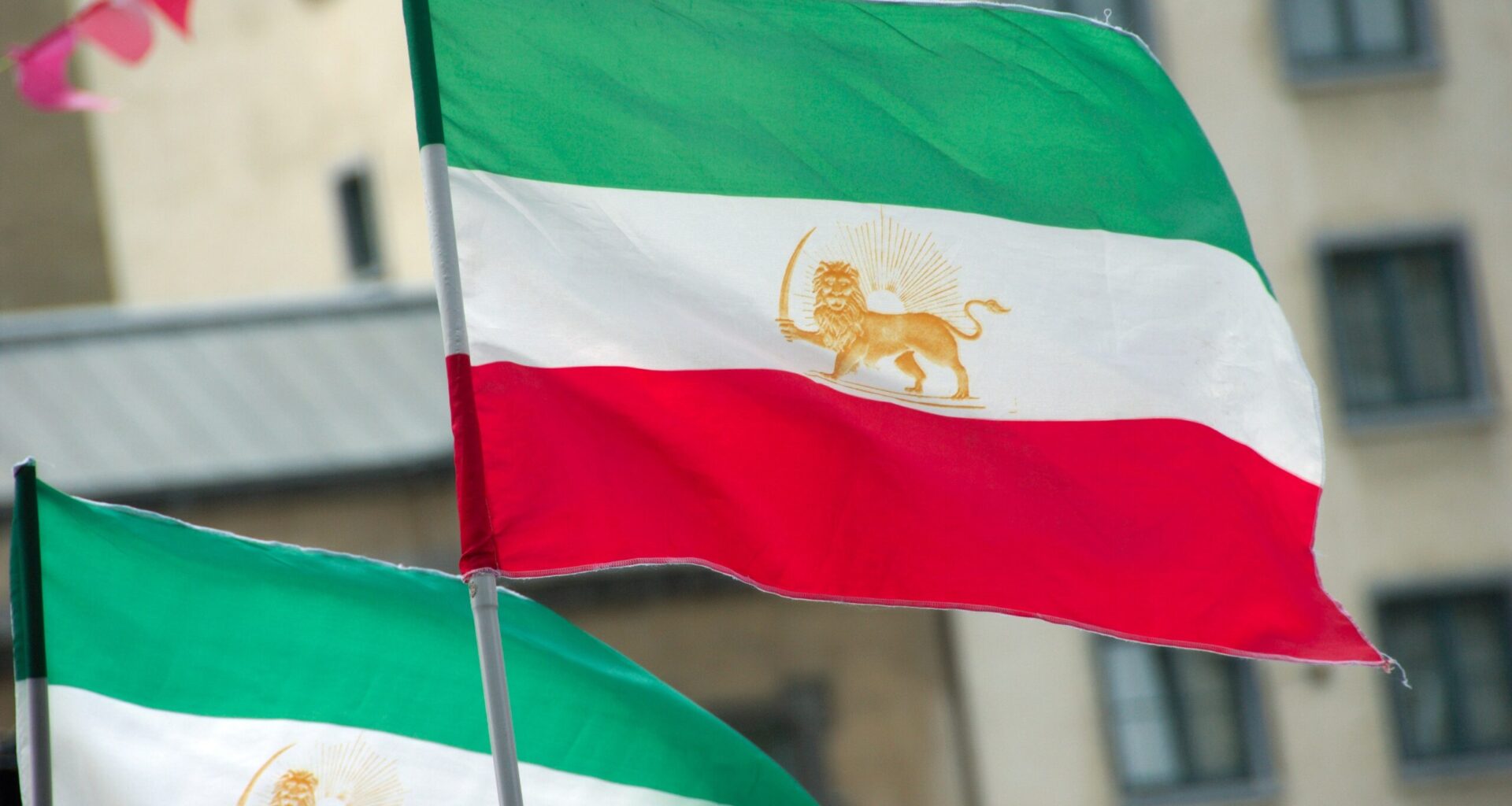
Nakisa Babadifar arrived in the United States with a child in her womb and a prayer in her heart. She and her husband, Ayoob, are among the many Iranian Christians who fled the country to escape persecution by the Iranian regime. Initially they found refuge in Türkiye. But after the Turkish government began deporting Christians back to Iran, they once again fled.
Their journey to the United States, she said, “is difficult to put into words.”
Part of their grueling ordeal to reach the border through Mexico involved riding a bus for 72 hours straight with no stops. The sojourn would have been deadly if it had been during the heat of summer. She was also five months pregnant.
Settling in Texas, the Babadifars found community in a Farsi-speaking refugee congregation within the Diocese of Dallas, which is a ministry of Gateway of Grace, an organization that supports refugee families. The Rev. Dr. Canon Samira Izadi Page, the diocese’s canon for multicultural mission, is the founder and executive director of Gateway of Grace. Page and her family fled Iran in 1989.
Babadifar said she’s grateful for the congregation for being part of her life, especially during times when she had “no strength left.”
Right when she was about to give birth, Ayoob was detained by immigration authorities. “I spent the final weeks of my pregnancy in a stranger’s home, alone and terrified,” she told The Living Church through a statement shared by Page. “By the grace of God, Ayoob was released just 48 hours before our son, Evan, was born. For a moment, we thought the storm had passed.”
Trump’s return to the presidency in 2025 meant a tightening of immigration restrictions, including for asylum seekers like the Babadifars. U.S. immigration law allows individuals to seek asylum–or to remain in the United States without fear of removal or deportation–if they can prove their lives are at risk in their home country due to their race, religion, nationality, or political stance.
As one of the world’s few theocracies, the Islamic regime of Iran requires extreme devotion to a fundamentalist interpretation of Islam. Conversion to Christianity by Muslims is punishable by death.
But the risk for Iranian Christian asylum seekers doesn’t seem to end when they arrive in the United States. One day in June 2025, the Rev. Ara Torossian of Cornerstone West Los Angeles, an evangelical church, received a call for help from two church members — a husband and wife — when two U.S. Border Patrol agents approached them near their residence.
Torossian captured the couple’s arrest in a video, where he can be heard telling the agents that the husband is an asylum seeker. “It doesn’t matter,” one agent said, before proceeding to bind the husband’s hands. He then said they were fleeing for their lives because of their faith, but the agents didn’t respond.
CBS reported recently that the Trump administration has mounted a campaign to void the asylum claims of thousands of immigrants with active cases. The U.S. government has also deported two planeloads of Iranians, the first group flying out in September 2025, after negotiations with the Iranian government.
According to the Department of Homeland Security, the hold on asylum applications is part of “ongoing efforts to support the priorities of the Trump administration by ensuring that aliens who would pose a danger to the security of the United States are not granted asylum or withholding of removal.”
Babadifar said the government’s policy changes turned what should have been a simple case review “into a nightmare.” During the check-in, Ayoob was once again arrested. She was left to care for their 14-month-old son alone. With her husband’s income gone, they lost their apartment. “I lost the stability we fought hard to find,” she said.
But during her “darkest hour,” she found “more than just a roof,” but a family in the congregation and Gateway of Grace who were there for her while her husband was detained.
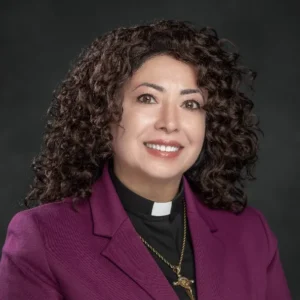 Samira Izadi Page
In an interview with The Living Church on January 13, Page said that Babadifar’s story is just one of the many “stories of brothers and sisters in Christ” who are experiencing difficulty in the immigration process.
On January 12, she spoke with the mother of a young man whose asylum case was denied, leading to his detention. The young man and his family had been refugees in Türkiye for eight years. His mother was crying over the phone to Page, recounting the suffering she and her son endured in the Middle Eastern country.
“They came in through Mexico to apply for asylum because they have no way back. They can’t go back to Iran,” Page said. “They came here with so much hope, and then all of that is shattered.” Another couple who had been in detention for seven months were just released, and Gateway of Grace and the diocese are now working to find them housing, furniture, and a vehicle, and to help with their job search.
Page spends much of her time providing pastoral care and encouraging the community, which faces many challenges. Another weighty concern for them is news of massive protests in Iran, which have been followed by followed by a government crackdown against those who speak out against the Islamic regime.
The Associated Press reports the number of deaths from the protests has surpassed 2,500, although some are reporting the figure could be north of 10,000.
“We keep praying at church for God’s protection over the people who are standing up against injustice and oppression,” she said, emphasizing that the danger of what’s happening in their country of origin is not an “abstract idea” for her parishioners of around 200 people.
“These are people whom we know and love — my mom, my sister, my brother — so we are really concerned about their safety,” Page added. Their prayer is for the people’s revolution to succeed and for the oppressive regime to be overthrown.
Page noted the strong support her community receives from the diocese. In a pastoral letter, Bishop Rob Price of Dallas listed the names of people from the diocese who are detained, several from the Spanish-speaking community. He asked every parish to pray for them by name every Sunday.
According to Page, despite the challenges faced by Iranian Christians like Babadifar, their faith continues to shine through. In letters she has received from Iranian Christians held in various detention centers, she describes how they have been “written with so much hope.”
“They’re struggling, but [are] able to create that sense that God works in the midst of absurdity,” she said.
In Türkiye, Babadifar and Ayoob served in a church called Kingdom of Heaven, where they were baptized in 2021. Although she doesn’t know what the future holds for her husband’s case, she knows she’s not alone. “My son and I are surrounded by a community that reflects the very ‘Kingdom of Heaven’ we set out to serve so many years ago,” she said.
On January 18, the Second Sunday after the Epiphany, Babadifar will be confirmed as an Episcopalian.

Caleb Maglaya Galaraga is The Living Church’s Episcopal Church reporter. His work has also appeared in Christianity Today, Broadview Magazine, and Presbyterian Outlook, among other publications.