
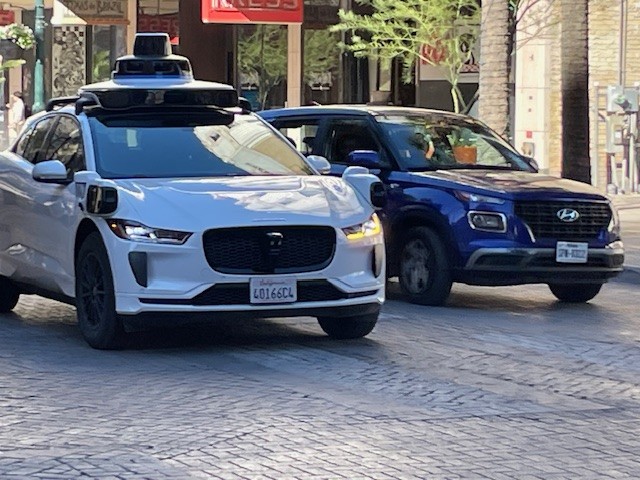
A vehicle with a driver passes a Waymo robotaxi sitting motionless in the 400 block of East Houston Street. The company said it froze because traffic lights on the downtown thoroughfare were out. That’s the same issue that led to gridlock in San Francisco during a power outage last month. “This is a rare occurrence, but a scenario that we are working on improving,” a company spokesman said.
Patrick Danner/Staff
Waymo, still facing scrutiny in California for gridlock caused when its robotaxis froze as traffic lights went dark during a power outage in San Francisco, is still struggling to solve the issue.

One of the company’s cars was spotted partially blocking an intersection in downtown San Antonio, where Waymo is preparing to roll out its service this year.
Article continues below this ad
“It seems one of the traffic lights were out, so the vehicle paused for a handful of minutes,” a company spokesman said of the incident last week.
READ NEXT: Waymo ready to roll driverless robotaxi service in San Antonio, 4 other cities
A witness, though, said traffic signals in the 400 block of East Houston Street at Jefferson Street were working, with the robotaxi sitting motionless as the signals cycled through several green lights.
Drivers of other vehicles blew their horns and swerved around the frozen Waymo, a Jaguar I-Pace outfitted with the array of sensors and cameras Waymo uses to make them fully autonomous. The city wasn’t immediately able to confirm last week that the traffic lights were out.
Article continues below this ad
The company spokesman said the car sat while it was waiting for a human in Waymo’s fleet response team to clear the vehicle to proceed. The company has said the human helpers are like a “phone-a-friend” service for the cars when they experience a situation their technology doesn’t understand.
It’s the same issue, though at smaller scale, that caused traffic tie-ups last month in San Francisco, about which the company has said the large number of dark signal lights and vehicle requests for confirmation to proceed overwhelmed the human overseers. It has issued software updates in response to that problem but acknowledges it’s still gathering data.
Waymo said it was rolling out software updates, improving emergency response protocols and expanding coordination with local officials after stalled robotaxis became a focal point of the San Francisco gridlock during a massive outage last month.
Aidin Vaziri/San Francisco Chronicle
“This is a rare occurrence but a scenario that we are working on improving,” the spokesman said.
Article continues below this ad
RELATED: Austin ISD says Waymo robotaxis continue to pass school buses despite software recall
It was also the second instance last week of Texas trouble for the autonomous ride-hailing industry leader. In Austin, where Waymo operates about 200 cars in a 140-square-mile service area, Austin Independent School District said the company’s robotaxis have continued to illegally pass stopped school buses. That’s despite the company’s claims it resolved the issue with software updates.
The school district has threatened legal action against Waymo and asked that it halt operations during school drop-off and pickup hours.
The company began testing its robotaxis in San Antonio last year. The fleet currently has about 20 vehicles and is operating from a temporary site.
Article continues below this ad
In November, Waymo announced it was expanding its ride-hailing services this year to San Antonio, Dallas, Houston, Miami and Orlando.
The Google spino-ff already operates in five U.S. cities including Austin, where it launched in partnership with Uber last spring. It launched in San Francisco in 2024 and now also operates in Atlanta, Los Angeles and Phoenix.
Waymo’s planned 2026 expansions will put it further ahead of Austin-based Tesla Inc., which has said driverless ride-hailing and autonomous driving is a key to its future. That company now operates a small fleet in Austin, though some of its robotaxis still have human safety monitors on board, and in the San Francisco Bay Area, where cars all arrive with a human minder in the driver seat.
Article continues below this ad
The San Antonio Police Department said it did not receive any calls about the halted Waymo on Houston Street.