
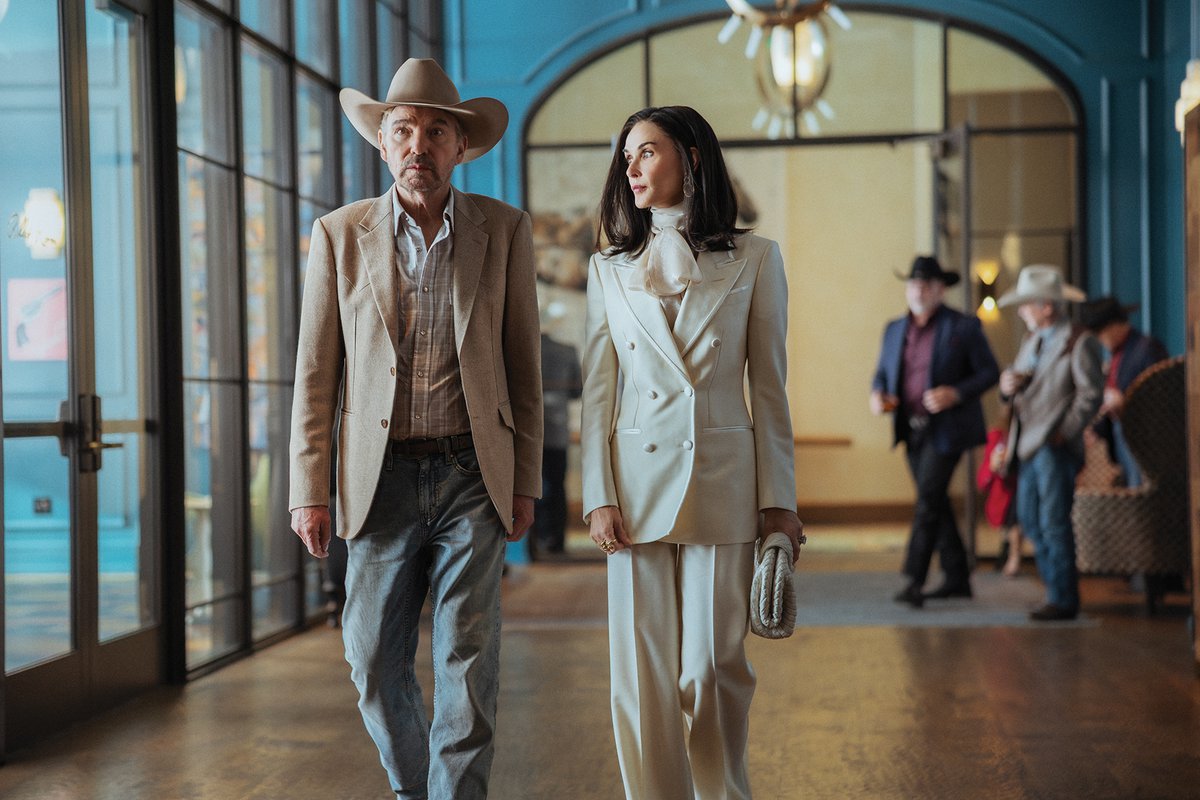
Now that the Taylor Sheridan–made, Billy Bob Thornton–starring, Fort Worth–centric second season of the Paramount+ series “Landman” has officially ended — or at least left viewers dangling on what Tommy Norris(Thornton) will do next — it’s worth pausing to consider just how deeply the show embedded itself in the city it called home.
Season 2 wasn’t content to use Fort Worth as a postcard backdrop. Filmed across 135 days on location, the series wove the city’s neighborhoods, landmarks, and businesses directly into its storylines. From the Stockyards’ dust and ritual to the polished calm of downtown offices and hotel lobbies, “Landman” didn’t just pass through Cowtown — it settled in. Road closures and traffic delays aside, Fort Worth got its close-up.
The economic footprint was equally tangible. According to Visit Fort Worth, Season 2 employed 3,856 people locally, including 1,092 crew members, 192 cast members, and more than 2,500 extras. Out of those extras was our very own Contributing Editor, John Henry, who can attest firsthand what it’s like being on the set of “Landman.”
The Fort Worth red-carpet premiere reached 11.2 million people, while 9.2 million viewers tuned in within the first two days of release — a 262 % jump from the Season 1 premiere. Hotels filled, restaurants stayed busy, and the city briefly became a working set, its daily rhythms bending around production schedules.
But the show’s impact isn’t captured by statistics alone. On screen, Fort Worth functions less as scenery than as a lived-in environment — one that shapes the show’s tensions, ambitions, and uneasy compromises. Watching “Landman” often feels like moving through the city alongside its characters, each location carrying the weight of what’s been said, unsaid, won, or lost there.
The season opens in the Fort Worth Stockyards, where the ritual calm of the cattle drive contrasts sharply with the instability of the oil business Tommy navigates. Episode 1 also establishes a visual language of power and scale at Dickies Arena and the Will Rogers Memorial Center, spaces that reflect the institutional gravity pressing down on the characters long before any deals are struck.
Downtown Fort Worth becomes the setting for quieter, sharper exchanges. Office towers and hotel interiors stand in for boardrooms where influence shifts incrementally — a look here, a pause there — as alliances strain and recalibrate. The reflective glass and controlled lighting mirror a world where leverage matters more than volume.
Restaurants, too, play their part. In Episode 4, 61 Osteria hosts a lunch defined less by food than by restraint, the tension hovering just above the table. By Episode 8, Toro Toro offers a more solitary setting, where reflection replaces negotiation, and the weight of earlier choices settles in.
Away from downtown, the show leans into the city’s everyday texture. Scenes filmed on the grounds of TCU capture moments of transition and uncertainty, while the White Elephant Saloon in the Stockyards offers release — music, movement, and the illusion of escape — in Episode 6. Cattlemen’s Steak House, featured in Episode 3, anchors another kind of ritual, where history, appetite, and conversation overlap in a space that feels immune to trends.
Even lesser-known corners of the city find their way on screen. A West Fort Worth building repurposed as The Patch Cafe becomes a recurring stop, its modest scale and worn-in feel grounding the show’s broader themes of labor and ambition. It’s the kind of place Fort Worth residents recognize immediately, whether or not they’ve seen it on television.
Taken together, these locations do more than establish geography. Conversations unfold on patios near Bowie House. Power shifts inside downtown offices. Quiet reckonings happen over meals, and loud ones spill out into the Stockyards after dark. Across Season 2, Fort Worth isn’t just a setting — it’s character, geography, and subtext all at once. That’s the mark of Sheridan’s best work: the sense that real places carry real weight, and that “Landman”’s oil-country drama is inseparable from the city that hosts it.