
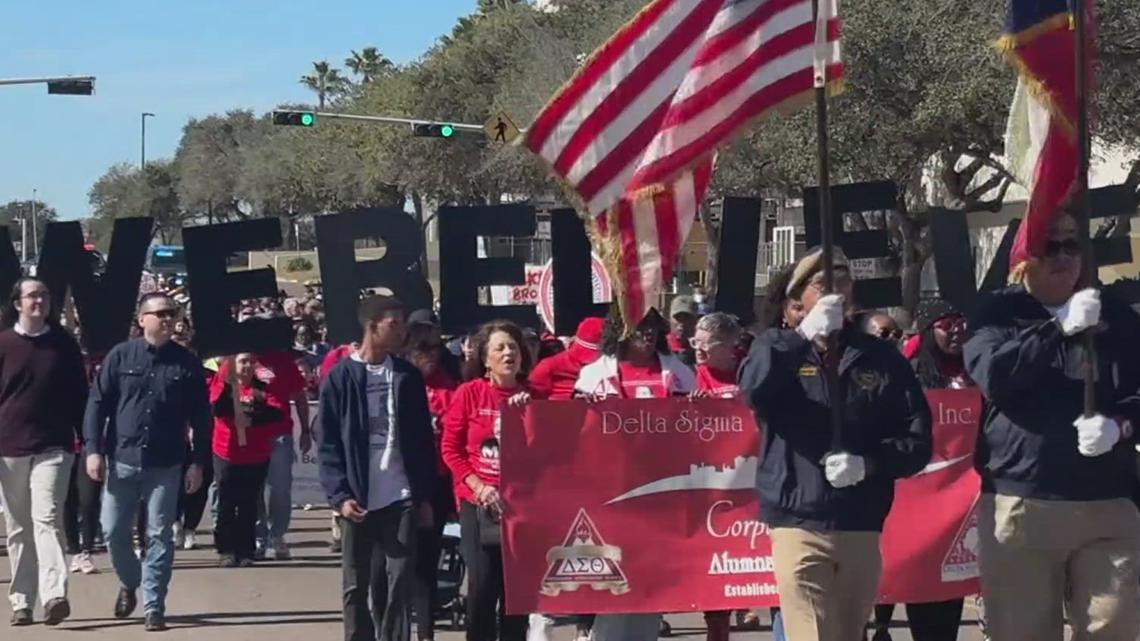
Several participants at the MLK Day March in Corpus Christi issued blunt warnings about the future of civil rights.
CORPUS CHRISTI, Texas — Today’s Martin Luther King Jr. March in Corpus Christi focused on honoring the past, but many people we spoke with were more concerned about the present and what lies ahead.
From Selma to South Texas, marchers and panelists shared blunt opinions about where civil rights stand in America right now.
The Nueces County Courthouse was a busy place as the annual March for MLK wrapped up and a justice forum took place inside. We asked participants and panelists how they see the state of civil rights in the country today.
Mattie Darnley is from Selma, Alabama, a city known for its role in the historic voting rights marches of the 1960s. She attended the march with a clear message.
“I think we are going backwards because nothing much has changed,” Darnley said. “The only reason is because black people don’t pull together like every race in the world.”
Many who marched had earlier taken part in the justice forum held inside the courthouse. Attorney Matt Manning, one of the panelists, offered a stark assessment.
“I think we are going backwards in sixth gear,” Manning said. “There’s a very strong concerted effort to attack anything that has been a gain in the last 50 or 60 years. We are saying the quiet parts out loud now. Things that used to be beyond the pale politically, morally, and socially are no longer beyond the pale.”
Another panelist, Del Mar College history professor Jim Klein, reflected on what Dr. King might think if he were alive today.
“I think he would be concerned,” Klein said. “He would be concerned about the dramatic divisions in the country. We need to do what we can to try and maintain his legacy.”
Darnley said change begins with how people treat one another.
“If we learn how to love each other as much as we love our animals,” she said, “It would be a much better place to live.”
The voices heard at today’s march and forum came from different generations and backgrounds, but they shared the same concern. Progress made decades ago cannot be taken for granted.
For many who gathered, honoring Dr. King’s legacy is not just about remembering history. It is about confronting where the country stands right now.