

Texas gained “around zero” net jobs in 2025, according to a recent projection by the Federal Reserve Bank of Dallas, suggesting a downward shift from the state’s prolonged, high employment growth trajectory.
“It is a big deal for Texas,” Luis Torres, a Dallas Fed economist who authored the analysis, told The Dallas Morning News. “It’s a low-hiring, low-firing environment.”
Related

The Dallas Fed’s 2025 Texas Employment Forecast, which aims to provide a more comprehensive look at the state’s overall jobs activity months before the Bureau of Labor Statistics releases its official employment numbers, is based on an average of four models that include measurements of projected national GDP, oil futures prices and national and Texas economic indices.
The central bank branch’s forecast came soon after the Texas Workforce Commission released its own report that suggested a rosier picture, putting Texas’ year-over-year nonfarm jobs growth rate at around 1% as of November.
Business Briefing
However, that data didn’t account for downward revisions from the first half of 2025, and could potentially be adjusted downward in the future.
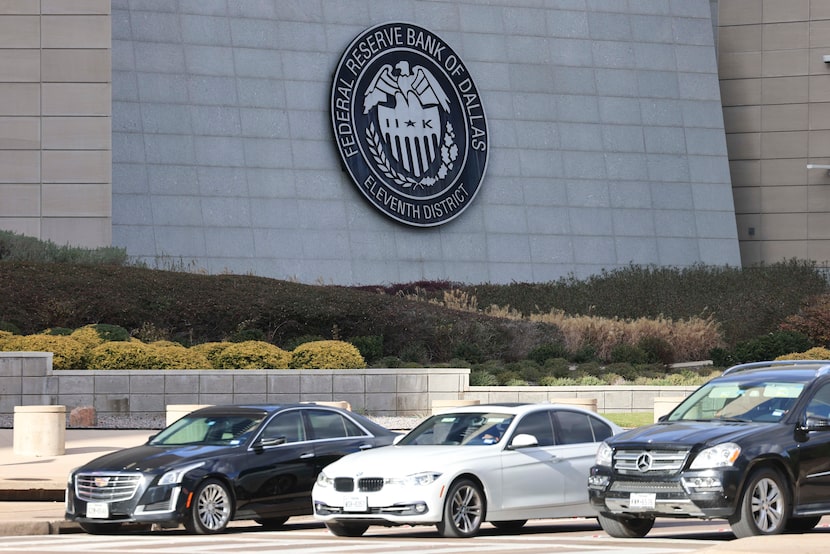
Federal Reserve Bank of Dallas photographed, on Wednesday, Jan. 14, 2026 in Dallas.
Shafkat Anowar / Staff Photographer
The Dallas Fed’s analysis wasn’t entirely dour. The bank put the statewide seasonally adjusted unemployment rate at 4.2%, representing no change from the end of 2024. Major Texas metro areas, including D-FW, also saw no increase in unemployment rates.
And the state’s economic productivity, as measured by GDP, actually saw a small boost, Torres said, likely in part because of more technological integration represented by artificial intelligence.
“AI is improving productivity,” he said. “[It’s] part of that story.”
Yet the halt in Texas job growth still represents a major economic shift for a state that’s been adding positions for years, while simultaneously benefiting from a corresponding population boom. Texas’ long-term trend is a job growth rate of around 2% annually.
From the end of 2021 to the end of 2024, the state added more than one million jobs, official data shows, for a total of over 14 million.
That’s the same number Texas has now, the Fed’s forecast concluded. The report put the state’s employment last month at 14.2 million, and implied that Texas actually lost a net of 2,200 jobs last year, although that number is statistically negligible.
It also found that the state lost around 23,000 jobs in the fall, although December saw a slight rebound.
Much of the downshift stems from the oil and gas industry, which has recently been shedding workers amid persistently low oil prices, and additional uncertainty around tariffs and other geopolitical tensions. Last year, many of the state’s biggest energy companies, including Chevron, Exxon Mobil and ConocoPhillips, announced job cuts that cumulatively numbered in the thousands.
More broadly, the Trump administration’s immigration crackdown is also dampening Texas’ immigrant-heavy labor supply, while lingering uncertainty around tariffs and other macroeconomic factors also continues to weigh on Texas employers.
The state has recently seen job growth, on the other hand, from the healthcare sector and construction industry, in part because of Texas’ — and Dallas-Fort Worth’s — ongoing data center boom.
In recent years, Texas has easily outpaced the national economy — and North Texas, in particular, has emerged as one of the country’s most booming metro areas. However, it’s not immediately clear what the forecast might augur for the near future.
The absence of a spike in unemployment claims, at least, was reassuring, Torres noted, while an energy sector recovery or other factors could still theoretically push Texas back toward its 2% traditional growth rate.
“Right now, there’s changes happening in the economy,” he added. “But I think what still helps the Texas economy is its overall model of low regulation pro-business, there’s no state income tax, low taxes — all these things are still beneficial, but still you have these other headwinds going forward.”
 Stocks sink amid trade clash fears between U.S., Europe
President Donald Trump’s push to take control of Greenland has injected fresh volatility into markets.
 Dallas gathers to confront inequity, shape solutions at ‘Drivers of Opportunity’ symposium
First-of-its-kind event brings city officials, nonprofits, and residents together to tackle disparities in education, jobs, and health
 U.S. mortgage rates slide to one of lowest levels since 2022
Lower interest rates can save homebuyers hundreds each month.