
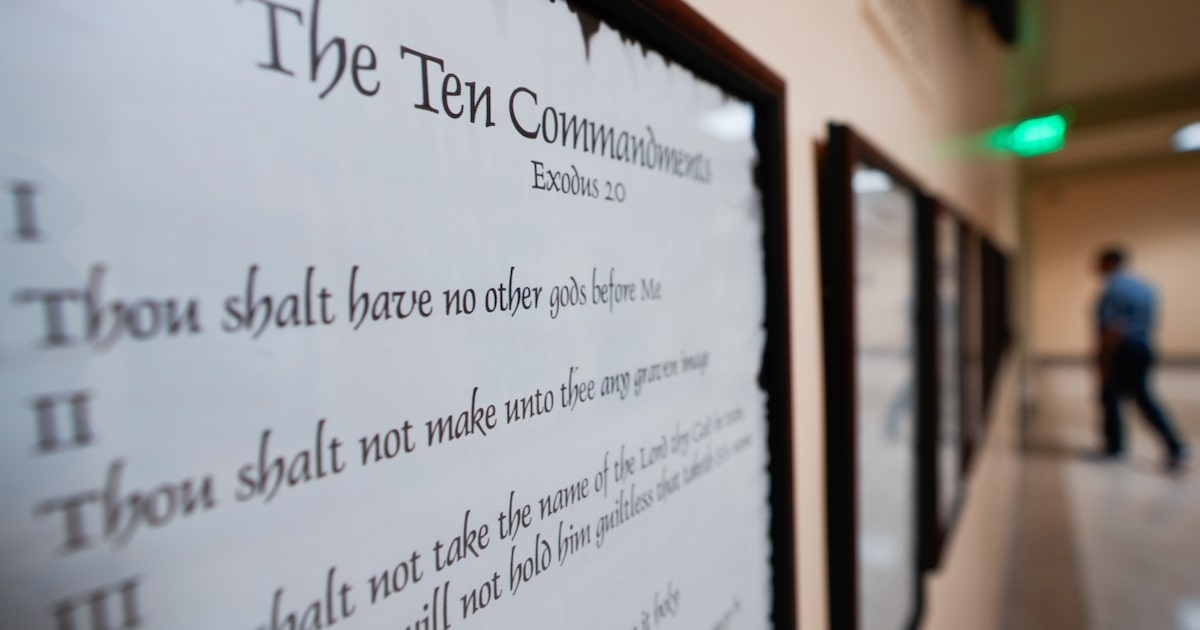
Judges on the U.S. Fifth Circuit Court of Appeals focused on the constitutionality of displaying historical texts in schools as they weighed state laws in Texas and Louisiana that mandate the display of the Ten Commandments in public school classrooms.
At a nearly two-and-a-half hour court hearing Tuesday in New Orleans, judges asked an attorney representing families who oppose the laws, Jonathan K. Youngwood, if he believes the Declaration of Independence, Martin Luther King Jr.’s Letter from Birmingham Jail and the Pledge of Allegiance are constitutional in school settings.
Youngwood said a passing reference to “under God” in the Pledge of Allegiance is “far less egregious” than posting the Ten Commandments in every classroom. “They are labeled as instructions, as commandments,” Youngwood said.
The court heard arguments regarding the mandate to display the Ten Commandments under Senate Bill 10 in Texas, alongside a similar Louisiana law.
The Education Lab
The case is among three Texas lawsuits against the Ten Commandments display law backed by advocacy groups that include the American Civil Liberties Union and Americans United for Separation of Church and State.
Related
Texas Attorney General Ken Paxton, who has been defending most of the school districts being sued, filed an appeal after an August decision from U.S. District Judge Fred Biery in San Antonio that blocked the displays from several districts, including Plano, Austin, Houston, Fort Bend and Cy-Fair ISDs.
Attorneys for those who oppose the laws argue they infringe upon parents’ rights to decide their children’s religious education. Paxton and other supporters say the Ten Commandments’ role in schools is justified since they “have historical significance as one of the foundations of our legal system.” Some legal scholars disagree with that stance.
When one judge asked about the Declaration of Independence’s constitutionality if it were placed in schools, Youngwood said it would be. The judge asked what makes that permissible if the document references “Nature’s God,” “the Supreme Judge of the world,” and “the protection of divine providence.”
Youngwood said religion doesn’t have to be removed from all aspects of public life, citing a 1980 Supreme Court decision, “Stone v. Graham.” The decision struck down a Kentucky statute requiring the Ten Commandments be posted in every classroom. Paxton’s office argues the test the court used in making that decision has since been abandoned, while the attorneys for the families have been referring to “Stone” as a legal precedent.
Related

Another judge said to Youngwood: “Nobody’s telling the kids they have to look up at everything that’s posted on the walls.”
He responded: “They may not see the poster every minute they’re in the classroom, but it will be there every minute they’re in the classroom — which means it’s unavoidable.”
The appellate court first heard the lawsuit involving the Texas families, but a three-judge panel already considered the Louisiana case in January 2025. Those judges unanimously sided with the families in a ruling that came out in June, but the decision was vacated once the full court decided to rehear the case.
Related

Jonathan Saenz, president and attorney for Christian conservative advocacy group Texas Values, attended the hearing in New Orleans as his organization filed a supportive legal amicus brief on behalf of state Sen. Phil King, who authored SB10, and one of the bill’s primary sponsors, state Rep. Candy Noble.
“I don’t want to get overconfident,” Saenz wrote on social media following the hearing. “But the oral argument went really well for the Texas law and the Louisiana law.”
A decision isn’t expected for “some number of months,” Youngwood said at a news conference after the hearing.