
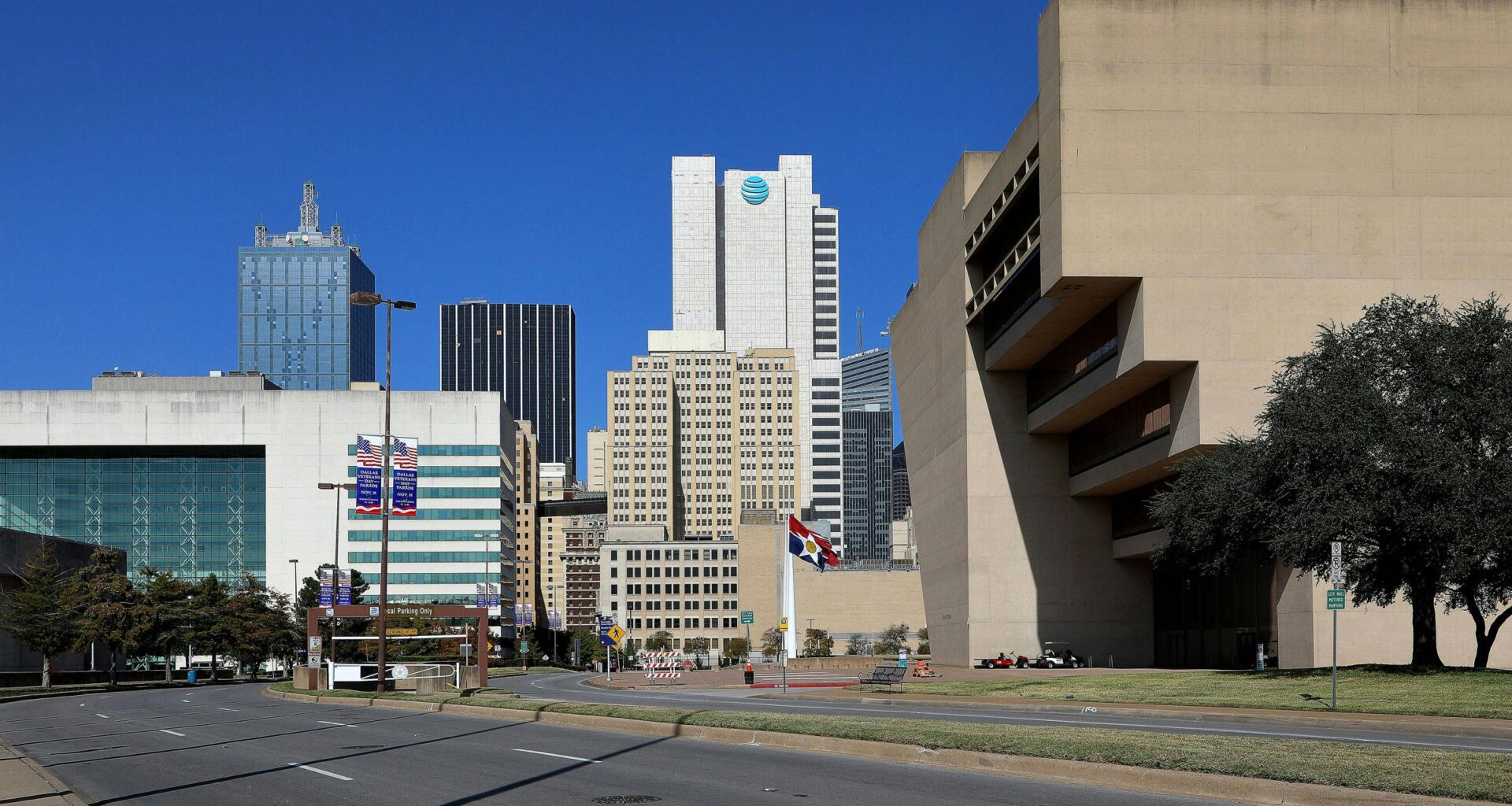
Visit downtown Dallas during the weekday lunch rush, and its reputation for being a moribund neighborhood can seem particularly unfair. On a recent Tuesday, beneath a giant video screen affixed to a skyscraper and across from two historic beaux arts–style hotels, dozens of people wandered a sunny plaza in the AT&T Discovery District. Many of them were headed into the Exchange food hall for fish tacos, lobster-truffle rangoon, or chicken-tikka-masala wraps.
At nearly every table inside the bustling dining space, someone was wearing an AT&T shirt, vest, or quarter-zip pullover. A woman pecked at a laptop bearing a sticker that read “#LifeAtATT.” A man with an AT&T visitor badge clipped to his belt asked one of his lunch companions where he lived, and his answer was Plano—the last thing any downtown Dallas booster wants to hear right now.
Earlier this month, AT&T announced it will move its corporate headquarters from Whitacre Tower, a 37-story skyscraper that anchors the Discovery District, to the Legacy business park in suburban Plano, with some employees relocating as early as 2028. The company’s departure means the loss of several thousand workers at a time when the Central Business District’s office market is already on life support, with a vacancy rate of reportedly more than 27 percent.
Days after the AT&T news, Shawn Todd, whose real estate firm jump-started many downtown redevelopments this century, said that one of his properties, the National, a 51-story, mixed-use building on Elm Street that received millions in tax-increment financing (TIF) from the city, was headed into foreclosure. Then, last week, Neiman Marcus’s parent company, Saks Global, filed for bankruptcy, seemingly increasing the likelihood that the days are numbered for Neiman’s historic flagship downtown. The store was set to close last spring before city leaders and downtown investors reached an agreement with Saks on a temporary reprieve.
But the loss of AT&T could prove more devastating than any of the other recent departure announcements (a list that also includes the offices of Bank of America and Deloitte). The telecom has more employees downtown than any other company, according to Jennifer Scripps, CEO of the booster nonprofit Downtown Dallas.
The tax-revenue loss to the city has been estimated at $62 million annually, according to the Boston Consulting Group. Scripps describes the situation as a crisis Dallas can’t waste. “I believe that cities are always truly evolving,” she said from a corner office inside the National, which was an empty husk ten years ago but now features luxury apartments, a Lucchese Bootmaker store, a Chick-fil-A, and an impending ownership switch after the foreclosure.
For a city whose highway-choked downtown has long lagged behind other large (and even smaller) cities in population density, the loss of AT&T could be seen as a catalyst to reorient the Central Business District around greater entertainment options and more residences—or, if Dallas does nothing, as an unfortunate milestone in a hollowing out of the urban core.
AT&T moved to Dallas from San Antonio in 2008, during the early stages of downtown’s most recent evolution, in which developers like Todd transformed vacant offices into housing and retail spaces. About 10,000 apartment units and hotel rooms downtown used to be offices, according to Downtown Dallas, making Dallas a top-ten city in the U.S. for such conversions. The neighborhood’s residential population, almost nonexistent in the nineties, surged from about 6,600 in 2008 to nearly 12,200 in 2019. AT&T began developing the Discovery District, at a cost of $100 million, in 2018.
Two years later, the COVID-19 pandemic hit downtown hard, and the effects have lingered. Workers stopped coming to offices. Crime went up. Residents reported an increase in homelessness. After nearly five years of allowing remote and hybrid work, AT&T required employees to return to the office five days a week, starting in January 2025. Around the same time, the Boston Consulting Group released a report in which an anonymous corporate stakeholder said public-safety concerns could lead the company to relocate. Downtown violent crime declined about 11 percent year-over-year in 2025, coinciding with an increase in police presence and ongoing private-security efforts, although overall crime levels were basically flat, according to police data.
When announcing the move to Plano, AT&T CEO John Stankey portrayed the relocation as a strategic decision to improve the employee experience. In a company-wide email, obtained by Texas Monthly, he said the new Legacy headquarters, built from the ground up on 54 acres, would bring the company’s entire North Texas workforce, some of whom already work in the suburbs, into a single space “designed for collaboration, innovation, and engagement.” Scripps said parking had also been an issue for AT&T. She’d regularly see the company’s workers at a Field Street garage several blocks from Whitacre Tower—a normal walk in a densely developed city, but a hike to some suburbanites.
The soon-to-be home of AT&T, Legacy business park, was developed in the late seventies by Ross Perot, whose Electronic Data Systems decamped from Dallas, in part because so many of its employees lived in Plano. Now home to more than two dozen companies and spanning nearly 2,700 acres, Legacy is a landmark of the still-unabated growth north of Dallas. Led largely by Collin County suburbs like Frisco and Prosper, the Dallas–Fort Worth area added more than 700,000 residents between 2020 and 2024, according to the most recent Census Bureau estimates. Downtown Dallas gained about two thousand residents to bring its total to just under 15,500 in the same time frame, while, overall, the city of Dallas lost population.
Frisco and Plano regularly dangle economic incentives to lure corporations and entertainment destinations, from restaurant and nightlife districts to a Universal Studios theme park. To compete with them, “Dallas is going to have to be super focused and super hungry,” Scripps said.
The city is investing $3.7 billion to replace the Kay Bailey Hutchison Convention Center, which it believes will spur further development. Dallas College is working on a downtown expansion that will also likely entail more housing. Paul Ridley, who represents parts of downtown on the Dallas City Council, said the development over the last thirty years of Uptown, a ritzier neighborhood just north of downtown (to which some formerly downtown companies moved), should spur the city to encourage residential and entertainment options in the Central Business District.
Whether Whitacre Tower or many of Dallas’s eighties-era skyscrapers are good candidates for residential use is unclear. In 2024, Todd told me the opportunities for conversions downtown were dwindling, with particularly tall and wide buildings being too difficult or too costly to convert. Last year, the city agreed to invest up to $103 million in TIF funding to help finance the attempted purchase and conversion of Bank of America Plaza, Dallas’s tallest building.
Another downtown building with an uncertain future is City Hall. The land beneath the I. M. Pei–designed brutalist structure, with a sloping, cantilevered front made famous in the 1987 film Robocop, is coveted by developers. In November, the city council asked the city manager to explore real estate and economic-development opportunities for the building. Ridley was one of three council members who opposed the measure, noting that downtown has dozens of acres of undeveloped land, with thirty more acres becoming available after the convention center renovation. “So I fail to understand why, all of a sudden, Dallas City Hall is interfering with their development plans,” Ridley said. “It makes no sense to me, and none of them have ever explained it.”
Developer Ray Washburne, who has invested tens of millions downtown, wants to see the City Hall land become a new arena and entertainment district for the Dallas Mavericks. Coupled with the Dallas College expansion and convention center redo, he believes that could stimulate economic and population growth post AT&T. “It’s a time of transition,” he said.
But to truly capitalize on the opportunities, he and other downtown advocates continue to push for further city improvements. These include planting more trees, bringing more activities to neighborhood parks, and altering car-traffic patterns to make streets safer for pedestrians. Washburne doesn’t believe that losing AT&T was a foregone conclusion if city leaders had more effectively offered a vision for downtown’s future. “They wanted to know what was the plan, and there wasn’t a plan,” he said.
Dallas officials won’t be able to forget about AT&T easily. Anyone stepping out the front entrance of City Hall can see Whitacre Tower rising prominently ahead, a constant reminder of the need to do something about the soon-to-be emptied space. Constant, at least, until the potential demolition of City Hall itself.
Read Next