
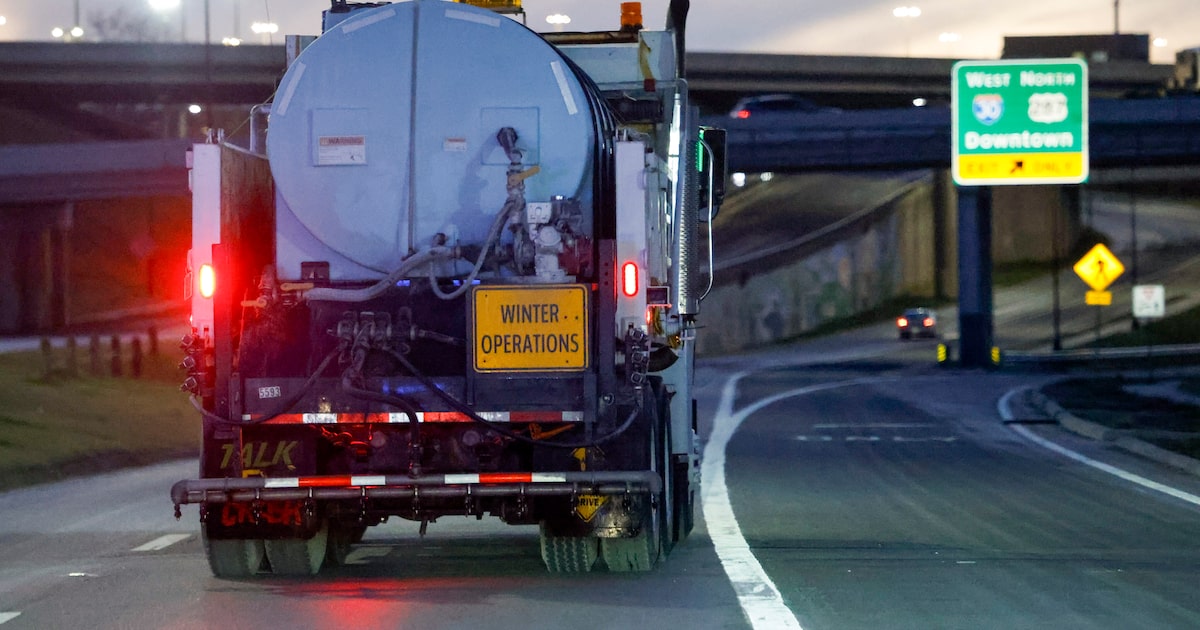
Have you ever seen a truck spraying the road before a winter storm and wondered what that mixture is?
Right now, road crews in North Texas are putting down a mixture that typically includes a saltwater brine made of sodium chloride to prevent icing, said Tony Hartzel, a TxDOT spokesman. The mixture also contains sand and “chat” — a fine, gravel-like material — to boost traction and increase friction.
But what is it about the brine that makes it good for fighting ice? The reason is fairly simple.
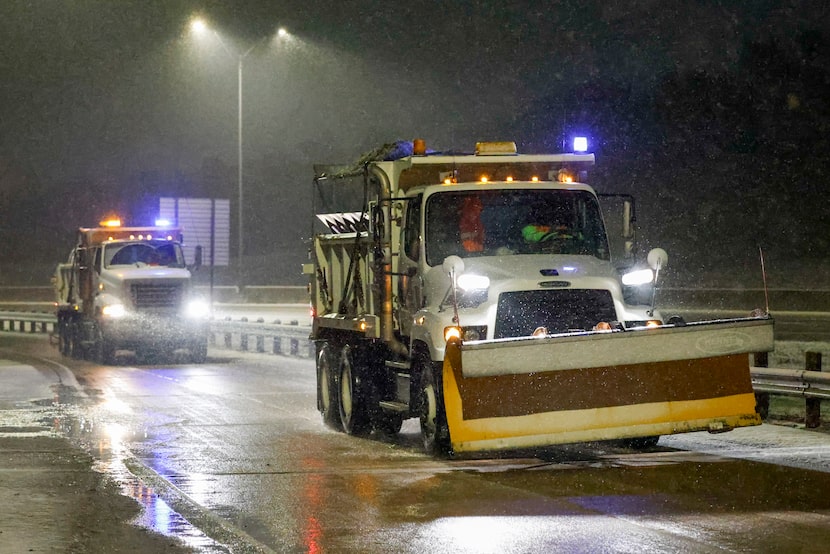
A TxDOT snowplow and brine truck drive along a frontage road near Interstate 30 and Beach Street, Thursday, Jan. 9, 2025, in Fort Worth.
Elías Valverde II / Staff Photographer
News Roundups
When precipitation hits streets or sidewalks at 32 degrees Fahrenheit or colder, it can quickly turn to ice. Mix salt into water, though, and the freezing point drops, making it harder for water molecules to form ice crystals. The saltier the solution, the lower the temperature at which it freezes. That’s why salting can prevent ice from forming or help melt what’s already there.
Salt for ice control is hardly a new idea. It has been part of winter road maintenance in the United States for decades. It gained attention after New Hampshire began experimenting with it in the early 1940s, and by the 1970s, the country was using nearly 10 million metric tons a year to deice roadways. Today, an estimated 20 million metric tons of salt is used on U.S. roads a year, according to the University of Vermont.
Aside from lowering the odds of ice forming, the road treatments in North Texas are meant to keep precipitation from bonding to the pavement — so it can be churned into slush by traffic or pushed off the road by crews, Hartzel said.
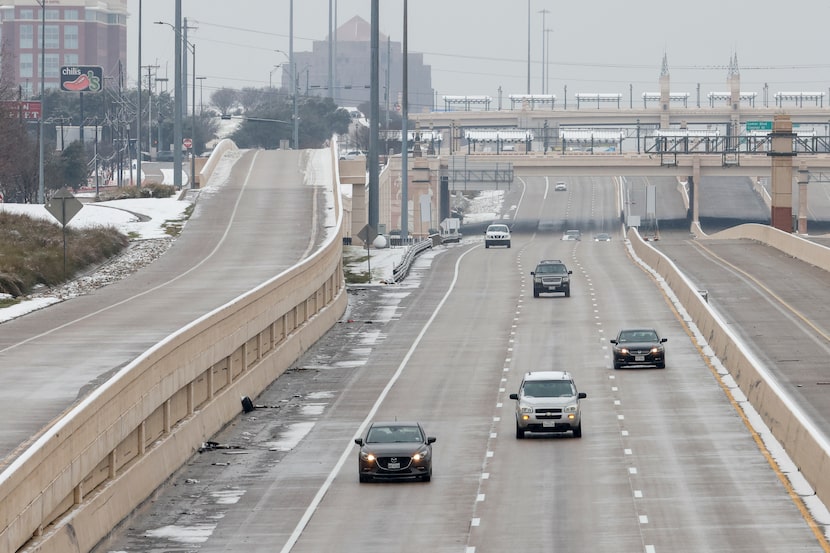
Cars drive along Interstate 30 near Collins Street, Friday, Jan. 10, 2025, in Arlington.
Elías Valverde II / Staff Photographer
Even so, he warned drivers shouldn’t let down their guard. “Just because we apply a treatment to a roadway,” Hartzel said, “they should still consider that there is going to be ice and or snow and drive to those conditions.”
A wintry mix of freezing precipitation is expected to start Friday afternoon and persist through Sunday night. Temperatures are not expected to rise above 32 degrees at DFW International Airport from 6 p.m. Friday until Monday afternoon.
Related

If you must drive during the inclement weather, be sure to reduce your speed, avoid braking suddenly or making sharp turns and use sand, kitty litter or cardboard to help regain traction if your car gets stuck.
Additional winter weather driving tips can be found on TxDOT’s website.
Staff writer Julia James contributed to this reporting.
Miriam Fauzia is a science reporting fellow at The Dallas Morning News. Her fellowship is supported by the University of Texas at Dallas. The News makes all editorial decisions.
 What’s the scientific difference between snow and other types of winter precipitation?
A lot depends on the changing air temperature from the clouds to the ground.
 Dogs can hurt their tails by wagging. What to know about ‘happy tail syndrome’
Why some dogs injure their tails from wagging, when to see a vet and what treatment looks like.
 Is it cedar fever or the flu? How North Texans can tell the difference
What to know about antihistamines, allergy shots and limiting pollen exposure.
 Texas is expanding its medical marijuana program. Here’s what to know about the drug
Here’s how it’s being used and what science says about its effectiveness.