
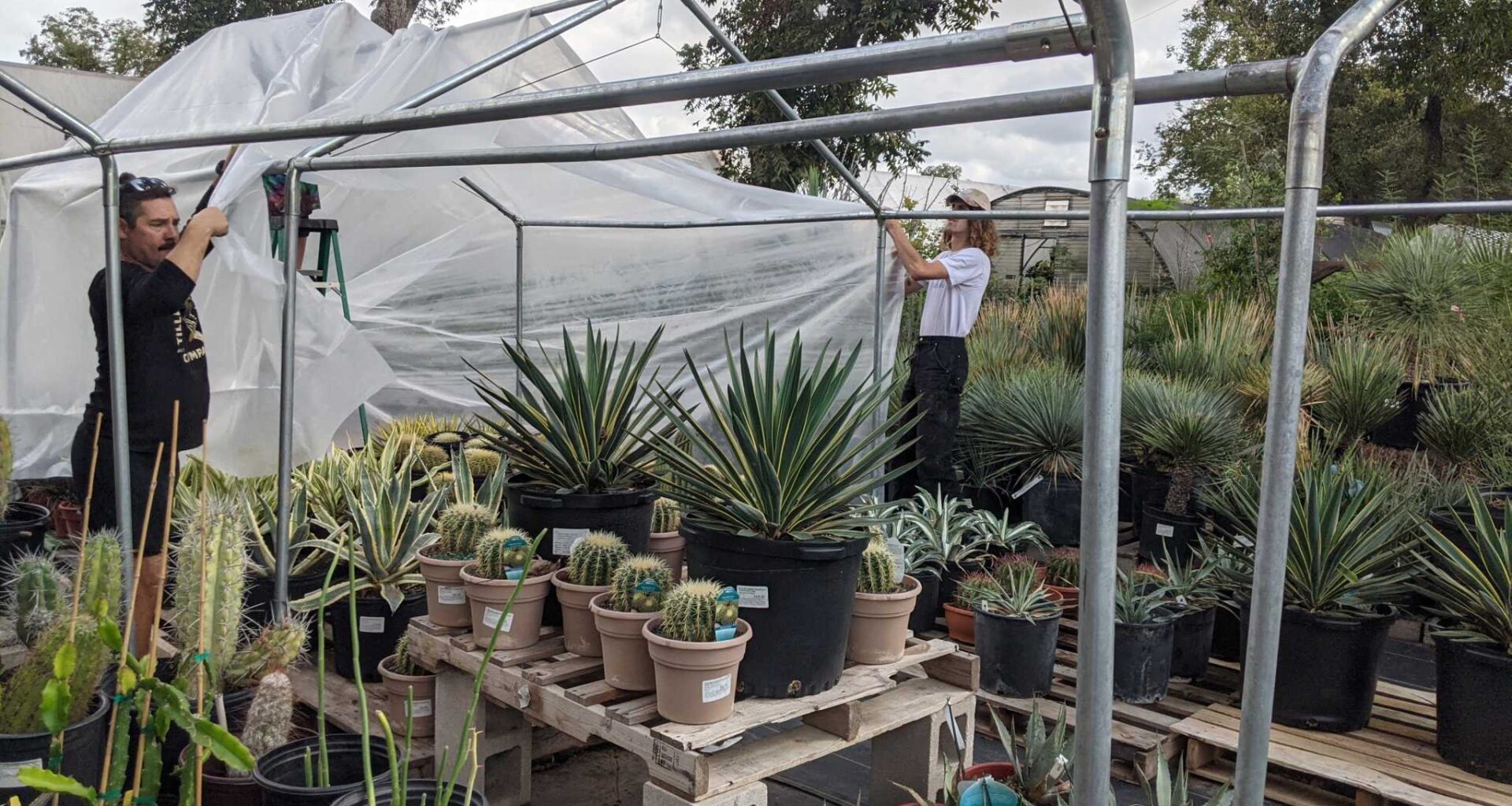
Workers at Tillery Street Plant Company pull a heavy plastic sheet over a carport frame to protect cacti and succulents at the nursery on Nov. 11, 2022.
Deborah Sengupta Stith / American-Statesman
Central Texas gardeners have been cruising through this exceptionally mild winter with little need to worry about frost-sensitive plants. But with an arctic blast on the horizon this weekend, it’s time to bring in your moveable tropical and succulent containers and make plans to cover citrus and avocado trees and other sensitive plants.

The simplest way to freeze-proof your Texas garden is to plant native species, said Melissa Hagen, houseplant manager at Tillery Street Plant Company in East Austin, when we talked to her in 2022. You don’t have to protect natives from a freeze, “and they reliably come back year after year. You just let them go dormant,” she said.
Article continues below this ad
But for those of us who enjoy the whimsy of tropical color and succulents in our landscapes, here are some tips on how to prepare for this weekend’s freeze.
When do container plants need to come inside?
When the mercury drops below 40, Hagen begins making room in her house for her outdoor containers. If you have a lot of plants, it’s easier to rehome them “in stages,” as opposed to a frantic pre-freeze scramble.
“I do let (the tropicals) get down to the high 30s and most of them are OK,” she said. “But the more sensitive ones start to get damaged. So the longer they stay out in the cold, it’s not that they die, it’s just they start to look less good.”
Article continues below this ad
It’s a good idea to bring in containers and protect your plants whenever there’s a freeze warning. “You never know if it’s only going to be that one hour or if it’s going to end up being three degrees colder than they predicted,” Hagen said. “So that’s where you have to be careful.”
Melissa Hagen (l) greenhouse manager at Tillery Street Plant Company and Sonja Muniz from Eastside Succulents pose for a picture at Tillery Street on Nov. 16, 2022.
Provided by Melissa Hagen
What to know about pests, repotting and pruning
As you bring your plants in, examine them closely to make sure they are pest free. Indoor infestations will spread easily.
Article continues below this ad
This is also a good time to prune, but Hagen does not recommend repotting plants til spring. Plants go dormant in the winter, and when you increase the volume of soil in a pot, it creates more moisture when your plant is drinking slower than it does during the growing season. Combined with “lower light, shorter days, (it) can just lead to over watering pretty easily. So it’s best to just get things through the winter and then you can think about repotting in February, March once they start growing again,” Hagen said.
How to cover sensitive plants that can’t come in when it freezes
If you have containers that are too large to bring in, or tropicals in the ground, you can cover them to protect from frost. Some nurseries, including Tillery Street, sell a frost cloth called a Planket that has a rope fastening at the bottom, but regular sheets and blankets work just as well. Hagen doesn’t recommend using plastic to cover your plants because it can stick to leaves.
“You want to make sure that you are covering your plants all the way to the ground,” she said, “so there’s not airflow underneath that really is letting all the heat out.”
Article continues below this ad
Some plants, like avocado trees, grow stronger and more cold hardy as they mature. They also become more difficult to cover. Some people use PVC pipes to build structures they cover with heavy plastic to protect beloved citrus or olive trees. A thick layer of mulch on the ground also can help protect roots.
When you have to cover your plants, try to do it a little earlier in the day, to capture heat, and make sure to secure blankets firmly on windy days. Hagen covers her plants early if there’s rain, even light rain, before a freeze. “Just that little bit of ice sitting on the leaves really can damage things,” she said.
While some tropicals, like ficus plants, a variety that includes rubber trees and fiddle leaf figs, are more cold hardy than others, the wild temperature swings we have in Texas can take a toll.
“With climate change and days that go from 80 degrees down to 30 degrees in the same night, the plants aren’t quite prepared,” she said. They don’t have time to build up the sugars that Hagen calls “the antifreeze that helps them to survive through the winter.”
Article continues below this ad
Tropicals in the ground generally fare better in a hard freeze than container plants, although any freeze might knock your plants down to the roots. Hagen had a bird of paradise in the ground survive a hard freeze uncovered when the potted one right next to it died.
Hagen recommends watering your perennials and in-ground plants deeply before a freeze as the water provides insulation for the plants.
How do I protect my succulents from a freeze?
Succulents add beautiful variety to drought-stricken Central Texas summer gardens, but most varieties can’t handle our wet and cold winters. A few notable exceptions: Ice plants are relatively cold hardy (but should be covered during a freeze) and ghost plants can survive a deep freeze.
Article continues below this ad
The Tillery team uses heavy plastic sheets over steel carport frames to create temporary greenhouses to protect the nursery’s succulents and cacti. This is a relatively inexpensive way some Texas gardeners create winter shelter for plants in their yards.
To err on the safe side, Sonja Muniz, social media and retail manager for East Austin Succulents (which used to share a property with Tillery Street), recommends bringing most succulents in when temperatures drop to 40 degrees.
Most succulents have a built in “water pipe,” where the plant stores moisture to survive long dry spells, Muniz said. If it freezes, your plant’s a goner. When warm temperatures return, “their cell structure will kind of burst, so it’s hard to bring them back to life,” she said.
The same is true for aloe (as many of us learned during the great succulent purge of 2021).
Article continues below this ad
“They have that nice soft, gooey substance that people use for smoothies, skincare,” Muniz said. “That same structure is not meant to be in freezing cold temperatures.”
On the other hand, mature agaves and cacti withstand the cold like champs. “They can do it. They love it,” Muniz said. “The bigger ones can take more of that hard weather. The baby ones that are in 6-inch, 4-inch containers are not ready to be outside yet.”
Muniz warns against watering established succulents before a freeze. (Yes, this is the opposite of what we said about perennials and other in-ground plants.)
“That combination of wet soil with the cold temperatures leads to shock,” she said.
Article continues below this ad
Oh no, I forgot to cover my plants!
We’ve all been there. The day after a freeze, your plants are a mushy mess. Take a deep breath, cut back the dead foliage and hope for the best.
Hagen likes to tell people “if you did leave your plant outside and it definitely got damaged, maybe died,” wait until mid-spring, March or April, to make a final assessment. “Anything that got knocked down from a freeze will start to come back (by then) if it’s going to and I’ve had great surprises,” she said. From tropical trees to a Monstera that “got knocked down just to the roots” with just a hint of green, some of her plants have proved more resilient than expected.
Article continues below this ad
During the big freeze of 2021, many established olive trees in Central Texas died down to the roots, leaving their owners heartbroken. “Then they pushed out a flush of growth in the springtime from the base,” Hagen said.