

The multipurpose facility will offer interdisciplinary research opportunities for
faculty and students.
CREATORS


Texas Tech University’s Edward E. Whitacre Jr. College of Engineering will build a multipurpose clean-room facility after receiving a $12 million Texas
Semiconductor Innovation Fund (TSIF) grant award. The university will match the state’s
funding, bringing the total project award to $24 million, furthering its mission to
lead semiconductor production and workforce development.
The project will be led by three researchers from Whitacre College: Roland Faller, dean of Whitacre College; Changzhi Li, associate dean of research and graduate programs in Electrical & Computer Engineering (ECE); and Hieu P. Nguyen, associate professor in ECE.
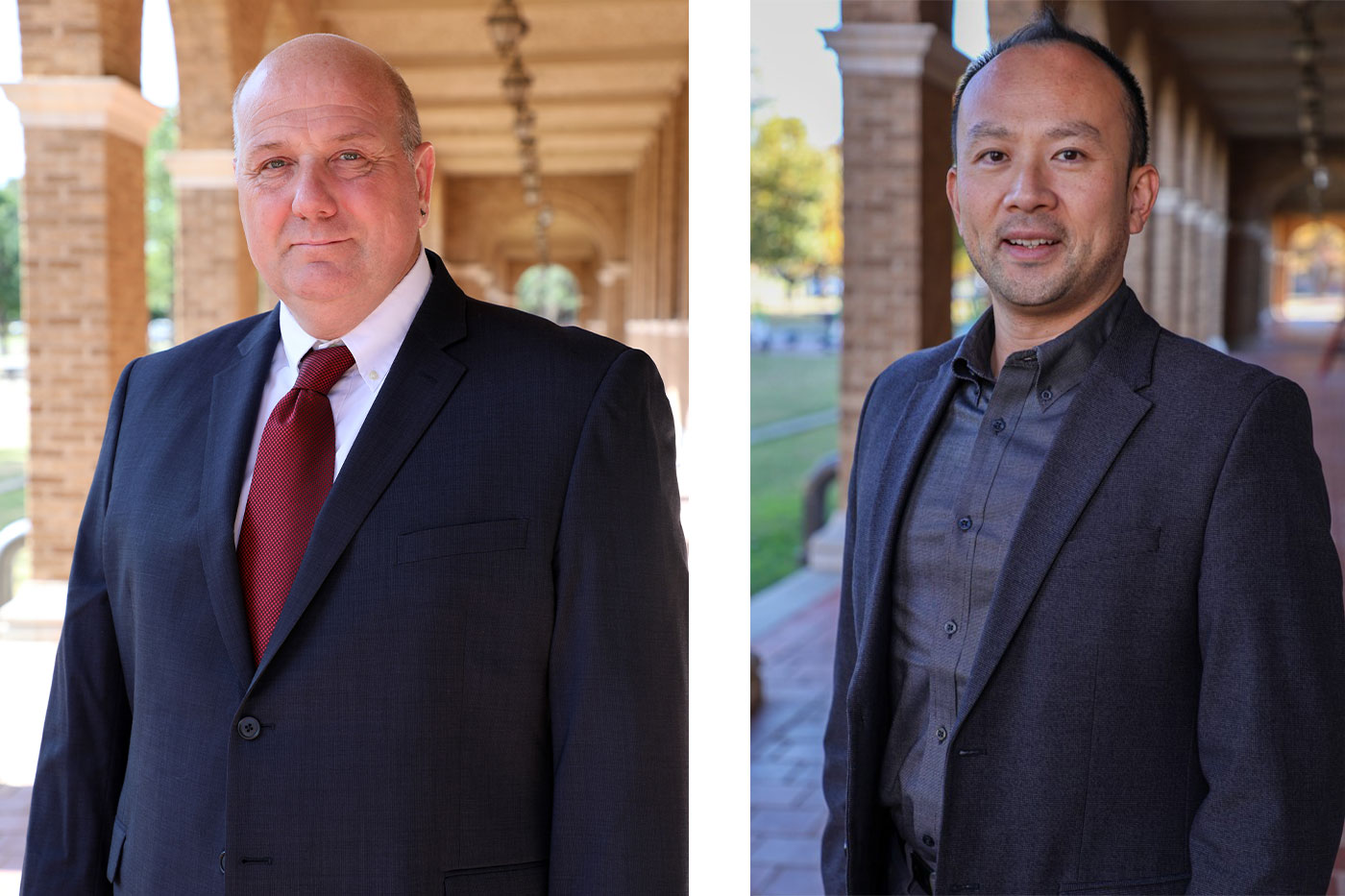 Roland Faller and Changzhi Li
Administered by the Texas CHIPS Office, a division within the Texas Economic Development
& Tourism Office in the Office of the Governor, TSIF grants may be awarded to Texas
institutions of higher education for semiconductor research and projects and to business
entities established in Texas to encourage economic development related to semiconductor
manufacturing and design. TSIF was established in 2023 when Gov. Greg Abbott signed
into law the Texas CHIPS Act.
“We are grateful for the support of the Governor’s Office and the confidence it reflects
in Texas Tech University,” said President Lawrence Schovanec. “This investment strengthens our ability to contribute to the state’s growing semiconductor
ecosystem through research, innovation and workforce development. It also affirms
the important role that higher education plays in advancing the competitiveness and
economic strength of Texas.”
Faller echoed Schovanec’s gratitude.
“We are thankful for the TSIF program in the Office of the Governor,” he said. “This
facility will allow advanced research on next generation ultra-wide bandgap semiconductors
and at the same time help train the workforce for the future of semiconductor manufacturing
in Texas.”
A clean-room facility provides an ultra-sterile environment for semiconductor manufacturing,
as microscopic particle contamination could destroy the functionality of a microchip.
Clean rooms used in semiconductor development are designed to block particles ranging
from 0.1 to 1 micrometer in size, depending on the room’s classification under the
International Organization for Standardization. For comparison, human hair can range
from 50 to 100 microns wide, while viruses are roughly 0.1 micron.
Clean rooms require an enclosed space and reliable control over factors such as temperature,
humidity, airflow, noise, vibration and airborne particles. Buying and setting up
the necessary equipment can be expensive, but maintaining a clean room is even more
costly.
That’s why Nguyen is pleased to see Texas Tech match the TSIF award.
“Texas Tech really wants to push this research to a higher level,” he said. “Without
this funding, I don’t think we can have a good quality clean room.”
Li stressed that the state-of-the-art clean room will provide opportunities for interdisciplinary
work beyond the interests of ECE.
“This project represents a comprehensive integration of research infrastructure development,
academic research and education across multiple levels,” Li said. “There will be research
opportunities for students from diverse disciplines, including electrical and computer
engineering, mechanical engineering, physics, chemistry and environmental science.”
In addition to the existing smaller clean rooms currently operating at Texas Tech,
the new clean room is expected to enhance the efficiency of faculty research.
Researchers can do a lot of work on the theory side, yet all the momentum grinds to
a halt when the time comes to design the physical chip.
“The new clean room will be a game-changer, empowering our researchers to achieve
higher precision and groundbreaking discoveries,” Nguyen said. “It will serve as a
hub for pioneering research and will help attract collaborations and investments that
benefit our entire university community.
 Hieu P. Nguyen
Nguyen is most excited about the ways students’ educational experiences will be enhanced.
He teaches a couple of courses on semiconductors that cover topics from introducing
semiconductor fabrication technologies to very-large-scale integration (VLSI) processing.
While he can talk about a clean room’s role in semiconductor development, it will
be another thing for students to see and work in this type of environment.
“If we can have some hands-on experiences or experiments for the students and they
can use the clean-room facility directly to make a chip, the students would be very
ecstatic,” he said.
The clean room is planned to be operational in 2027 and, according to Li, will offer
strong support for the new electrical engineering technology major the college is
planning to launch that same year.
The upcoming clean room, combined with several grants for semiconductor workforce
and device development, are creating a lot of excitement surrounding Texas Tech’s
role within the burgeoning semiconductor industry.
“Our peers and colleagues around the country and the world will recognize Texas Tech,”
Nguyen said. “Having a state-of-the-art clean room will increase Texas Tech’s standing
in the scientific community and attract top talent.”
Learn more about the Edward E. Whitacre Jr. College of Engineering.