
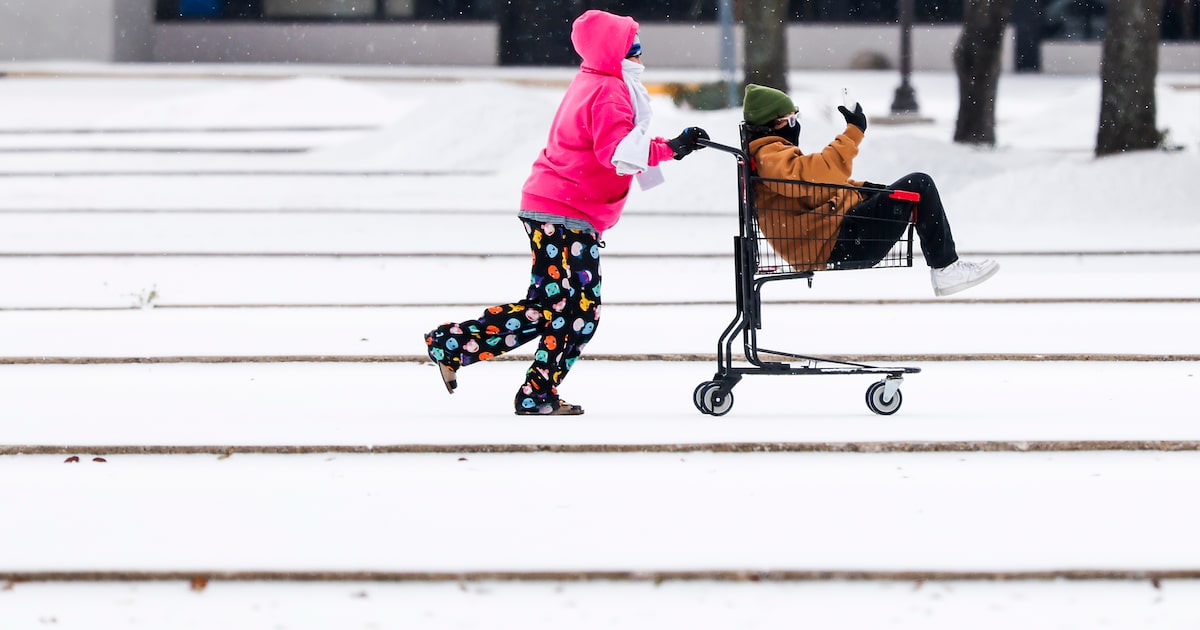
After the weekend’s winter storm brought icy conditions to the Dallas-Fort Worth area, you may be wondering what to do if you need to walk outside. Before you go, here’s what to know about the dangers of ice, why it’s slippery and how to tread carefully.
Dangers of ice
Ice can cause serious falls and injuries. In 2017, the United States Bureau of Labor Statistics reported over 20,000 workplace injuries due to ice, sleet or snow, with two out of every 10,000 full-time workers missing at least a day of work.
Some groups are more vulnerable to falls than others. Men are more likely to spend time in outdoor jobs, engage in risky behaviors and put off medical care, which can raise the odds of complications after an ice-related fall, according to the University of Kentucky’s Injury Prevention and Research Center.
Older adults are more susceptible because their balance and muscle strength can worsen with age, and because of medical conditions such as osteoporosis that make fractures more likely. Older adults are also more likely to suffer traumatic brain injuries after a fall.
News Roundups
Black ice can be particularly dangerous because its transparency can make it hard to spot. It can form on roads, sidewalks and driveways after light freezing rain or when snow, water or existing ice refreezes. Local weather officials warned of black ice possibly forming on Tuesday morning in Dallas-Fort Worth.
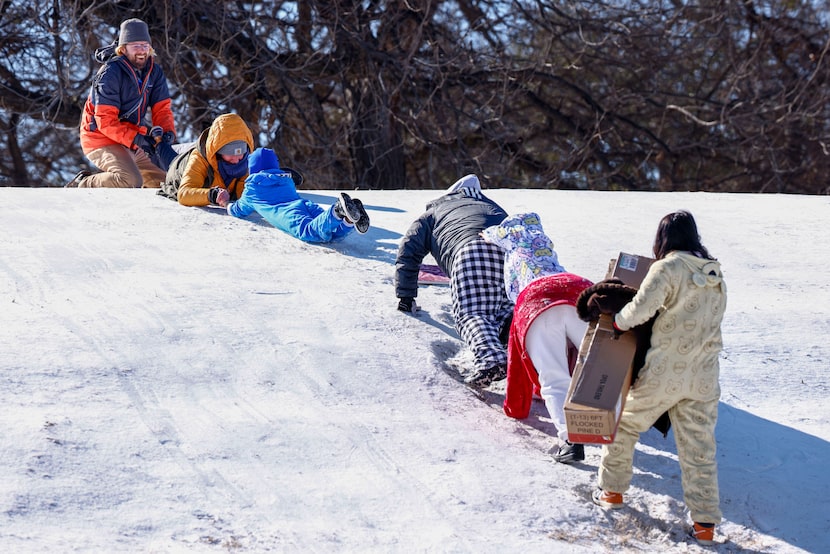
Stefan Nelson (from left) and his partner Cassie Maguire, 35, form a human chain to help Joseph Gonzalez, 10, and his family up an icy hill so they can sled at Trinity Park, Monday, Jan. 26, 2026, in Fort Worth.
Elías Valverde II / Staff Photographer
Why is ice slippery?
While ice looks to the naked eye like water in solid form, a nanometer-thin layer of liquid water can coat its surface. That thin film is what makes people either slip or glide smoothly across (in the case of an ice-skating rink).
Why this layer forms on top of ice has long been a subject of scientific debate.
It’s known that ice has an unusual ability to melt under pressure. Most materials behave differently, with pressure turning liquids into solids, Robert Carpick, a professor of engineering and applied sciences at the University of Pennsylvania, told the university magazine Penn Today.
“But pressure-induced melting only happens in a very narrow temperature range,” Carpick said, “while ice remains slippery well outside those limits.”
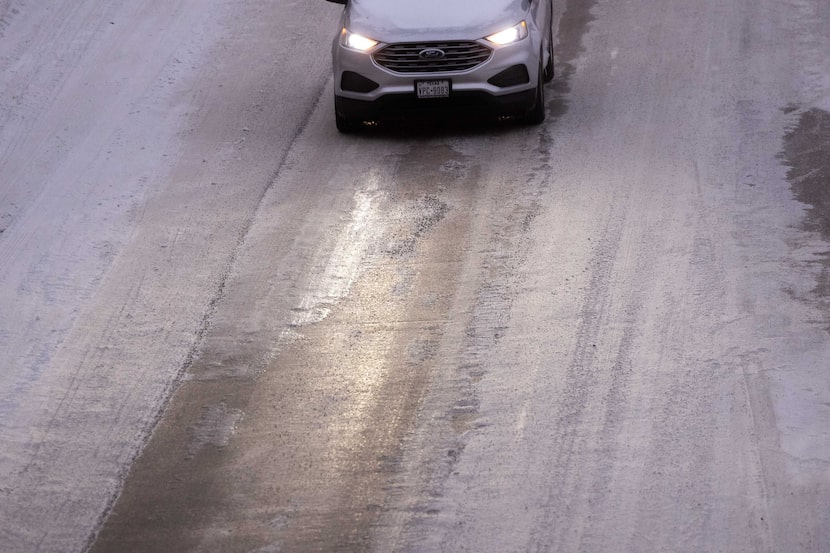
Ice is reflected off of a cars headlights as vehicles drive on North Central Expressway during a winter storm on Monday, Jan. 26, 2026 in Dallas.
Juan Figueroa / Staff Photographer
Other theories suggest the watery layer comes from friction-generated heat or because water molecules at the surface are a bit looser and wigglier, leaving the top of the ice partly melted, Quanta Magazine reported last month.
While there is no scientific consensus, research published this month found ice crystals in this surface layer can crystallize at different rates, causing them to form different shapes, at least based on the study’s computer simulations. The findings may explain why scientists have observed ice crystals appearing in a wide variety of forms, from prisms to flat plates.
How to walk safely on icy ground
Try not to walk directly on ice. But if you do, avoiding a slip comes down to two things: the right footwear and how you place your feet.
Wear shoes made of rubber and neoprene, which provide better traction than those with plastic and leather soles, according to an online guide from Eastern Oregon University. You can also use trekking poles or wear ice cleats over your shoes, The New York Times reported in 2023. Just be cautious if you are moving between icy and clear patches on a sidewalk, as cleats can catch on bare concrete and make you trip.
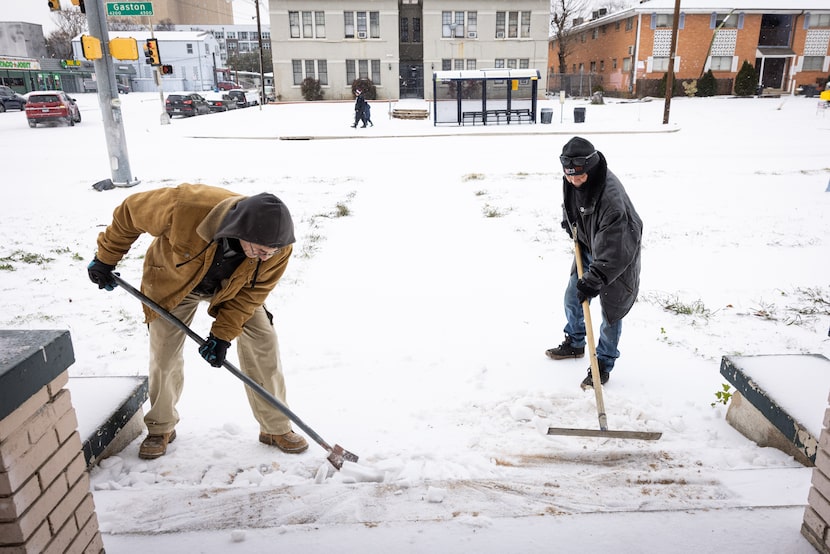
Joe Hernandez, right, helps his landlord clear ice from steps outside of an apartment complex on Gaston Avenue in Old East Dallas on Sunday, Jan. 25, 2026.
Angela Piazza / Staff Photographer
When you walk, take short, flat-footed steps — almost a shuffle — to stay stable. Bend forward slightly so your center of gravity stays as directly over your feet as possible. Most importantly, go slow and keep steps small; bigger steps can shift your center of gravity and make balancing harder, according to The Times.
Sometimes, slipping and falling is inevitable. If you do fall down, keep your arms close to your body, bend your back forward and tuck your chin forward to help avoid injuring your wrists or hitting your head on the ground.
Miriam Fauzia is a science reporting fellow at The Dallas Morning News. Her fellowship is supported by the University of Texas at Dallas. The News makes all editorial decisions.