
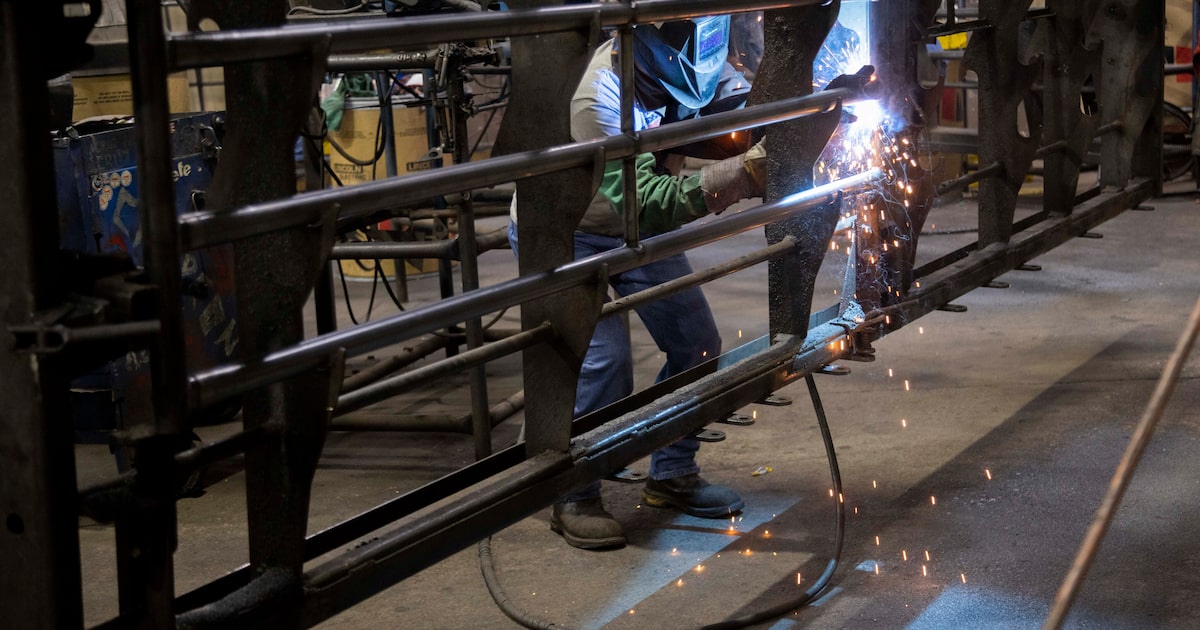
After a rough December — and months of lagging overall state economic growth — Texas’ manufacturing sector rebounded this month, according to a report published Monday by the Federal Reserve Bank of Dallas.
The central bank branch’s Texas Manufacturing Outlook Survey, a monthly survey of dozens of business executives around the state, indicated that overall factory activity in January was at an “above-average pace,” the report concluded.
The Dallas Fed’s production index, which aims to offer a broad read on Texas manufacturing activity, jumped to 11.2 from -3.0 in December, when the sector contracted.
Executives also indicated they expect more manufacturing increases six months ahead, suggesting some degree of optimism among the hard-hit sector, according to the bank.
Business Briefing
Related
The Dallas Fed does not identify survey respondents by name, but responses from some executives revealed enthusiasm about the sector’s upturn. One executive cited a boom in both sales and new equipment purchases, and another said they were expecting increased demand from new home construction.
The survey also indicated that new orders increased, while prices of raw materials remained mostly unchanged.
“Employment growth also resumed in January and work hours were flat,” Jesus Cañas, senior business economist at the Dallas Fed, said in a statement. “Selling price pressures increased, while input price pressures were little changed and wage growth slowed slightly.”
In recent months, the Lone Star State’s manufacturing industry has also experienced a boon specific to Dallas-Fort Worth. Companies like Hithium, a Chinese battery manufacturer, and T1 Energy, an Austin-based solar panel manufacturer, have been opening facilities and ramping up production even as the Trump Administration has for months slashed public funding for the clean energy industry.
“Honestly, we couldn’t think of any other place we would rather be building right now,” Russell Gold, a T1 representative, recently told The News in an email. “Texas has got a great workforce, it’s got a great business environment and it’s got really good energy prices, which are all important.”
Not out of the woods yet
The Dallas Fed survey was conducted Jan. 13-21, and elicited responses from 82 representatives from Texas manufacturers.
While the responses indicated an overall return to manufacturing production expansion in the state, business executives also expressed plenty of caution after a difficult year for U.S. manufacturing writ large, when federal policies, particularly around tariffs, left producers around the country grappling with a high degree of uncertainty that complicated everything from ordering and pricing to supply chains.
Respondents to the Dallas Fed survey also reiterated as much in the early days of 2026, citing lingering jitters about the jobs market and various geopolitical fears. Others cited significant uncertainty stemming from China, as well as the Trump administration’s policies on tariffs and immigration enforcement.
Further questions from the Dallas Fed also underscored the degree to which jobs growth in the state has largely dried up.
In surveys of executives from both the state’s manufacturing sector and service sector, 44% of respondents indicated they were currently trying to hire workers, a figure that was down from 51% last July, and represented the lowest share since the bank began asking the question in 2019.
Availability of applicants had also improved over the past three months and worker retention had become easier, researchers found.
Another report from Dallas Fed researchers, published earlier this month, projected that Texas actually saw zero net employment growth in 2025 — a significant downshift from the state’s recent high jobs growth trajectory. In recent years Texas has averaged around 2% annual net jobs growth.
“It is a big deal for Texas,” Luis Torres, a Dallas Fed economist who authored that analysis, told The News. “It’s a low-hiring, low-firing environment.”
Still, the same forecast projected that Texas’ GDP had seen some increase, which Torres attributed in part to companies’ increased use of artificial intelligence. The flat overall jobs picture stemmed in part from the struggles of the state’s large oil and natural gas sector.