
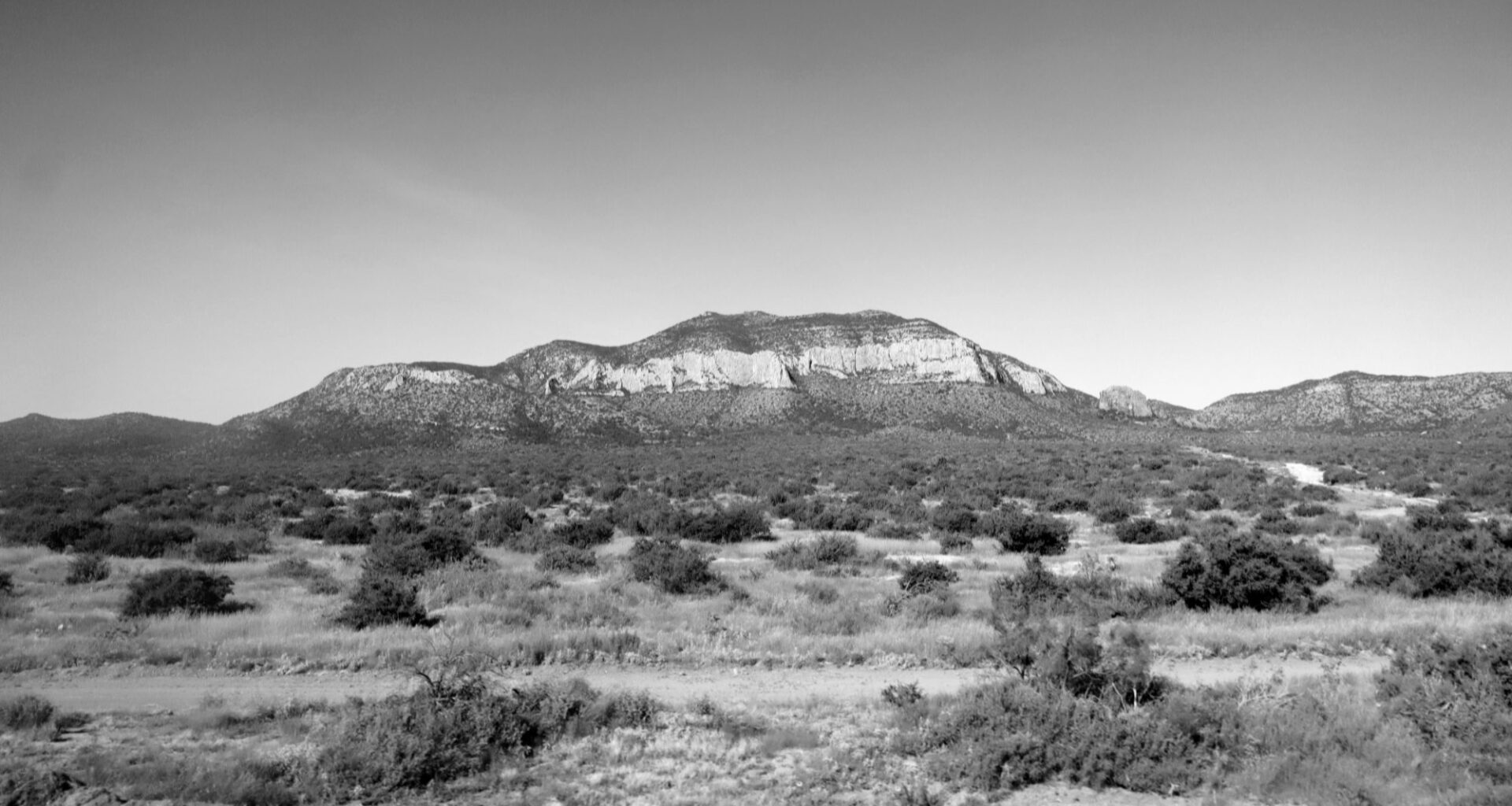
Sunset Limited riders get great views of the Chihuahuan Desert, and the large Sightseer Lounge railcar windows give a great vantage point to take it all in.
As the Sunset Limited Amtrak train wound its way through the Chihuahuan Desert on the Texas side of the United States/Mexican border, I sat in the Sightseer Lounge railcar and looked out the windows that curved up to the ceiling. Mountains towered over miles of arid terrain that was only occasionally interrupted by dirt roads and small towns. With cellular service borderline nonexistent, there wasn’t much to do but read one of the books and magazines I brought along for the trip, or keep looking out the window.
By that point, I’d been on the train for three days, and all I could think was that those views alone were worth the trip.
On the last Tuesday of July, I left Chicago aboard the Texas Eagle train, going all the way down to San Antonio where, overnight, two of the railcars were attached to the back of the waiting Sunset Limited train heading for Los Angeles. Sunset Limited arrived in El Paso, Texas, on Thursday, at 1:30 p.m. local time. I didn’t stay in El Paso long — only three hours, in fact — before I had to catch the train back and repeat the journey in reverse, returning to Chicago on Saturday afternoon.
Now, spending a total of six days on the train just to visit a city for three hours may seem foolish. But for me, this truly was as much about the journey as the destination. I’ve never been to Texas before, and the train journey took passengers through a decent chunk of the state. Besides, I wasn’t stuck on the train the whole time. I managed to get out and stretch my legs in Dallas, Fort Worth and Austin — and those are just the major cities. It may not have been the fastest, or the most on-time way to see the country, but it was certainly more scenic and memorable than flying in a plane, and more comfortable than riding a bus. And, unlike a road trip, I didn’t have to worry about gas, food and lodging.
Riding the Rails
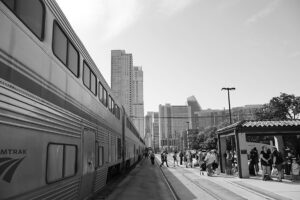
Chicago-bound Texas Eagle makes a smoke stop in Austin, Texas. The smoke stops give riders an opportunity to stretch their legs a bit — in this case, for about 15 minutes.
While I’m no stranger to long-distance trips, this was the first time I spent more than one night on board an Amtrak train. I rode coach to El Paso, but, for the trip back, I ended up getting a room in the sleeper car. Since the pandemic, Amtrak ran a promotion called “BidUp,” which let riders with coach tickets submit a “bid” on a sleeper, and whoever submits the highest bid gets the upgrade. It’s a gamble, but it paid off this time — I saved around $150 compared to what I would’ve paid if I got a sleeper in the first place.
The coach experience isn’t too bad. Amtrak seats are more comfortable than anything on a plane or a bus, and I found that you can sleep relatively comfortably if you get a window seat. But there were definitely upsides to being in a sleeper car: a bunk bed that’s actually horizontal, access to the shower and free meals.
A note about the meals. For reasons too long to get into here, Sunset Limited offers multi-course meals that are cooked on board that are free to sleeper car passengers but available for coach passengers for a flat fee. On the Texas Eagle, sleeping car passengers get free meals that are pre-made and microwaved on board. On either train, passengers can buy drinks, sandwiches and snacks at the cafe/lounge car.
(A side note about the meals: I’m not sure if the Texas Eagle ran out of regular dining car food, or what might have happened, but for the last lunch on board, we were served cafe car hot dogs and other snacks. A couple from Dallas I shared a table with splurged for a sleeper because they wanted to experience the romance of the train and were, to put it mildly, underwhelmed.)
Speaking of the lounge car, I would be remiss not to talk a little more about the Sightseer Lounge. The tall windows make for a perfect spot to view the Texas landscapes, and get a sense of just how much variety there actually is in that state. There are tables with power outlets, which are pretty comfortable places to work, or window-facing seats that are pretty comfortable places to watch the views and read a book. And I would recommend bringing a book. Maybe it is my provider, but there were pretty large sections of Texas where my phone didn’t get a signal at all.
The many Texas stops
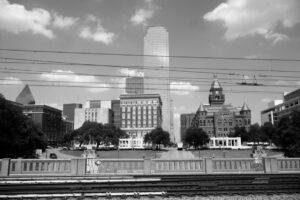
The view of downtown Dallas, Texas, from the Texas Eagle window.
The Texas Eagle route takes it through Illinois, Missouri and Arkansas before reaching Texas, but it passes through Arkansas and most of Missouri at night. Along the way, riders get plenty of great views. I already talked about the Chihuahuan Desert views, but there are plenty of other things to see. The train takes passengers across the Mississippi River, through the heart of Dallas, and I got a pretty good view of St. Louis on the way back. It weaves through small towns, showing murals, monuments and glimpses of places that highways bypass. A bus driver who lived in the suburb of Dallas and was taking the train home helpfully pointed out some sights, which definitely added to the experience.
Like all long-distance trains, the Texas Eagle and Sunset Limited make “smoke stops” where riders can step outside and get some fresh air — sometimes for as little as five minutes, sometimes as long as an hour. The stops may be shortened if the train is running behind, but some stops can’t be rushed. Fort Worth, for example, is one of the spots where locomotives get refueled and all the accumulated garbage and other waste is removed.
The crews very actively discourage passengers from leaving the station, and some stops are too short to do much exploring anyway. But longer stops gave me an opportunity to see even more of Texas than I could outside the window.
I would say the most memorable smoke stop was in the town of Alpine on the Sunset Limited portion of the trip, in far west Texas. The train stayed there for half an hour, stretching long enough to block two rail crossings at once. I ended up walking around downtown for a bit, looking at small businesses, a local hotel and a very crowded mural paying tribute to the local civic organizations. One store was open, and beckoned passersby with signs promising bargains. I considered stepping inside for a bit, but I was worried that I would get distracted and miss the departure, so I decided against it.
The town of El Paso
If you want to see El Paso by train, I would recommend staying a day or two, because, one thing I keep thinking about looking back, is that I didn’t have nearly enough time to explore everything it had to offer.
The city sits right on the Mexican border, and it is quite a sight to disembark from the train, walk through the El Paso Union Station and step outside to see the city of Ciudad Juárez just on the other side of U.S. 85, so close and yet so firmly separated. The station is located in what clearly used to be an industrial area that has seen some redevelopment. But it is a walk away from a modern-looking downtown and El Segundo Barrio neighborhood full of historic buildings that made me think of that famous Marty Robbins song. Its storefronts brimmed with interesting shops. Just to give a few examples atop of my head, there was a Western wear store, a Mexican goods store, a hat store and Rasputin’s Curiosities, Vintage and More, the kind of random curiosities shop that brings extra flavor to any shopping strip.
Why “Rasputin’s?” I asked the owner.
“Because he was an awesome dude!” he responded, like it was the most obvious thing in the world.
Because my time was limited, I had to choose between visiting the El Paso Museum of History and El Paso Museum of Art. I chose the latter, and it gave a pretty impressive view of the local art scene. I also wish I had time to stop by the El Paso Holocaust Museum and Study Center and Centennial Museum and Chihuahuan Desert Gardens, which is dedicated to the long history of Chihuahuan Desert and people who lived there.
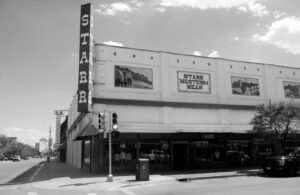
Starr Western Wear in El Paso’s El Segundo neighborhood.
I did get to ride the El Paso Streetcar system, which uses rehabbed vintage streetcars that link downtown to several older neighborhoods. The streetcar is a bit slow, but here, the views out the window, especially as it climbs up and down the hill, are a big attraction. I would be remiss not to mention customer service — the driver on my trip was courteous and helpful to every rider.
I would also be remiss not to mention the famous Juanita, the Burrito Lady. El Paso is one of the smoke stops, with trains usually stopping for half an hour, and she is usually there to sell burritos and drinks. She is such a part of the Sunset Limited lore that, when the train pulled into El Paso, the train crew announced who she was and encouraged riders to give her some business. On the way back, another announcement rang out across the rail cars: Juanita wasn’t getting many customers, and the crew really encouraged the riders to fix that.
I bought a burrito and a soft drink for $6. It was worth every penny.
If you like this story, you can get a whole lot more practically every day of the week by subscribing to journal-topics.com. Click here to choose your preference of either print or online, or call 847-299-5511.