
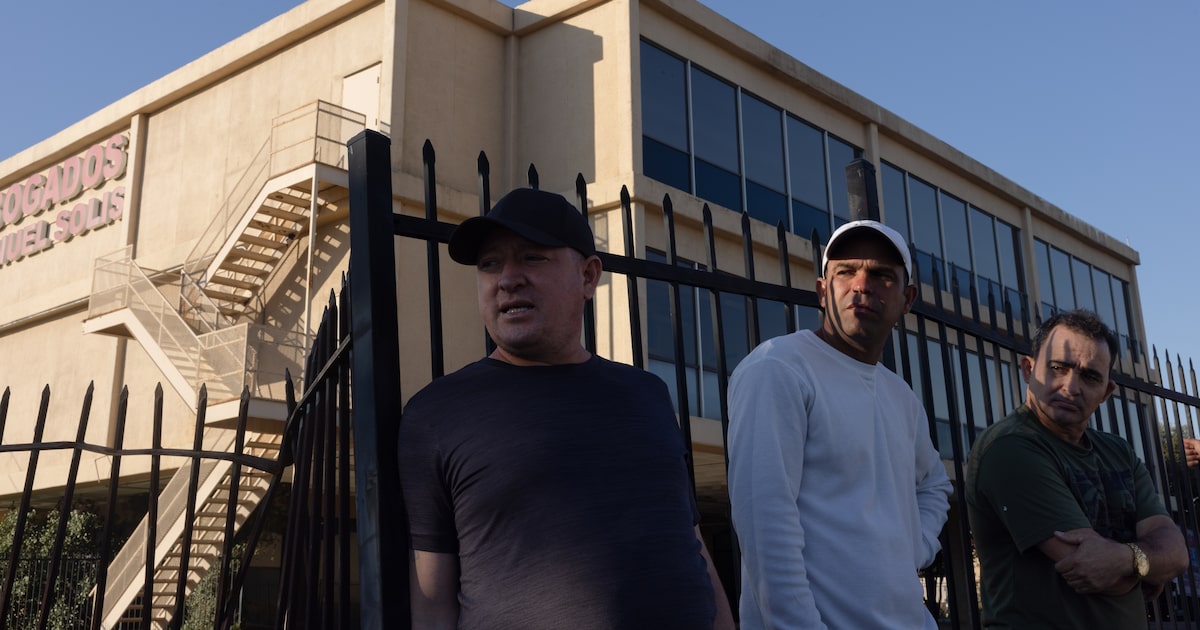
The federal government’s ongoing immigration crackdown is likely hampering the Texas economy by contributing to weaker overall employment growth, according to a recent analysis by the Federal Reserve Bank of Dallas.
While Texas’ long-term job growth rate has traditionally averaged around 2% annually, the current growth figure has fallen significantly, to an estimated 1.2% — a decline the researchers say is likely due in part to a lower number of immigrants in Texas’ labor supply.
The analysis was authored by the Dallas Fed researchers Isabel Brizuela, Emily Kerr, Pia Orrenius and Madeline Zavodyn, an economics professor at the University of North Florida.
Related

“Texas’ strong domestic and international in-migration helps explain why state job growth outpaces that of the nation,” the authors wrote.
Business Briefing
“Those inflows have recently slowed. Findings … suggest immigration policy changes will negatively affect the ability to hire and retain foreign-born workers at one in five Texas businesses this year.”
“Immigration enforcement can impact labor supply in a number of ways,” they added.
The analysis was based on findings from the bank’s monthly Texas Business Outlook Surveys, which collect responses from hundreds of representatives around the state from the manufacturing, service and retail sectors.
The report’s authors were unable to comment further, the Dallas Fed told The News, because of a media blackout ahead of the Fed’s Open Market Committee rate-setting policy meeting.
‘Chilling effect’
For decades, the Lone Star State boasted one of the country’s fastest-growing economies, in large part because of the state’s ability to attract foreign workers.
Between 1970 and 2024, the percentage of immigrants in Texas’ labor force shot up from less than 5% to 23%, according to an analysis of census data by the group FWD.us, a national immigration and criminal justice reform advocacy group, with the state likely adding more than a half million new immigrants between 2021 and 2024 alone.
Texas’ foreign-born workers also add some $200 billion to the state’s annual economy in personal income, according to Dallas Fed data, and account for around half of the state’s landscaping, construction and taxi industries, among other major contributions.
The report cited a drop in entries into the United States through the Southwest border because of increased border enforcement and slower processing times. The authors also cited the government’s revocation of work permits, and humanitarian protections ― and a dramatic increase in Immigration and Customs Enforcement arrests.
“The stepped-up visibility and intensity of enforcement has produced a chilling effect,” the authors wrote.
“As fear spreads in immigrant communities, foreign-born individuals are more likely to miss work or school and less likely to venture out to shops and restaurants.”
Around 20% of Texas businesses surveyed said they will be less able to hire and retain foreign-born workers this year because of the changes, and 3% said they were already experiencing a negative impact.
Yet those figures are a likely underrepresentation of the policies’ impact, the authors note, “because the survey does not include some sectors that rely heavily on immigrant workers, such as construction and agriculture.”
Among the firms that said they are impacted by immigration policy, about 40% said employees had missed work because of enforcement fears, nearly 60% said they were unable to hire qualified workers because of status issues and 49% said they were facing hiring difficulties because of fewer foreign-born applicants.
The report also cited responses from employers that more explicitly noted how a climate of fear had taken hold, including one response from a real estate professional that described how some longtime contractors were suddenly quitting their jobs and avoiding travel and their usual activities.
In response to the immigration-related challenges, 48% of the impacted firms also said they have or plan to increase work hours for existing employees, 38% mentioned increasing wages and benefits and 33% mentioned hiring more U.S.-born workers, naturalized citizens and green card holders.
 Amazon delivery firms are bailing amid rising costs, meager profit
Drivers say profits are dwindling from rising costs for insurance and maintenance even as Amazon tightens performance metrics.
 What to know about the proposal to create new funding for Texas State Technical College
If approved, the constitutional amendment would expedite TSTC’s ability to build new campuses and buy equipment.
 Fancy office campuses become avatars of a new status quo
Tricked out workspaces are the wave of the future.