
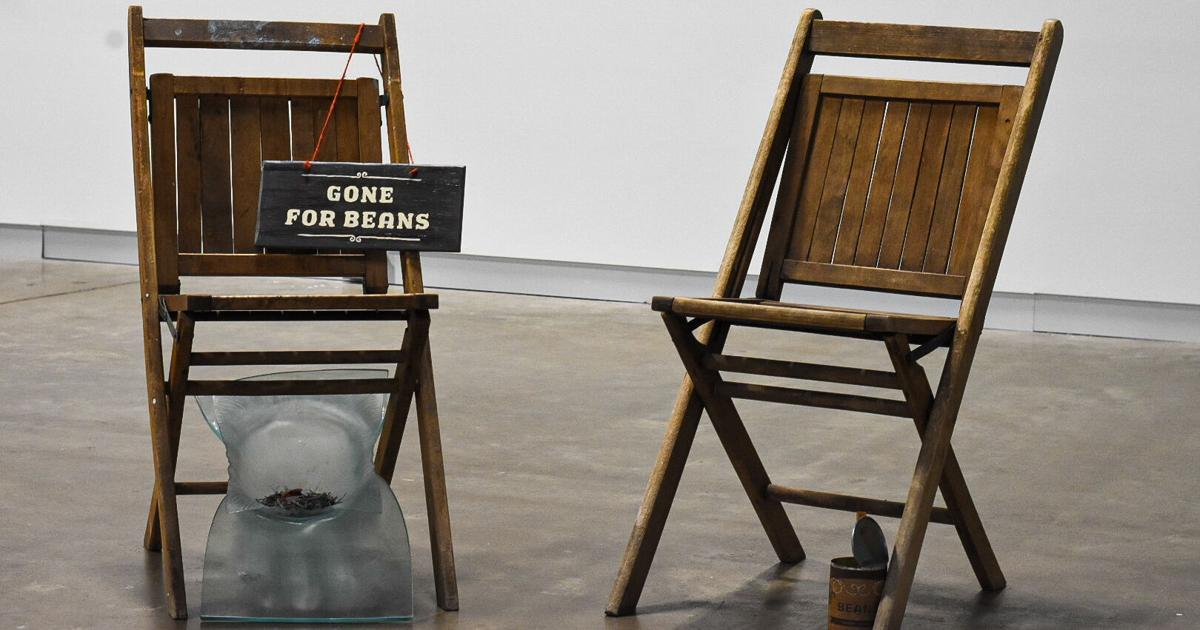

Two wooden chairs sit as part of the exhibit “Gone for Beans” by Lucas Fitzpatrick on Jan. 29 at the Arlington Museum of Art. Fitzpatrick said the title is an analogy for life, specifically a bird that has just begun to fly.
Video, painting, blown glass and photography — styles that collide and mediums that overlap share a temporary home at the Arlington Museum of Art through Feb. 22.
The second UTA Annual Juried Exhibition: Fall 2025 isn’t unified by a single artist, style or era, but by a shared passion for art. With nearly 30 artists featured, the exhibit showcases a wide variety of mediums, including sculpture, blown glass, bronze, painting, photography and video art.
The exhibit was meaningful not just to the students, but to the people who made it possible behind the scenes.
Benjamin Terry, Art and Art History Department distinguished senior lecturer, coordinated among UTA, the Arlington Museum of Art and the guest curator to bring the exhibit to life.
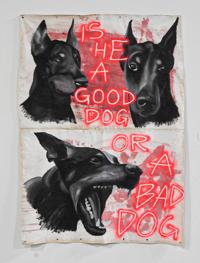
“Good Dog or Bad Dog?” by Marbella Hernandez depicts black dogs and red lettering Jan. 29 at the Arlington Museum of Art. The canvas consists of acrylic and spray paint.
“This exhibit is a reminder that students are already artists, not just artists-in-training,” Terry said in an email. “Opportunities like this help bridge education and professional practice, and I hope this collaboration continues to grow in future years.”
The same level of excitement is shared by others working closely with the exhibition.
“I love being a part of this not only to see the raw talent of UTA’s art department, but also to help artists bring their work to life in the gallery space gives me much joy,” said Natalie Neale, Arlington Museum of Art assistant director of exhibitions, in an email.
Clare Milliken, Modern Art Museum of Fort Worth assistant curator, shared a similar feeling.
“I was interested in working on this exhibition because of the caliber of art that comes out of UTA’s BFA and MFA studio programs. I’m always excited to see what art students are creating and conceptually working through,” Milliken said in an email.
“Sunday Morning, After”
In a corner of the exhibit lies a TV mounted on the wall. On its screen plays a video tracing a woman’s journey through a miscarriage — a story rooted in real life, where grief moves slowly, memory lingers and recovery is neither linear nor simple.
For Chan Kim, cinematic arts graduate student, the video, titled “Sunday Morning, After,” was more than just an art piece submitted for a gallery. It was her story told in the form of video art.
“It’s a very personal story. So for me, it can be very vulnerable,” Kim said. “It’s my story.”
A woman mourns by burying baby’s breath seeds. She sometimes regrets her decisions and wonders what the outcome would have been if she had acted differently. She pours the soil and the seeds out from the plant pot and becomes determined to get rid of the thoughts.
Video courtesy of Chan Kim
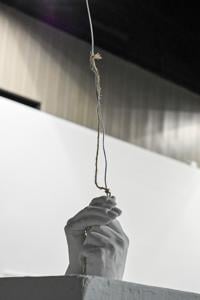
“By a Thread” by Paula Currie shows a sculpted hand gripping a suspended wire Jan. 29 at the Arlington Museum of Art. The piece is created with plaster, wire and string.
Kim, who had the video done before the gallery opportunity arose, said that from the preproduction, shooting and postproduction, the film was a five-month labor of art aimed at encouraging women to keep moving forward.
“So this is about women’s right, or women’s decisions, but my video doesn’t say, ‘This is right, this is wrong,’ but I wanted to show that it’s up to you, but just go moving forward,” she said.
Like for many other fine arts students, Kim said that having published work is important, and the exhibit was a good achievement for her.
“I’m a filmmaker, so I submit my film to a lot of film festivals. A museum or exhibition is one of the most important achievements,” Kim said.
For her, the opportunity also served as a healing process. She said the act of creating is not just about the final work. It is a way to help the artist process and make sense of personal experiences.
“Many other artists also maybe feel the same way. It could be very personal, and maybe it’s their identity,” she said.
“Gone for Beans”
In the center of the gallery sits the largest piece of the collection, a mix of two assemblages and blown glass. “Gone for Beans” was the main piece, made of glass.
Glass graduate student Lucas Fitzpatrick’s pieces include a mix of everyday items collected or created across many years. Some items come from thrift shops, some were family heirlooms, some were family photos and others are elements crafted for the exhibit.
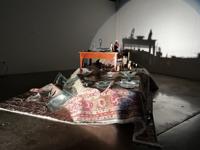
Photo courtesy of Lucas Fitzpatrick
“I make art about the human condition, for people to relate to, whether they agree, disagree, love or hate it,” Fitzpatrick said in an email.
Fitzpatrick, who hasn’t been doing art for very long, said assembling his pieces was like a full-time job, spending at least 40 hours a week in and around the studio to experiment, refine and expand his practice.
The installation process for his work was not an easy one.
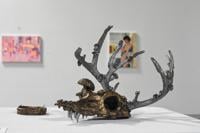
A bronze skull with branching antlers, “Impermanence,” sits next to a bronze dish, “Permanence,” created by NoVa DeVries on Jan. 29 at the Arlington Museum of Art. “Impermanence” is made of bronze and aluminum, and “Permanence” is made of bronze.
Fitzpatrick moved to Texas in the summer and left much of his work in Wisconsin. He was able to fly back to Wisconsin, pick up a U-Haul, pack his work, drive to Toledo, Ohio, to pick up work for his professor and drive back to Arlington within three days, he said.
“I was in the tricky predicament of having submitted work for an exhibition and the work was 1,000 miles away,” he said.
Fitzpatrick’s inspiration came from his relationship with his fiancee and their journey ahead. His artwork was mainly about family and living through to the next generation.
“Think about the generations of families after us; they matter more than we do. Teach them how to dream, and help them to follow it,” Fitzpatrick said.
“Why It’s Me”
The same relationship between art and identity can take on many forms, including more traditional mediums.
Painting senior Janice Montes chose oil painting. Her two-piece collection, titled “Why It’s Me,” showcases faceless self-portraits.
Montes used her paintings to talk about psychological disorders like depersonalization-derealisation disorder.
While her paintings are based on photos from her childhood, she adds a surrealistic environment to most of them and makes each painting faceless.
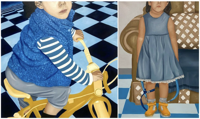
Photos courtesy of Janice Montes
Montes said that although the paintings don’t have a personality due to the lack of faces, she used the color yellow to give them that personality and value, emphasizing something that was meaningful to her at the time.
When choosing what photos to use for her collection, she said, she focused on finding an icon in them, something she could try to give a sense of nostalgia to.
This exhibit is not Montes’ first. Her work has also been showcased at Tarrant County College, an opportunity that was also made possible by UTA professors, she said.
For her, this opportunity served as a tool to help her step up her career ahead of graduation.
“It’s already difficult to get into galleries, shows and group shows, and having on a CV, on a resume that your name is at a museum,” she said. “You have the opportunity to sell these works and maybe promote it and have collectors. It’s really meaningful.”
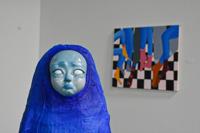
“Left Behind,” a blue sculptural figure by Amelia Spence, is displayed Jan. 29 at the Arlington Museum of Art. The installation is made of chicken wire, plaster, clay, acrylic paint and resin.
“Museum of Self ”
UTA alumna Phoenix Warren turned to photography, using images of herself as a canvas that she digitally altered in Photoshop to explore different aspects of herself.
Warren’s work was previously showcased in the 2024 exhibit, and she said she didn’t expect her work to be accepted a second time.
The photographs she submitted for this year’s exhibit were part of a collection of photos, titled “Museum of Self,” that she had since before the first exhibit.
The collection of photographs started as a class project that Warren said she took much further.
Warren has an ongoing collection of photographs that represent how people may perceive her but said she chose “advertisement photos” for the exhibit.
“These don’t really depict a true perception of myself. They’re more of me in a neutral outfit, neutral everything, and then the writing and the background is a mix of red and white, just to be really punchy,” she said.
In the photographs, she said, she wanted it to feel like she was poking fun at the whole thing.
Warren said she has never pressured herself to have published work and that she does photography for the fun of it. She said she gets more enjoyment from going to critiques.
“I feel like once you kind of get to a museum, it’s like, ‘Oh, this is so good.’ And I feel like everyone kind of just says that it’s good because it’s in a museum, and it’s like, ‘Well, duh, it’s good, it’s in a museum,’” she said.
While Warren’s work has already seen museum spaces, that doesn’t stop her from aiming high.
“Reaching for the stars would be like having a spread in Vogue,” she said.
@_.lexlie_