
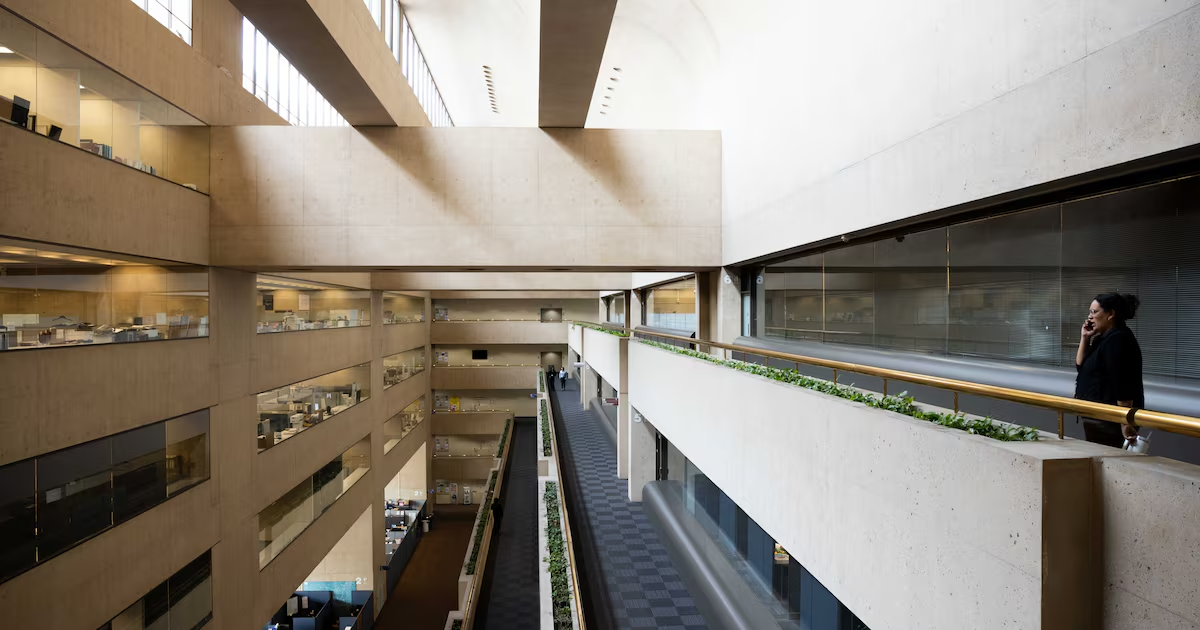
Sarah Crain couldn’t help but marvel at the looming visage of Dallas City Hall.
A little after 6 p.m. Wednesday, the I.M. Pei-designed building, and its exposed concrete and large windows lit up the southern half of downtown.
“I think to abandon this for a potential Maverick site is disheartening,” Crain said.
Dallas officials are inching closer to a decision about whether to leave or stay at the current City Hall site at 1500 Marilla Street, deliberations that are coinciding with the city’s efforts to keep its NBA team in town.
Political Points
Crain and Preservation Dallas, the nonprofit she leads, toured the City Hall building to educate the public about the architectural importance of the facility.
Dozens of preservationists gathered near flagpoles on the plaza for the evening event.
The tour, given by Marcus Wilson, the city’s chief planner at the Office of Historic Preservation, covered the design, significance and history of the building.
Crain said Wilson’s tour was educational, and that he did not represent the city’s stance. To appear neutral, city staff did not want the news media to join the tour when the group moved inside. Preservation Dallas said they will be hosting more tours this month.
Outside, residents who came for the tour watched as Wilson and Crain explained the vision behind the I.M. Pei’s Brutalist design.
“A lot of times we think of brutalist architecture as just being a big block of concrete, not particularly interesting,” Wilson said.
However, the style’s beauty is often found in the geometry of a structure, and how it interacts with its environment.
“It’s almost as much glass as it is concrete,” Wilson said about the building, further explaining that Pei wanted to use the glass to symbolize the transparency of government.
The building opened to the public in 1978. Local officials at the time wanted to rebrand the city’s image after President John F. Kennedy was assassinated on Elm Street. It was also Pei’s first government building, and he would later go on to design buildings such as the Fountain Place that dot the city’s skyline.
Council member Paul Ridley, who had been a member of the preservation group for two decades, said he was not surprised the tour was sold out. The debate had galvanized preservationists and regular residents about the importance of the building to the city.
“I wanted to come along just to show my support for preservation,” he said.
The tour coincided with the release of a new report by a group of prominent Dallas architects.
They dispute reports that Dallas City Hall needs more than $400 million in repairs, saying decades of facility studies put documented outstanding needs closer to $34 million to $36 million after ongoing modernization work.
They said recent cost projections lump routine repairs together with full replacements and elective upgrades, inflating figures without the kind of yearlong facility condition assessments used in past reviews.
The architects said there is no evidence in the historical record to support a sudden maintenance crisis and urged city leaders to rely on rigorous, evidence-based analysis before considering relocation.
The critique marks their latest salvo in the escalating debate over whether to repair the existing building or move City Hall offices elsewhere.
Supporters of relocation have said the aging complex faces mounting infrastructure failures and outdated systems that will ultimately cost far more to patch over time than to build a modern City Hall designed for today’s needs.
“I think [architects’ assessment] is much more realistic number than $500 million,” Ridley said.
Things will become clearer once the city releases findings from a wide-ranging review shepherded by the Dallas Economic Corporation, and that first discussion begins Feb. 23.