
For the past several months, Eanes ISD administration has considered various ways to garner $5 million-$6 million in cost savings or revenue generation in order to balance the fiscal year 2026-27 budget.
The board of trustees unanimously approved an optimization plan Feb. 3, which will include a revenue-generation program and staffing optimization plan to reduce a projected budget shortfall.
Some context
At the Jan. 13 board meeting, Chief Financial Officer Chris Scott presented four possible budget optimization packages for the board to consider, each with a mix of options that could net millions of dollars in savings or revenue generation.
These options included local revenue increases, staffing optimization, freezing or reducing salaries, and calling for a voter-approval tax rate election, or VATRE.
Board documents also state that additional measures will be necessary in order to account for declining enrollment and revenue, account for increasing costs, and rebuild the fund balance.
The update
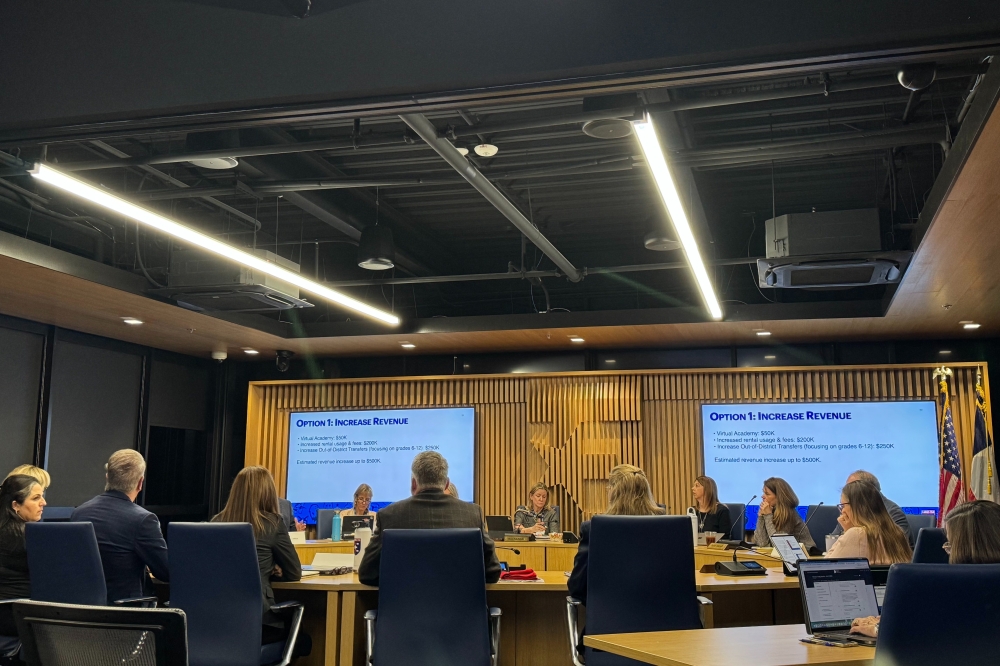
The approved optimization plan includes local revenue increases that could net $600,000 in savings. These increases would be achieved through increasing facility rental usage and fees, creating a virtual academy which would launch this summer, and increasing the number of out-of-district secondary student transfers.
The projected savings for this option is up $100,000 from the the previous board meeting, which Scott said could come from the increased rental usage and fees.
“Once we feel like we’ve got $600,000, we’re not stopping,” Scott said. “If we find other revenue generating avenues, we’re going to explore them and take them if we can.”
The plan also includes staffing optimization, which could net between $3.3 million-$4.5 million savings through a reduction in workforce and attrition.
According to Molly May, assistant superintendent of teaching and learning, for 2026-27 this would include:
Reducing seven full-time central administration positions through consolidation, reassignment and attrition, saving $455,000 annuallyReduce five full-time campus paraprofessional positions through staffing realignment and role consolidation, saving $325,000 annuallyAdjusting elementary staffing ratios through natural attrition, equivalent to eight full-time positions and saving $520,000 annually. This would create ratios of 1-22 in K-2, 1-23 in third grade, 1-24 in fourth grade and 1-25 in fifth grade.Increasing the enrollment-to-staff divisor at the secondary level to reduce the total number of general education teaching positions, equivalent to 33 full-time positions and saving $2.15 million annually. This would result in larger class sizes and fewer low-enrollment or singleton electives.Eliminating duplicate positions remaining from the Barton Creek-Valley View blend, equivalent to three full-time positions and saving $195,000 annuallyIntegrating librarians into the elementary specials rotation to create a five-day specials rotation with music, art, library and two physical education classes, equivalent to 6.5 positions and saving $422,000 annuallyReducing student support staff across campuses based on need and consolidating services, equivalent to seven full-time positions and saving $455,000 annuallyWhat they’re saying
Passing a VATRE could net up to $3.8 million in savings, but trustees John Troy and James Spradley both spoke against going forward with an election, with Spradley saying the community should instead look toward a future bond.
“I think even putting a VATRE on a ballot kills a bond because it kills trust—because it shows that we would float it out there and see what people think, and I don’t think that’s the right approach,” Spradley said. “I think we need to take that money that we would spend to do this [VATRE] audit, the effort and time that we would spend to get ready for this, and focus that more on getting us ready for a bond, which makes a lot more sense.”
Looking ahead
The board could also consider freezing salaries or reducing raises but will not make any decisions on this until the 2026-27 budget process is underway in May, which Scott said will allow administration to provide the board with more information.