
The Institute of Texan Cultures (ITC) in San Antonio held a ribbon-cutting ceremony to celebrate its reopening on Wednesday, January 28. The University of Texas at San Antonio (UTSA) institution had been closed for 18 months during a period of transition, from its former space at Hemisfair to its new, temporary location in the Frost Bank tower downtown.
A press release describes the ITC as “a living museum dedicated to authentically reflecting the diverse people and stories of Texas,” through archives, permanent and rotating history and culture exhibits, and rotating art exhibitions. The ITC was established in 1965, then housed in the 40,000-square-foot Texas Pavilion following the Hemisfair ‘68 world’s fair, where it remained until UTSA vacated the aging building in 2024.
 An installation view in the Institute of Texan Cultures
During a tour of the new grand entrance lobby and two exhibition spaces, Monica Perales, ITC Associate Vice Provost, said the ITC now has a 3,300-square-foot main gallery for what she termed its “semi-permanent gallery,” and a 1,800-square-foot gallery for rotating exhibitions. A commissioned mural by San Antonio artists Sandra Gonzalez McKinney and Malachy McKinney, Texas Tapestry: Patterns of Belonging, greets visitors in the lobby, while serving as an educational touchpoint with examples of flora and textiles found throughout the state.
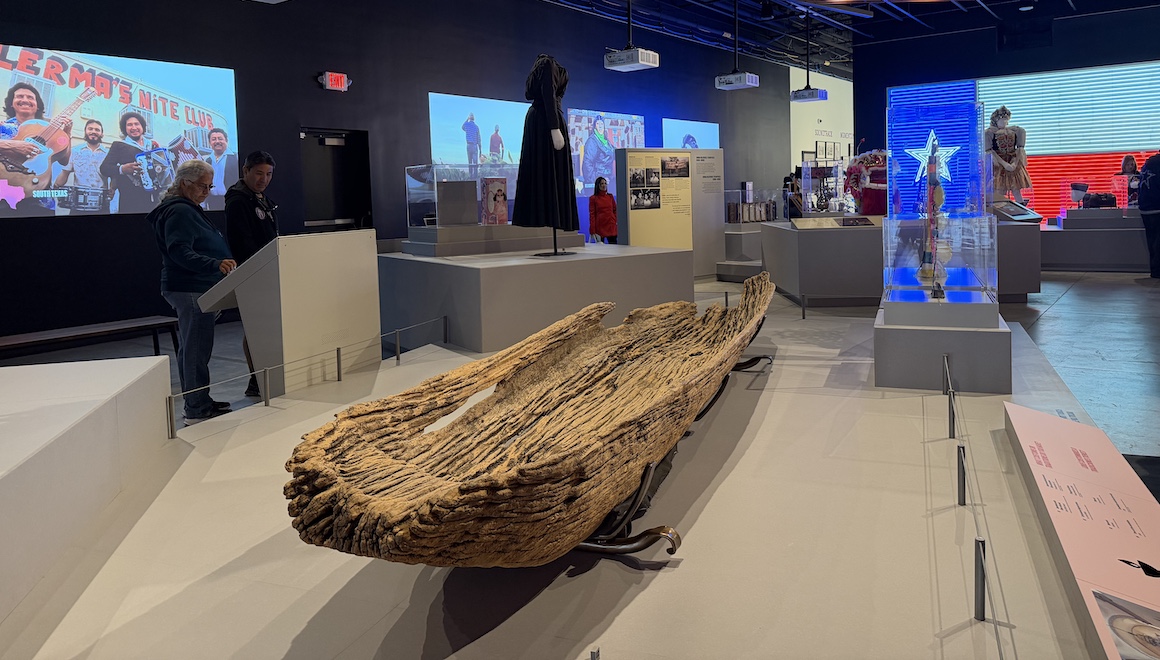
The Common Threads / Hilos Comunes exhibition in the main gallery includes artifacts drawn from the ITC collection, UTSA special collections, and on loan from community members. An early 1800s cottonwood dugout canoe hand-hewn by Indigenous Karankawa peoples greets visitors as they enter the gallery, flanked by an undated metal menorah on loan from Temple Beth-El in San Antonio and a 1979 árbol de la vida from the ITC collection. An ornately constructed and decorated lowrider tricycle, identified as Holy Roller custom lowrider tricycle, circa 1971, on loan from Joe Anthony Alvarez Jr., sits among an array of objects, including a 1951 acoustic guitar belonging to Sam “Lightnin’” Hopkins, a Chinese sheng pipe flute, and an undated Tigua drum with painted surface.
 “Holy Roller custom lowrider tricycle,” c. 1971, on loan from Joe Anthony Alvarez Jr. at the Institute of Texan Cultures
Bianca Alvarez, ITC Head Curator, described her work in combining artifacts from the collection with materials from community members as “an opportunity to bridge scholarship and academia with community experts,” who are “experts in their lived experience.”
The main gallery is lit by the glow of the giant neon Texas flag, originally commissioned in 1968 for the Texas Pavilion. “We knew that this was one of the most iconic and recognizable symbols of the Institute, and that we needed to have it in our space,” Ms. Perales said. She also shared that displays in the main gallery will change periodically with objects and labels switched out in keeping with consistent themes.
The current exhibition in the back gallery, Mumentous: The Upsizing of a Texas Tradition, documents the Texas high school tradition of making massive and intricate homecoming mums in photographs by Amy Schultz, and elaborate examples sourced through a statewide competition. The exhibition traveled from the Arlington Museum of Art, gaining an 18-foot-tall ribbon display handcrafted by Christina Winston, the ITC’s Exhibition Designer.
 An installation view of “Mumentous” at the Institute of Texan Cultures, with display centerpiece by Christina Winston
Though the current ITC space is a temporary home, Ms. Perales said, “We see ourselves as part of a research university, so we are doing our research as a museum. We’re using this transitional space to understand how we want to tell stories. We’re using this time to explore partnerships, and ways that we want to do the work that we do. For us, it’s understanding that with an eye towards our sustainable growth and our sustainable future.”
Admission to the ITC is $10 for adults; $5 for youths, residents over age 65 and military members; and free for children under age 5. Admission is also free for UTSA faculty, staff, and students.
Learn more about ITC programming on the museum’s website.