
One sentiment that I have heard lately from people around me at art openings, dinner parties, protests, friend gatherings, and on the radio is: “How can we help change what’s happening in the world?” Positive change can come from movement, from risk, from convictions, from struggle and from bravery. Art can be a catalyst for giving people a voice, especially in a cultural revolution. The advent of surrealism in 1925 came on the heels of the Great War, when dissent was necessary to avoid the pitfalls of hunger, oppression, ignorance, and imperialism. With the current rise of unrest in the United States of America, the centennial celebration of surrealism could not have arrived at a better time. We are fighting an oppressive and murderously unjust faction in our country, one that has broken countless laws of justice against humanity and today, as I write this, another innocent peaceful protestor was murdered by ICE agents in Minneapolis.
One hundred years have passed since the emergence of the groundbreaking surrealism movement. Globally, we have had multiple museums and cultural institutions celebrating this anniversary with exhibitions, including (but not limited to): Sixties Surreal at the Whitney Museum of Art (2025-26); Dreamworld: Surrealism at 100 at the Philadelphia Art Museum (2025-26); Surrealism and Us: Caribbean and African Diasporic Artist since 1940 at the Modern Art Museum of Fort Worth (2024); Long Live Surrealism! at the Blanton Museum of Art (2023-24); Surrealism Beyond Borders at the Tate Modern and The Met (2022); and Surrealism- The Centennial Exhibition at Centre Pompidou (2025), to name a few.
As many of us already know, surrealism began with two rival manifestos, penned by Andre Breton and Yvan Goll, respectively, with Breton retaining the title of founder over time. These men wanted to voice their criticism of bourgeois values and rational thinking, embracing the tenets of Trotsky, communism, and anarchy while somewhat influenced by Freud and the power of the unconscious mind. Regardless of the conflicts, inherent misogyny, internal drama, and numerous expulsions from the group, these artists considered themselves to be revolutionaries, turning against the grain of the ruling norms of society, although they were later criticized as politically ineffectual.
The conflicts and oppressive regimes that inspired the subversive nature of this movement are, unsurprisingly, still present today. What is surprising, however, is the whimsical and decorous presentation of surrealism in some of these retrospectives. Gone is much of the political context and provocative onset of this movement, as the art from this period does often get reduced to quirky categories or gift store fodder. And while I did find some positive aspects of the selection of work and presentation, International Surrealism at the Dallas Museum of Art (DMA) is sadly no exception to this trend.
This exhibition was initially curated by Matthew Gale and culled from the Tate Modern collection in London where he worked as a curator until 2022. The Dallas iteration of International Surrealism is presented here by Sue Canterbury as a broad survey of mixed media with artists from around the world, noticeably a heavy concentration from Europe. Familiar and unfamiliar artists from across the 20th century do shine in this survey of the movement that is divided into six subgroups: Uncanny Nature, Desire, Dreams, Automatism, Politics, and Objects. The bilingual wall text and placards are quite thorough in placing the work into the context of the show, but often not in a global scenario. I did, however, appreciate some of the work and aspects of the exhibition design, which I will detail here.
 An installation view of “International Surrealism” at the Dallas Museum of Art
The entrance to the exhibition has a giant eye as a portal, indented into a royal purple wall that introduces the show. Through the center of the eye, we witness a sneak preview of Paul Delvaux’s delightful Sleeping Venus (1944), an erotic image clearly influenced by the trauma of the Second World War. This painting resides in the Desire section in the far back and was oddly guarded by a stanchion, which I only noticed on a few works in the show. I cut across the main room of the exhibition into this plum-colored alcove with glee. This darkened space possessed an appropriately oneiric tone that fit the ambiance to a tee. I meandered through Desire and witnessed some of the usual suspects — a Hans Bellmer doll sculpture, a headless Giacometti sculpture, an Adolph Gottlieb painting. My senses immediately perked up seeing the rare Leonor Fini Untitled (Praying Mantis) painted circa 1970, where two lovers lie in tense confrontation, the woman about to stab the prone man beneath her. Here was the energy I sought, a fierce feminine energy so often left out of surrealist survey shows. Photographs by Dora Maar and Kati Horna followed until I found several works by the ingenious Dorothea Tanning.
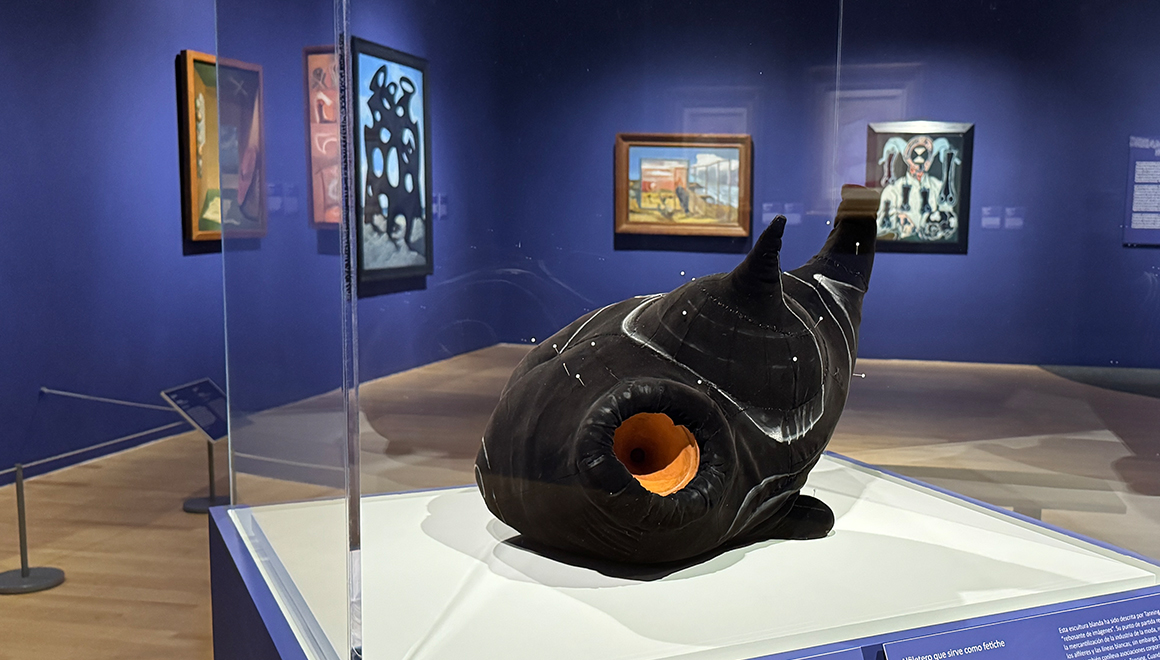
 Dorothea Tanning, “Pincushion to Serve as Fetish,” 1965, velvet, plastic funnel, metal pins, sawdust, and wood. On view in “International Surrealism” at the Dallas Museum of Art
In the center of Desire, entombed in a glass vitrine, Tanning’s velvet sculpture Pincushion to Serve as Fetish (1965) yawns at us with multiple orifices. Her first sculpture; it was originally interactive, allowing the visitor to stick it with pins! I love this vivacity, the insolent defiance of categorization and references to both domestic “women’s work” and voodoo culture. There is an interesting exchange between the delight and playfulness of her piece refracted with Giacometti’s female form behind it. He was known for his violent and objectifying representations of women and here we have a headless figure with breasts. No further comment necessary. To the left and to my relief hangs the delightfully complex Transference (1963) by Leonora Carrington, an alchemical exploration of her psyche at the time, containing imagery rife with her stylistic mythological guardians.
 Leonora Carrington, “Transference,” 1963, oil paint on hardboard
Premature observations tell me that International Surrealism showcases an unusual number of works by female artists. Gale and Canterbury have thoughtfully included 33 works by 15 female artists, roughly one third of the art in the show, when the average number of women’s art for museum surveys hovers around 11-15%. I have seen countless early photographs of the Surrealists and often with no women present, so this is a welcome sea change! Showstoppers abound as the category shifts to Dreams, and I relish a lavish Giorgio de Chirico, Tanning’s Eine Klene Nachtmusik (in the flesh and curiously, without stanchion), the predictable Picasso, and a Magritte that was new to me.
 René Magritte, “The Reckless Sleeper,” 1928, oil paint on canvas
The Reckless Sleeper (1928) captivates me with its exquisite depiction of how we (as artists) are always tortured (by our work) and always working, even in our sleep. This vertical oil painting shows a bald sleeper in a crude wooden box at the top of the frame (presumably Magritte himself). Below this “coffin” is a gray palette with symbols that are omnipresent in his other works — a dove, a bow, a mirror, a derby hat, an apple, and a candle. Even as we sleep, our creative drive will not rest. Here there is no peace, as the mind continues to speak our language to our psyche, forming new patterns and possibilities even when “at rest.” The Chair of my MFA program, the incredible artist Nayland Blake, once told me that true artists are always working, even if we are not “producing” work in the studio. We are observers of the light, of the world, of detritus, our busy neurological systems digesting and churning with ideas, failure, inspiration, dissatisfaction and longing. That notion is perfectly dissected within this Magritte.
Back in the main space, the design of the exhibition starts to confuse my senses. After some searching, I determined that I have now landed in the Automatism area, replete with abstract interpretations of the surrealist practice of automatic writing. Such methods were designed to free one’s processes from patterns or expected outcomes and improvise within your medium, often citing the subconscious mind or spirit allies as an influence. I enjoyed the Henri Michaux Untitled Chinese Ink Drawing (1961) presumably done, like much of his work, on mescaline, and I was then introduced to the paintings of Judit Reigl, a vibrant Hungarian artist who used gesture and chance to make pieces like Mass Writing (1961). Near a large Joan Miró, Jackson Pollock and Mark Rothko continued to bring posthumous clout to this selection of works, but I wondered if they are truly Surrealists? I spent more time with Roberto Matta’s painting Black Virtue (1943), a clear therapeutic exercise in processing trauma from the war in which he served.
 Roberto Matta, “Black Virtue,” 1943, oil paint on canvas
As I moved across the large room toward the Politics and Objects sections, I felt a nagging oppressive energy. This broad area with stark white walls and bright lights disappointed me, particularly in comparison to the lush intimacy of the clandestine purple space in the back. Using the “white box gallery” look for a show about surrealism seems bland and uninspired. Additionally, the amplified sounds from The Adventure of a Good Citizen, a 1937 experimental short film by Franciszka and Stefan Themerson in the far corner, gave an unwelcome Looney Tunes energy that pervaded the entire room. Headphones would have been the way to go here, or even a directional speaker, or the construction of a separate video gallery where a curated reel could have included a large array of filmmakers and video artists whose presence I missed. Even the curved funhouse mirrored wall in the center of the space didn’t lift my proverbial skirt. Isn’t there a way to present this work that summons the innovative promise of this seminal movement without the tired whimsy and, in doing so, upholds their original intent to subvert societal norms, even in an established institution like the DMA?
As I mentioned previously, I do see a missed opportunity to align this pioneering energy with current events in this country, to use surrealism to emphasize the power of art as a vehicle for free expression, provocation, revolutionary gestures, and alternative communities. The Politics section of the show definitely avoided such depths. The wall text commendably reflected on the importance of “social freedom” and rightfully identified the movement’s fight against fascism, colonization, and dismantling of hierarchical empires, but the selections did not exhibit much fire. Even so, the Politics area did manage to have the most international diversity, including British South African Merlyn Evans’ The Mark of the Beast (1940), Malangatana Ngwenya’s Untitled (1967), hailing from Mozambique, and Manuel Álvarez Bravo’s Striking Worker Assassinated (1940).
Bravo’s arresting image captures the violence and conflict in his homeland of Mexico and must have been quite shocking when first published in Breton’s Minotaure. The image comes with a physical disclaimer, warning visitors in advance both at the entrance of the show and near the piece itself. Bilingual, it reads: “This gallery contains a graphic photograph of a murder victim.” While somewhat graphic and indeed tragic, I found this family-friendly framing curious, especially on a day when the internet has endless videos of an innocent man being executed by ICE agents, not to mention other portrayals of challenging subject matter throughout the exhibition that had no disclaimer.
 Salvador Dalí, “Autumnal Cannibalism,” 1936, oil paint on canvas
One artwork I personally found more challenging was the inclusion of the Salvador Dali painting, Autumnal Cannibalism (1936), also in the Politics section. I understand that the public would expect to find at least one Dali painting in a survey of Surrealism, but more clarity about his viewpoints might be appropriate. Created in response to the outbreak of the Spanish Civil War, Dali’s work depicts two abstracted figures devouring each other, in a sea of brown and ochre hues. While the decimation and atrocities of war are prominent, the problematic history of Dali is not revealed here, including his Fascist sympathies towards Franco and the Nazis as well as his purported racism. For Hyperallergic, Isabella Degalovich wrote an excellent critique of the Philadelphia Art Museum’s surrealism survey Dreamworld, in which she also questions the choice to include such “blockbuster” artists, especially Dali, without their controversial context.
Nearby, a diverse grouping of Objects provides some welcome levity for my brain. These sculptural adventures play with material and form, revealing the wry joy that these pioneers must have felt in their creations. Here is clay, plaster, found objects, wood, copper, and bronze pushed into unexpected territories. The essence of surrealist magic, in my humble opinion, is born from a delicately balanced recipe containing social commentary, innovation, humor, pushing boundaries, and an element of surprise. Louise Bourgeois’ Knife Couple (1949) ticks all the boxes, an elegant pair of wood carvings with copper from a group of work called Personages that resemble two knives or two lovers, depending on your frame of mind, I suppose.
 Louise Bourgeois, “Knife Couple,” 1949, wood and copper
Rounding out the last of this meandering exhibition, I landed back in the plum darkness with the landscapes and natural elements that comprise Uncanny Nature. A strange category, save for the fact that humans have grappled with the forces of nature for centuries, perhaps reaching an all-time high in the early 1900s, as institutional accessions peaked. Natural elements do have a place in much of surrealist materiality and imagery and were celebrated here with the majesty of abundance in flora and fauna, namely: Jean Arp’s Sculpture to be Lost in the Forest (1932), A Present for the Past (1942) by Gordon Onslow-Ford, or Wolfgang Paalen’s The Passenger (1941). Instead of abstracted landscapes, however, I deeply longed for one of the missing elements that I consistently associate with the Surrealists for a category: Provocation, Readymades or Found Objects, Exquisite Corpses, Doubling, Metamorphoses, or The Occult.
Returning to the entry, I saw one of several cases throughout the show of surrealist ephemera — books, pamphlets, novellas, and flyers — and tried in vain to get the vibe of how groundbreaking these were in the 1920s and ‘30s. It would have been nice to have a QR code to see inside the works. The foyer was designed thoughtfully, with a sample from each subgenre of surrealism represented with a lovely buffet of genders and backgrounds. I did appreciate that the only Man Ray piece was an enigmatic sculpture, lurking like a caged animal in the corner. I left feeling pleased, dreamy and satisfied, but I’m not sure the Surrealists would have wanted that?
This moment in time shines as a chance for any institution to speak out, celebrating our differences, as the current administration demands we rid them of DEI initiatives or any exhibitions that push boundaries. Here, we have the perfect opportunity to make the founding Surrealists proud and use the work to reflect and bring insight into the political turmoil that is happening now on a daily basis. Even a curatorial tour of these selections from the Tate collection with this lens would be a refreshing take. What would the Surrealists do with the current state of the world? What would they make of the title wall in the museum listing all the corporate sponsorship?
On my way to the DMA, I was craving a contemporary lens on this movement and was disappointed by the lack of innovation in this exhibition. Surely, we have all seen shows on surrealism over the years. This should not be about showcasing a collection or using rudimentary terminology to “introduce” newcomers to the movement. Here, we have an opportunity to be introspective — How far have we come in a century? What can we learn from these artists and how they used their passions to express dissent?
While International Surrealism contains some powerful artwork that is worth the visit, it also feels like a missed opportunity for self-examination as a society. After all, surrealism was not just an art movement, but a cultural phenomenon. Summarizing the storied techniques, revisiting the tired psychological aspects, and marketing the gift shop friendly imagery does not feel as innovative as we need for these charged times. Do we need another blockbuster, or could we use the Surrealists’ energy to channel our own passionate resistance to violence and oppression?
As Glasstire’s own Jessica Fuentes so aptly penned about the surrealism exhibition at the Modern Art Museum of Fort Worth two years ago: “…the show provides inspiration that we can and must move into a new unimaginable future, arguing that perhaps it will be the artists and writers who help the rest of society visualize and realize the road ahead.” So go ahead: Be inspired by the pieces from this impressive Tate collection but find and cherish the fire that ignited them deep within.
International Surrealism is on view through March 22, 2026, at the Dallas Museum of Art.