
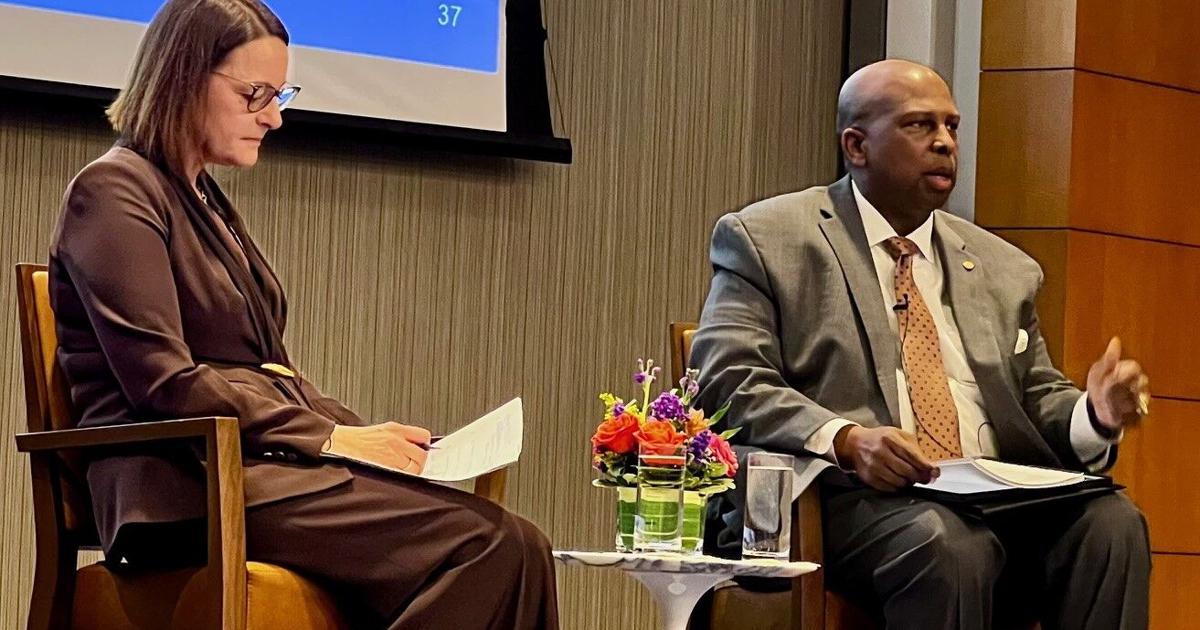
The seats in the auditorium at the Federal Reserve Bank of Dallas were filled Friday for the 2026 Texas Economic Outlook.
The Dallas Fed is one of 12 regional Federal Reserve Banks and serves all of Texas, north Louisiana and southern New Mexico. Unlike some of the other Feds, Dallas keeps close tabs on the energy sector and events at the border with Mexico that affect the rest of the state.
“You broke the attendance record,” said Pia Orrenius, a labor economist with the Dallas Fed told the crowd.
In addition to the hundreds in the room, several thousand were signed up to listen online to Orrenius’ outlook.
The year 2025 was like a roller coaster, she said. “We were feeling like we’re at the top of that roller coaster looking down, and it was an upside-down world.”

Pia Orrenius, an economist at the Federal Reserve Bank of Dallas, giving the 2026 Texas Economic Outlook on Feb. 6, 2026.
Though 2026 calls for “a pickup and growth” because of AI investment, data center construction and federal fiscal policy, Orrenius listed concerns, too. They include labor market constraints largely from immigration cutbacks, slow growth in the residential housing market, no real recovery in oil and gas prices and cuts to safety net programs.
Very low job growth
Texas saw near zero job growth in 2025 because of tariffs, falling immigration, federal government cutbacks and widespread uncertainty. Texas’ official growth rate was .01%, while growth for the U.S. overall was .04%.
Upcoming revisions may push them even lower.
“We think that it could be that downward revisions to U.S. job growth are going to mean that at the end of the day that U.S. job growth last year may also come in near zero,” Orrenius warned. “The interesting thing is that we haven’t seen this since 2000 to 2003 (after the dot-com bust).”
Headline unemployment is low, another jobless measure is not
While “headline” unemployment is still low at 4.3%, more concerning is the “U6” that measures those who are underemployed, work only part-time, or have simply given up and stopped looking. It is double, at 8.6%.
Orrenius said the drop in immigration, down by almost 50% from 2024 to 2025, and an additional 25% the second half of 2025 into 2026, has hurt Texas’ job growth.
“That’s going to make it really hard to generate, you know, any high rates of job growth, especially the kind that we’re used to. That’s just not going to be possible with this decline in migration to the state, this decline, really, in the labor supply.”
Construction is down and up
“Residential construction is not growing, but construction jobs are growing. In fact, that was our biggest growth sector last year. So that’s weird.” She said Texas’ “residential construction recession” is being offset by construction of semiconductor plants encouraged by President Joseph Biden’s Chips Act, infrastructure investment in LNG plants, and power and water plants related to AI data center expansion.
Eleven billion dollars, close to 8% to 9% of the building values in the state, was spent just on construction of data centers in Texas in 2025.
Orrenius said Virginia, Texas and Louisiana rank No. 1,2 and 3 in state data center construction.
Troubling signs
Texas has seen a 58% increase in homeowner’s insurance and property taxes over the past five years, about twice the national rate.
Mortgage delinquency rates are still low, but are trending up, something she said bears watching.
The underlying strength of the economy is always the “human capital.” Texas, she said, already has the highest uninsured rate in the nation. “One concern here is that with work requirements for Medicaid and so forth and other cuts in the safety net, is that this uninsured rate will increase, so we’ll see.”
The Federal Reserve Bank of Dallas, Feb. 6, 2026.
The Fed needs you … and your info
One way that the Fed stays up to date is through information they get from 1,000 business owners across its three states, and they are always looking for more survey panelists. The surveys are short and the business names are not disclosed, allowing people to speak freely.
How are businesses feeling? “There’s quite a bit of optimism. There’s quite a bit of uncertainty as well that certainly has not gone away,” Orrenius said.