
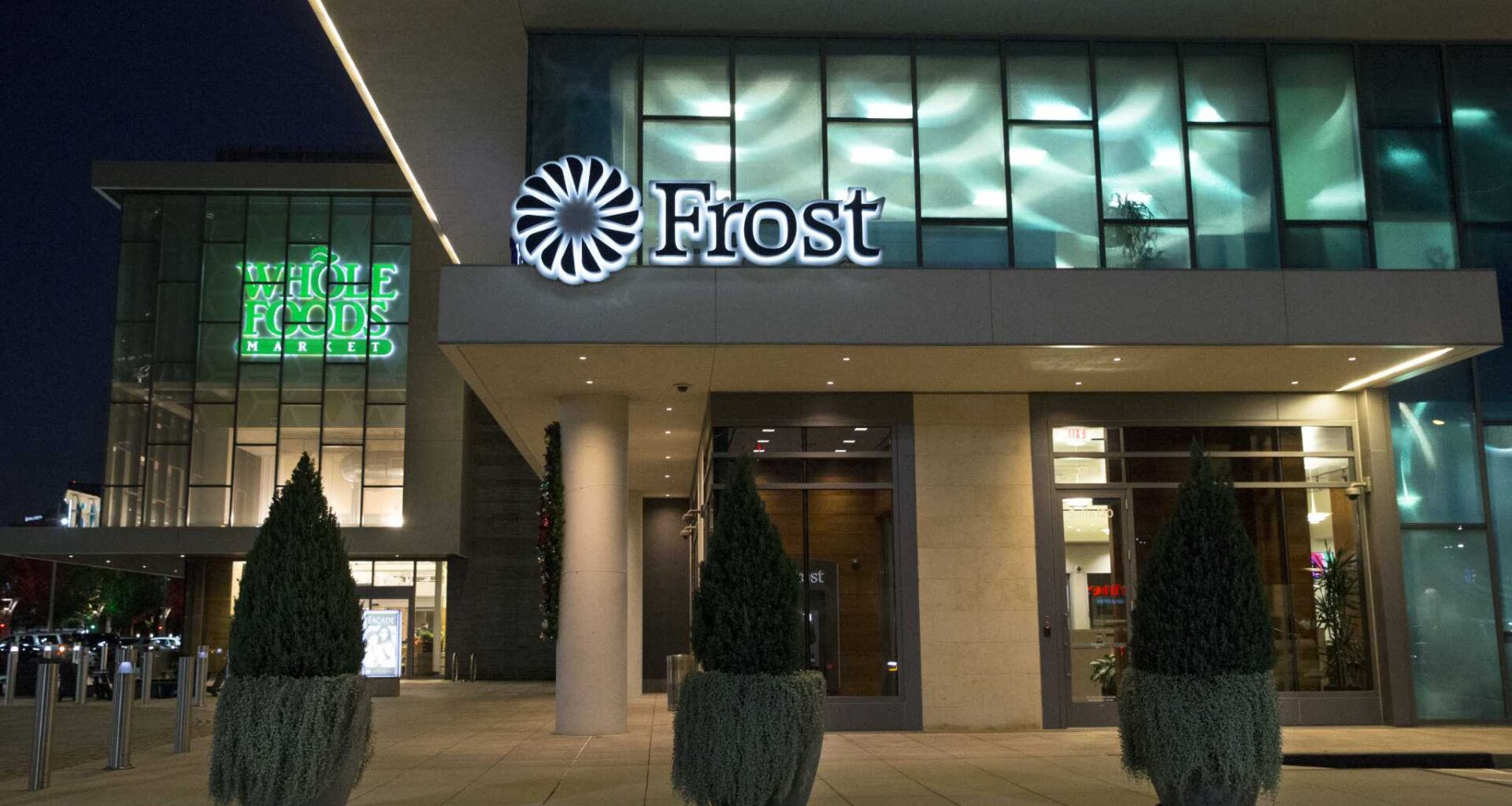
Frost Bank was the target of an alleged scheme that resulted in the theft of more than $1 million from its ATMs in 2021. Nine individuals were indicted earlier this year. One pleaded guilty last week and will be sentenced in January. Shown is a Frost Bank branch in Houston.
Yi-Chin Lee/Staff photographer
Nine people have been indicted in connection with an alleged scheme that stole more than $1 million from Frost Bank ATMs in 2021. Shown in a file photo is the Frost Bank Tower looming over the Robert E. Lee Hotel in downtown San Antonio.
Kin Man Hui /Staff file photo
An “internal flaw” in Frost Bank’s ATMs allowed nine individuals to loot more than $1 million from the San Antonio institution over a two-month period in 2021, according to federal court documents.

The alleged scheme involved more than 1,800 ATM transactions.
Frost Bank spokesman Bill Day didn’t have any information on whether it was able to recover any of the allegedly stolen money.
Article continues below this ad
“We have implemented measures to prevent any future similar fraud,” Day said Friday. Frost, with more than $51 billion in assets, is the largest bank based in San Antonio and among the 50 largest in the country. It previously has said it has the largest ATM network in the state.
In March, a grand jury indicted the nine individuals on bank fraud, conspiracy to commit bank fraud and identity theft charges.
BANK SALE: San Antonio’s Texas Partners Bank being bought by Prosperity in $269M deal
One of the defendants, 37-year-old Blake Semien of San Antonio, pleaded guilty to bank fraud and aggravated identity theft on Thursday. As part of his plea, the conspiracy charge will be dropped after his sentencing on Jan. 22.
Another defendant, Samuel Guerra, whose age and hometown couldn’t be determined, has agreed to plead guilty. His plea hearing is set for Oct. 22.
Article continues below this ad
Both men have been in custody since their arrests.
Six other defendants have entered not guilty pleas. The remaining defendant’s name has been redacted in the indictment because the individual hasn’t yet been arrested.
The charging document didn’t mention Frost Bank by name, only disclosing that the “victim” was a San Antonio-based financial institution. However, Frost’s name appeared in Semien’s plea agreement, which was unsealed last week.
SA INC.: Get the week’s top local business stories in your inbox
The court filings laid out how the alleged scheme worked.
Article continues below this ad
The ATMs targeted by the defendants have an “internal flaw allowing an individual to withdraw cash in such a way that the withdrawal did not register with the machine, and, therefore, did not result in the debiting of funds from the associated account,” the indictment said.
Semien’s plea agreement said he and others learned that if they requested a cash withdrawal from the ATM but did not actually remove all of the bills, a security feature would activate and attempt to pull the bills back into the ATM.
“By holding onto all but one of the bills during the retraction process, Defendant (Semien) and others were able to retain most of the money presented by the ATM, while tricking the ATM into registering the transaction as a failed withdrawal and not debiting the account used for any of the money that they received,” his plea agreement said.
Semien withdrew about $90,000 using that method, his plea agreement said.
It added that he exchanged Facebook messages with Guerra about carrying out the scheme with prepaid debit cards.
Article continues below this ad
MORE ON FROST: Frost Bank posts strong 2Q results on increased lending, branch expansions
The defendants would secure debit cards in their own name or in others’ names, the indictment said. They would recruit individuals to either provide debit cards for accounts already open or would ask them to open accounts and then provide the associated card.
The defendants also had others open accounts in the names of “unwitting friends and family members,” the indictment said. In addition, the defendants allegedly used identifying information for individuals who previously lost their wallets to open accounts in their name.
Semien’s defense lawyer, Charles Mais Jr., declined to discuss the case. Semien faces up to 30 years in prison, up to five years post-release supervision and a maximum fine of $1 million for bank fraud, He also faces the possibility of two years in prison, to run consecutively, and a $250,000 maximum fine for identity theft, his plea agreement shows.
The other defendants named in the indictment are:
Article continues below this ad
Chelsea Corrales, 34, of Bandera
William Conners, 36, of San Antonio
Darrin Donnell Williams, 41, of Schertz
Perkins Clayton Sexton Jr., 24, of Austin
Desiree Marrie Morris Smith, 30, of San Antonio
Brandylee Curry, also known as Brandylee Preston, 42, of San Antonio.
All six have pleaded not guilty and — save Sexton — were released on a $30,000 unsecured bond. Sexton remains in custody. Attorneys for the defendants either declined to comment or didn’t immediately respond to an email.
The six are currently set for trial in December in U.S. District Judge Orlando Garcia’s court.
Just how their alleged scheme was detected wasn’t revealed in court documents.
But after law enforcement began a probe, Semien’s plea agreement said, he told Corrales in a Facebook video message that Guerra mentioned that Corrales and others might be talking to police.
Corrales allegedly responded with her own video message, saying she didn’t know who was telling the truth about speaking with law enforcement.
“It was stupid to me, because if one of us — if somebody goes down, we all go down,” she allegedly said, according to the plea agreement.