
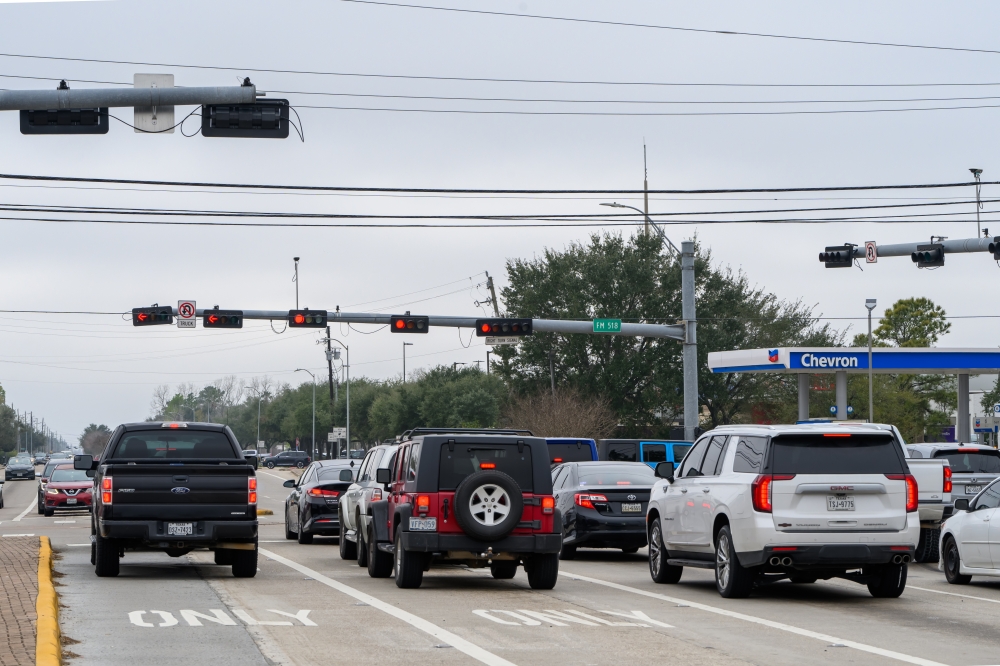
Pearland is rapidly modernizing the way it regulates traffic flow with a new generation of digital traffic sensors called NoTraffic—an artificial intelligence mobility platform that provides real time data on vehicle and pedestrian movements through intersections.
At a glance
The systems alert the city when something goes wrong, so city staff don’t have to rely on citizen reports or routine checks to become aware of problems.
“Prior to our system, you would start getting calls from drivers,” said Tim Morehead, the director of sales at Texas Highway Products. “Maybe there’s a wreck, and they start inundating you with the calls about the wreck, and you don’t find out about the wreck until you start getting all those calls.”
Morehead added that the sensor systems allow cities to fix traffic problems before residents flag them to the city.
In 2025, the city bought over 30 sensor systems from Texas Highway Products and is preparing to install nearly a dozen more in 2026, Morehead said.
The new sensors will be installed in batches of about 10-15 intersections at a time, Pearland Traffic Superintendent Mario Tellez said.
“>
How we got here
Pearland’s signal equipment and sensors, which differs from newer technology now being installed, are more than a decade old, Pearland Traffic Engineer Yolci Ramirez said.
To try reducing maintenance, the city was using in-pavement magnetometer sensors and then tried a single-camera per intersection detection. However, the cameras struggled with weather and obstructions, such as birds sitting on the cameras and blocking the footage, Ramirez said.
By 2024, the city began piloting the NoTraffic system and noticed a “big difference,” Ramirez said.
“Technology changes every year, and our signals [and] our equipment are no different,” Ramirez said. “It’s all electronic parts … [that] has been in place for more than 10 years. Usually, people think that once you build a new signal, it will last forever. That is not the case.”
Why it matters
From 2020-22, Pearland had nearly 2,100 accidents within the city’s intersections, according to data from a 2024 study conducted by engineering firm HNTB. This data helped show Pearland engineers that the old, fixed schedules weren’t enough, Ramirez said.
The new system tracks how people actually move through an intersection, such as red-light running.
“What that tells us is that maybe we need to extend the green time, or maybe we need to change how the signal is timed … so there’s not that many people running the light,” Ramirez said.
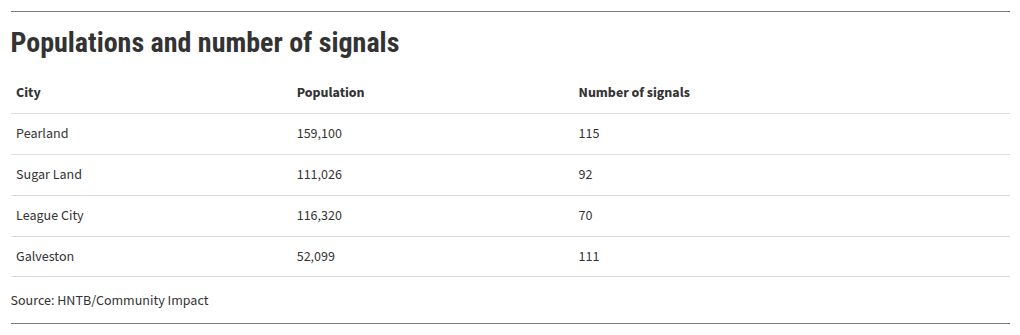
Currently, the city has 115 intersections, with a plan to add five more in fiscal year 2025-26, according to city documents.
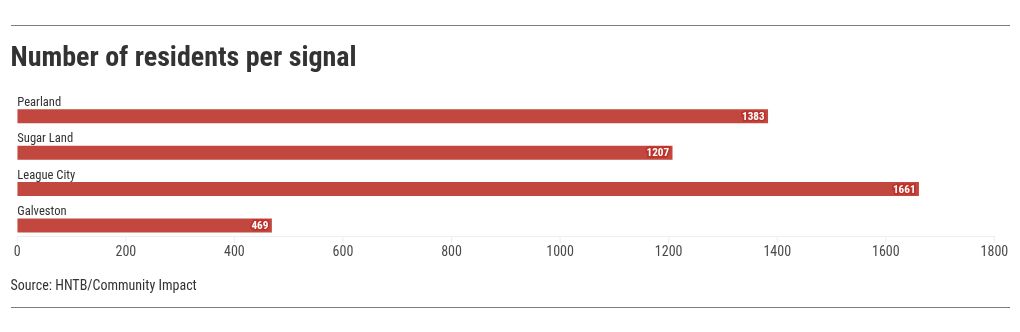
Compared to other cities in the Greater Houston area, Pearland maintains a similar ratio of residents-to-signals as Sugar Land, while falling between the high density of Galveston and the lower density of League City, data shows.
 Managing the impact
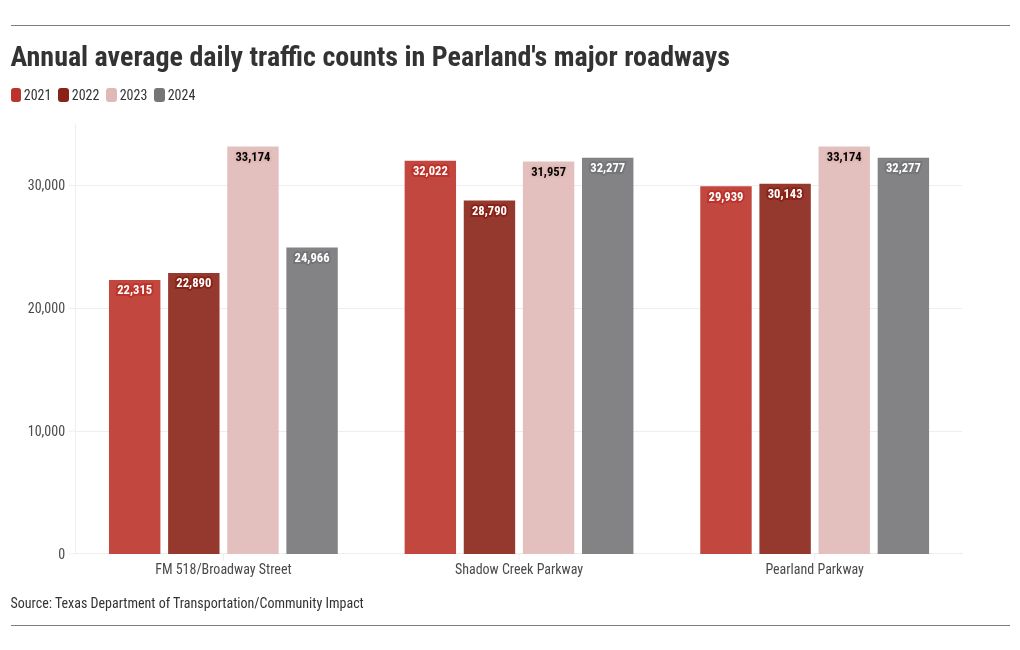
Since 2021, most major roadways in Pearland saw a steady increase in traffic volume, data from the Texas Department of Transportation shows.
Roadways such as FM 518, or Broadway Street, saw a sharp increase in traffic volume in 2023, followed by a sharp decline in 2024, data shows.
Regardless, Tellez named intersections such as Broadway Street and Dixie Farm Road as spots with “constant congestion.”
 Looking ahead
Currently, city officials are in the implementation phase of the 2024 study conducted by HTNB, which laid out a five-year roadmap for traffic management throughout the city, Ramirez said.
The implementation phase includes updating controllers, and standardizing the NoTraffic system on new signals.
Each NoTraffic sensor costs about $26,000. City officials are currently seeking grants to help pay for implementing the new sensors.
The study also evaluated staffing levels. Currently, Pearland has about 19 signals per staff member. For comparison, League City maintains roughly 10 signals per staff member.
Officials said Pearland’s higher ratio places greater operational demands on staff, which is why new technology must be rolled out gradually.
Intersections will continue to be improved gradually to keep up with technology changes, with no set date yet for full installation, Tellez said.
“In five years, there’s gonna be another better detection,” Ramirez said. “It’s like a phone … they change every year. We’re trying to have a plan for our staff, our equipment and funding.”