
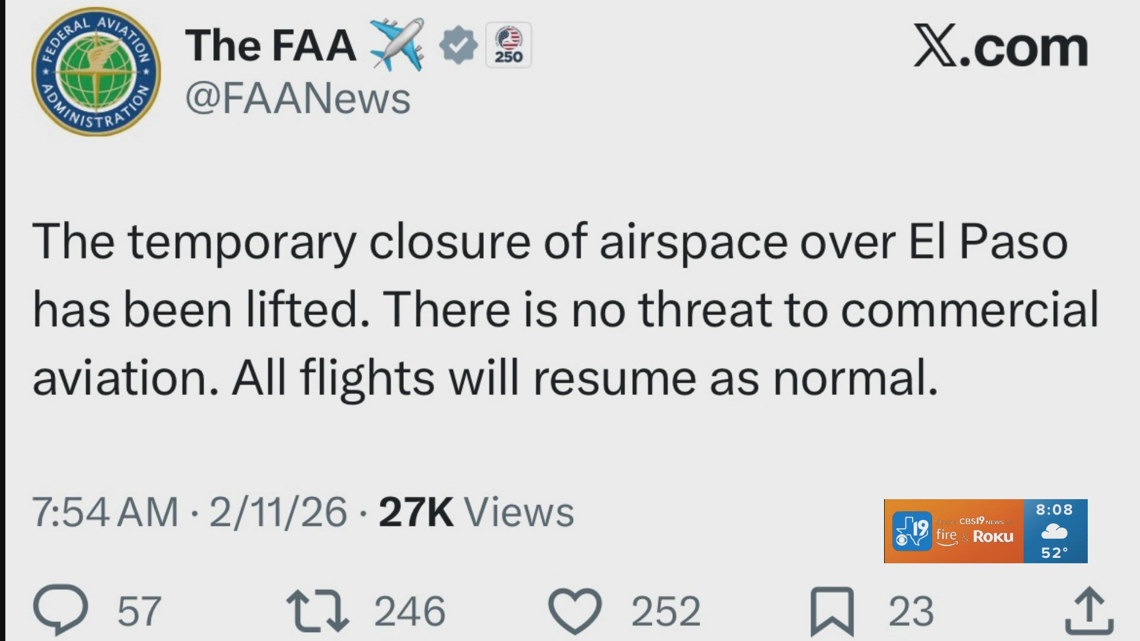
Federal officials said the closure was tied to a security incident involving drones near the border, prompting a brief halt to flights.
EL PASO, Texas — The Federal Aviation Administration reopened the airspace around El Paso International Airport in Texas on Wednesday morning, just hours after it announced a 10-day closure that would have grounded all flights to and from the airport.
The shutdown was expected to create significant disruptions given the duration and the size of the metropolitan area. El Paso, a border city with a population of nearly 700,000 and larger when the surrounding metro area is included, is a hub of cross-border commerce alongside the neighboring city Ciudad Juárez in Mexico.
According to AP sources, a Pentagon-FAA dispute over a military test of a laser to thwart drones led to the airspace closure.
Why was El Paso International Airport abruptly closed?
When the shutdown was initially announced, a notice posted on the FAA’s website said the temporary flight restrictions were for “special security reasons.”
Transportation Secretary Sean Duffy later shared in an X post that the FAA and Defense Department “acted swiftly to address a cartel drone incursion. The threat has been neutralized and there is no danger to commercial travel in the region.”
It was left unclear how many drones were involved or what specifically was done to disable them.
The Associated Press reported the closure involved a dispute between the Pentagon and the Federal Aviation Administration over the military test of a laser to thwart cartel drones.
Are cartels using drones?
Mexican cartels have long used drones to traffic drugs, control migrant crossings along the border and wage war with rival cartels and authorities.
Mexico first issued an international alert about the use of remote-controlled aircraft in 2010, and the practice has only continued to expand. Often rigged commercial drones, the aircraft offer cartels an advantage to subtly carry out their illegal activities without risking their own necks like they would in the past.
Between 2012 and 2014, U.S. authorities detected 150 remote-controlled aircraft crossing the border with Mexico. A decade later, in 2022, U.S. Customs and Border Protection detected 10,000 drone incursions in the Rio Grande Valley area alone, according to a 2025 report.
This report also indicated that more recently, Mexican cartels seem to be inclined to smuggle fentanyl in drones, which can carry up to 100 kilograms (220 pounds) of cargo.
The Associated Press contributed to this report.
Copyright 2025 Associated Press. All rights reserved. This material may not be published, broadcast, rewritten, or redistributed.