
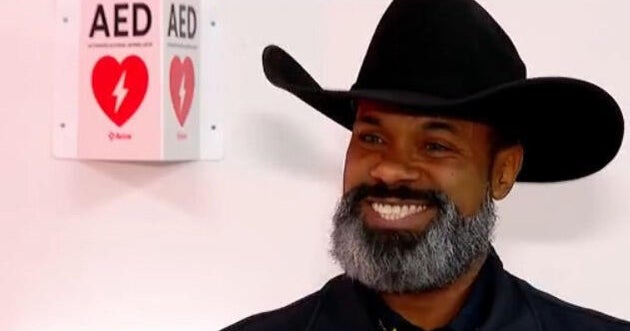
After a Fort Worth police officer was clinically dead for 15 minutes during a sudden cardiac event, his coworkers’ quick use of an Automated External Defibrillator (AED) saved his life. Now, the department is equipping patrol cars with life-saving defibrillators to ensure first responders can act immediately in emergencies across the community.
In May of 2024, Fort Worth Police Officer Terrence Parker was loading his vehicle outside the Bob Bolen Safety Complex when he says he started to feel an icy tingling sensation in his throat, but decided to ignore it.
“Wasn’t feeling too bad,” said Parker. “I was just kind of like overexerting myself just a little bit.”
Moments later, while in the restroom, Parker lost consciousness.
“From what I heard,” Parker said, “I dropped my phone, and the person next to me was like, ‘Hey, you dropped your phone.'”
Parker didn’t answer him, so someone looked over the stall.
“When they did, they said I was slumped over,” said Parker.
That’s when his coworkers went into action.
“I’m sitting in my office, and I heard down the hallway, ‘Get Rocsan,'” said Fort Worth Police Officer Rocsana Ferren.
Parker was “clinically dead” for about 15 minutes. He was rescued by his co-workers using a combination of chest compressions and the AED. Doctors say those efforts were critical to his survival.
“I’m here today because of them, and the good Lord decided he didn’t want me just yet,” said Parker.
That was on Ferren’s mind when she later met with the Tarrant County Nation of Lifesavers Committee.
She was asked if the police department needed anything to help save lives. She could only think of one thing.
Ferren asked for AEDs in the patrol cars—and the committee agreed.
“The Fort Worth Police Department, like many departments, is often first on the scene when a medical emergency happens, not necessarily because they are dispatched to respond, but they are out in the community, and they see things,” said MattZavadsky, the chairperson of the Tarrant County Nation of Lifesavers Committee. “So they could be at an event, they could be parked somewhere, and someone runs up to them somewhere and says, ‘There’s a medical emergency over there.’ And they may be the ones to initiate the call. So having an AED-equipped patrol car could make that AED available much more quickly than the EMS units arriving on scene.”
“If an AED was not readily available, I would not be here right now,” Parker said. “So, the purpose of having those inside the vehicles readily available, properly trained, is crucial.”
A life lesson that we all can take to heart.