
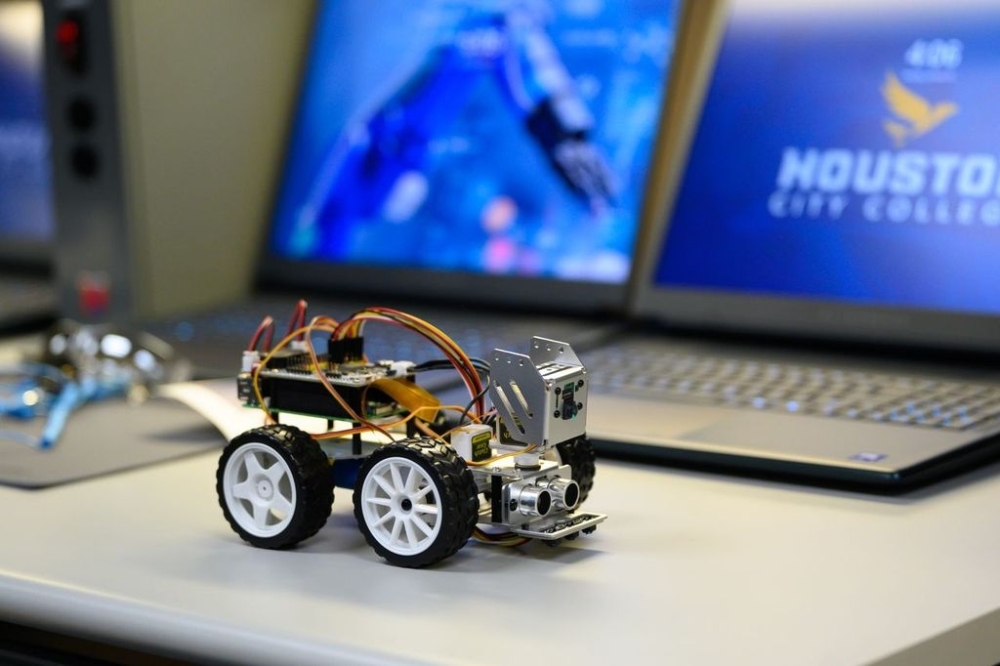
Houston City College officially took on its new name June 18—after 54 years as Houston Community College—reflecting the growth of the institution.
The name change comes after the college launched its first two baccalaureate degree programs focusing on artificial intelligence and robotics, as well as health care management, Community Impact reported.
What’s happening
Now, following the success of the programs, the college is bringing in three new four-year programs in computer information systems, business and nursing—with the first two expected to launch in spring 2027 and the latter in 2028, said Miguel Ramos, vice chancellor for instructional services at HCC.
“We definitely want to provide as many opportunities for student learning as possible,” Ramos said.
With five baccalaureate programs, the college will be utilizing the full extent allowed by the state to help fill gaps in the area’s labor market, Ramos said.
In the AI sector, that gap sits at tens of millions, with only 8.7 million nationwide currently learning AI-based skills compared to the 57 million interested, according to higher education marketing and research firm Validated Insights. That number shrinks to only 7,000 when limited only to AI education from higher education institutions.
As of early 2025, only about 2.5% of institutions offered a bachelor’s in AI despite high interest, Validated Insights found.
Zooming in
While the new AI program will be stationed at HCC’s Southwest College—located inside the 610 loop—students have already made an impact in Fort Bend County, HCC Southwest College President Michael Webster said.
A group of HCC students were finalists in a NASA competition, with an entry focused on the west side of the county that saw the development of a drone that used AI lidar—a sensing method that sends pulses of laser light to determine the presence, shape and distance of objects—to find feral hogs in ranches, Webster said.
“It’s a big problem on the ranches,” Webster said. “Those things multiply like crazy, they eat all the vegetation, and get in the way of the tractors.”

Additionally, Ramos said he expects the incoming business program—one of the college’s largest programs—to touch Fort Bend campuses.
HCC is not alone as other schools in the area are working to implement such programs as well.
At the University of Houston—which does not have a distinct major for AI—the school is working with professors to implement the tool into courses, said Teresa Acosta, UH director for faculty and departmental instructional support.
By the numbers
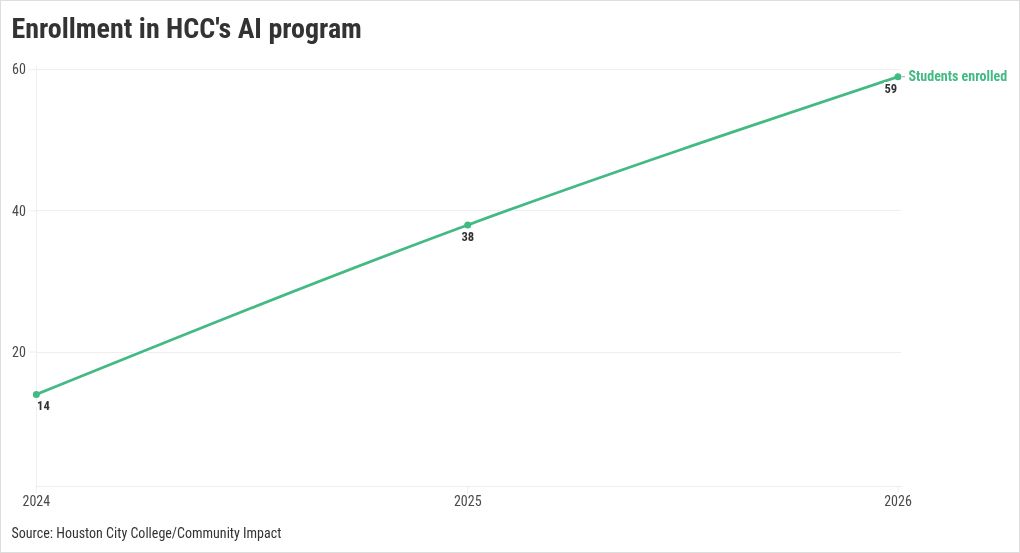
HCC’s AI program, which officially launched in 2020 as the first industry community college associate degree and in 2023 as a bachelor’s degree, has quickly exploded, with 59 students enrolled for the 2026 academic year—up from 14 in the 2024 academic year, HCC officials said.
And while AI is not the only factor, community college enrollment continues to rise—with a 4% increase in reported enrollment in fall 2025, according to the National Student Clearinghouse Research Center. HCC is among those risers, with a 95,401 enrollment total in the 2024-25 school year, according to college statistics.
 Zooming out
Over at UH’s campus, Acosta said the university hopes to see core courses implement AI in some way, whether it be rubrics, grading, helping with research or learning AI literacy.
“[There are] big companies here, and they’re expecting students to have AI skills,” Acosta said. “So, it just makes absolute sense that UH is going to be working with, leading [and] teaching with AI.”
At UH, which is bringing C.T. Bauer College of Business executive education mini-courses to Katy in March, AI elements have been implemented into classes, including the Technology Division in Sugar Land and engineering in Katy, said Jay Neal, UH associate vice president of Academic Affairs and chief operating officer.
Neal said UH’s AI-specific courses include:
Fundamentals of artificial intelligenceData science and machine learningSpecialized AI applicationEnergy and engineeringAdditionally, UH is rolling out a computer science master’s program with a concentration in AI and certificate this fall at the Katy campus.
The university is also adding new certifications and graduate and undergraduate programs falling within various AI and data analytics topics in business, engineering, education and computer science this fall, Neal said.
“We’re really trying to align our programs at these campuses that align with our industry partner needs,” Neal said. “Our industry partners, our business partners are driving that conversation, and we respond to it.”
Additionally, the university focused on putting Teaching Innovation Program grant money—awarded $300,000 in 2025 to departments to help develop and implement plans for new teaching approaches—toward AI, Acosta said.
The university also offers microcredentials, courses offering certificates that participants can put on their resumes or LinkedIn pages, Acosta said.
Looking ahead
HCC is also receiving funding from Google—among other major tech companies—to help train teachers and professors interested in AI. The $2 million Google grant has a high school focus, Webster said, with another grant securing paid internships for students.
“Education is constantly evolving. This gives [people] an opportunity to create degrees that are going to help them advance in their career, to get different job opportunities. We see a demand for that, ” Ramos said.