



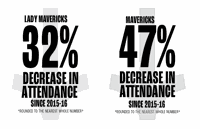
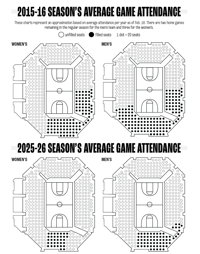
Over the past few years, attendance at UTA athletic events has decreased, leaving bleachers and seats close to empty. Win, lose or draw, the crowds remain more unpredictable than the games.
The Shorthorn Editorial Board believes consistent fan and student attendance plays an impactful role in college sports, and engagement at athletic events can help generate school pride and a sense of campus community.
Having a crowd roar in the bleachers behind a home team can directly affect student athletes. According to a 2025 study in the National Library of Medicine, when fans are in the stadium, home teams are more successful offensively. They take more shots and are more on target than in games without spectators. The impact on away teams is just as pertinent, as they see fewer wins, more points conceded and fewer points earned against teams with fans in attendance.
UTA has had those moments, seeing crowds upwards of 6,400 in the stands at College Park Center, nearly reaching its occupancy limit. But these record-breaking attendances have faded into the history of UTA Athletics. Of the top 10 largest crowds at the arena, dating back to 2012 when it opened, only one has occurred since 2020, according to UTA Athletics records.
A factor in the attendance drop following 2020 can be attributed to the COVID-19 pandemic. However, despite shutdown restrictions being lifted for years, attendance at athletic events has still been unable to recover from the dip.
Attending these games offers advantages over watching at home, including the dynamic of the in-person fan experience. What makes this experience unique is the unpredictability of sports and the distinctive arenas and stadiums that home teams defend, each reflecting the culture of the team and community that make up its noise.
At A Glance
The Issue: Attendance at UTA Athletics games is often low.
We Think: Sports play a large role in student engagement, school pride and campus community.
Take Action: Students should make an effort to attend more games and support the athletic programs.
Source: UTA Athletics • The Shorthorn: Jordan Johnson
Many UTA students have complained about a lack of activities on campus or parking issues when attending events. For many college students, budgets are tight, and finding cost-effective fun after going to class all day can be challenging.
Students may not realize that UTA Athletics games are free for all students and allow one friend to tag along for free. In addition, the majority of the team venues have offered students and fans the opportunity to indulge in stadium food and giveaways, including discounted meals, merch, coupons and occasionally monetary prizes.
As UTA basketball moves into the later stages of the season and postseason, and other programs are weeks into competition, students should consider going to games, if not for the teams themselves then for the community that sports inspire.
There are a plethora of sports events happening weekly, with 17 Division I teams currently competing. The spring semester is riddled with games on campus, including track and field, baseball, softball, basketball, tennis and wheelchair basketball.
Following Maverick social media accounts, viewing poster boards with flyers around campus or asking friends for any activities going on during the week are some of the best ways for UTA students to get engaged and stay up to date with athletic events.
If students are worried about parking, some lots are free during games, including the College Park garages for women’s basketball and volleyball, lots 25 and 26 for track and field, baseball and softball, and lot 30 for tennis.
Source: UTA Athletics • The Shorthorn: Kale Ivie and Haley Walton
There are countless opportunities to get involved as either a spectator or a participant. By keeping track of game schedules, promotional nights and special events, students can make the most of what their school’s athletic programs have to offer.
Even if students are not sports fanatics, the games can serve as a place to spend time with friends and disconnect from academic stress for a few hours. Students should use the events as a way to either try out new activities or spark school pride, with the possibility of walking away with extra money in their pockets and smiles on their faces.
The Shorthorn Editorial Board is made up of opinion editor Lillian Durand, editor-in-chief Pedro Malkomes; news editor James Ward; associate news editor Taylor Sansom; multimedia editor Samarie Goffney; engagement editor Sairam Marupudi; design editor Haley Walton; news reporter Acadia Clements; and engagement producers Jessica Arnold and Natalie Gomez. Goffney was not present for this discussion. Sports editor Kale Ivie attended in Goffney’s place.