
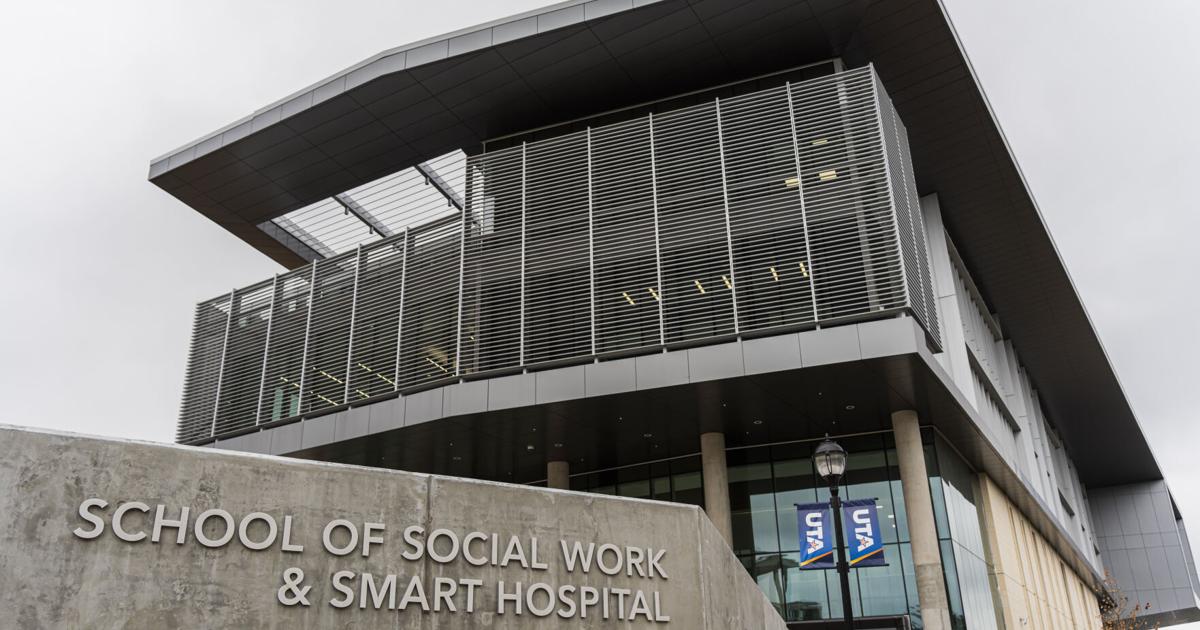


The College of Nursing and Health Innovation is searching for a new dean. There are four candidates, and the fourth one to address faculty and staff spoke Feb. 16.
File photo / Natanael Mazariego
Four candidates for the vacant dean position in the College of Nursing and Health Innovation presented their visions to faculty and staff throughout the month.
The dean engages, leads and energizes the community within the college to build new initiatives and collaborations across and outside of the university, according to a UTA website.
In the role, the dean will also identify strategic priorities for investment, assume responsibility for all facets of the college’s finance and administration, and develop a vision that reflects the needs of students, staff and faculty.
CONHI is one of the largest colleges at UTA, with nearly 12,000 students as of spring 2025, according to a UTA press release.
Here are the four candidates and their visions for the college.
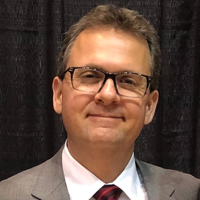
Photo courtesy of Mark Merrick
Mark Merrick
Mark Merrick is the dean of the College of Health and Human Services at the University of Toledo. He has 20 years of experience as the founding director of the Division of Athletic Training at Ohio State University’s College of Medicine.
During his presentation, Merrick shared his mission goal at UTA. He said he plans to grow the kinesiology department, steer away from a transactional sense of education and highlight the need for external philanthropy to support the college’s mission, emphasizing the importance of aligning donor passions with institutional needs.
Merrick brought up the priorities on the State Higher Education Executive Officers Association’s list of top 25 in education, emphasizing the misalignment of the priority of research and discovery items. Neither of those made it to the list, and Merrick hopes to bridge that gap.
“We also have to encounter the big disconnect that the state’s priorities and the university’s priorities are not always the same,” Merrick said. “But we have to learn to navigate better in that environment, our budget increases and political impacts that affect us.”
When asked about his plan to use the community for nursing and kinesiology to bring in more recruits, Merrick said he wants to begin by seeing who the university wants in its community and what they need.
“If we add programs, they should be programs of need,” Merrick said. “They should be programs where we can bring in the faculty who fit the culture that we are trying to create and the aspiration that we have for us.”
When asked about external fundraising, Merrick approaches that area by not relying solely on tuition and state supplement but on grants and philanthropic work.
“What I have found is people who are passionate about areas of things that are important to them,” Merrick said. “I have also found a college that does amazing things, and my job as dean is to bring the intersection of those two things together, where I can connect somebody’s passion with something that we have, and they can fund it.”
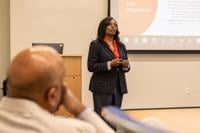
Versie Johnson-Mallard, dean and professor at Kent State University College of Nursing, discusses leadership tactics and student success strategies during a dean candidate presentation for the College of Nursing and Health Innovation at the Science and Engineering Innovation and Research Building Feb. 5. Johnson-Mallard shared how her personal background informs her values in nursing education.
Versie Johnson-Mallard
Versie Johnson-Mallard is the dean of nursing and a professor at Kent State University.
Freshman persistence and retention are important to her, she said. In her position as dean, she implemented a course called Flashes 101 designed to meet students where they are and bring them up to the level they need to be to succeed in college, providing one-on-one guidance and mentoring.
At Kent State, Johnson-Mallard created a program where nursing students would complete their degrees in 4 1/2 years, taking summer courses and focusing on their core courses for the first two years of their collegiate career.
Without this program, out of over 400 student applicants, the university would only invite 104 to the curriculum the following fall. Johnson-Mallard said that was unacceptable.
“We created this marathon approach, a new program, a new track, to help those students, help their dreams come true,” she said.
Johnson-Mallard touched upon UTA’s land-grant mission and how there is potential for a larger impact, new networking and design thinking opportunities.
“Students are what keeps the doors open,” she said. “They walk in, some of them pretending that they know everything, but in reality they want something, and I enjoy helping them to do that.”
Johnson-Mallard said new tracks, rules and regulations are necessary to support students who are being discouraged from majoring in nursing, like those who play sports or participate in ROTC.
“Together, we can reimagine education, safety and quality to help the health care field reach new heights of excellence,” she said.
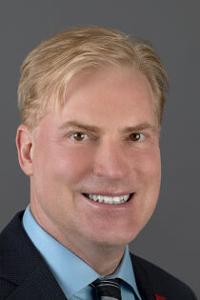
Photo courtesy of Kristan Jacobsen
Yves Lussier
Yves Lussier is a professor and the chair of the University of Utah Department of Biomedical Informatics at the School of Medicine.
During his speech, Lussier highlighted the importance of strategic advancement and the changes artificial intelligence can bring to the field’s workflow.
Lussier said preparing future graduates for sustained success should be the priority in a rapidly growing market.
UTA West will strengthen clinical trial capacity and deepen engagement with the modern industry ecosystem, he said.
Institutional validity depends on planning ahead financially and academically, he said, which attracts students and engages current students, faculty and staff.
Lussier said health care is 10 to 20 years behind other industries in terms of systems intelligence, noting that AI would allow the profession to track care information at multiple levels and communicate more quickly to provide better care, similar to Walmart’s inventory model.
A better workflow could help a physician identify care options earlier, he said, such as transferring a patient to a semi-intensive care unit that better fits their needs.
“Propelling the information up the pipeline a little bit like Walmart does is what we can feel will be coming in health care with workflows,” Lussier said.
Lussier said he believes AI should enhance professionals rather than replace them.
“If the AI can do better than our trainees as a consultant, we’ve not trained our trainees properly,” he said.
Other than innovation, Lussier said, his first priorities would be to focus on enrollment and the financials. Because he is not a nurse, he said, he also wants to ensure there is a nurse leader who can take care of accreditation.
Lussier highlighted the importance of strategic investment, specifically in the Smart Hospital.
“A dollar invested early is worth $3 or $10 two years later in any industry,” he said.
When asked what makes him uniquely qualified for the position, Lussier said he is an experienced scientist, noting that not many individuals have trained in the interdisciplinary field as he has.
He said his science was recognized among 10 pioneers of precision medicine at the White House, and he has extensive lab experience, including lab work in data science and AI.
“I’m not driven by ego, I’m driven by impact,” he said. “I think the opportunity here is to impact at scale, 12,000 learners, and more, the staff and the faculty.”
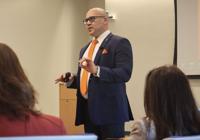
Bernard Rousseau, dean of the Doisy College of Health Sciences at Saint Louis University, speaks during a dean candidate presentation for the College of Nursing and Health Innovation Feb. 16 at the Science and Engineering Innovation and Research Building. Rousseau also serves as president of the American Speech-Language-Hearing Foundation.
Bernard Rousseau
Bernard Rousseau is dean of the Doisy College of Health Sciences and a professor of speech, language and hearing sciences at Saint Louis University.
During his interview, Rousseau discussed long- and short-term strategies for CONHI to continue to lead through retention and student success. He compared Saint Louis University’s and UTA’s acceptance and retention rates and highlighted how Saint Louis has raised ranks and elevated students.
As dean of the Doisy College of Health Sciences, Rousseau oversaw the transition of the institution into R1 status, saw a 128% increase in faculty research expenditures over three years, a 41% growth in research expenses in the 2022 fiscal year, 36% additional growth in fiscal year 2023 and a 21% growth in fiscal year 2024. He also saw the recruitment of 12 new faculty members in three years and $2 million in teaching lab and simulation renovation.
In his first year as dean at UTA, Rousseau said, he would align UTA’s people, programs and purpose and work to understand CONHI’s strategy. He said he would also raise money for the mobile unit and simulation programs and increase space.
“I am really interested in the commitment that UTA has towards providing access,” Rousseau said. “The mission really involves accessibility and affordability for learners. Over 50% of your students are Pell-eligible. This is important to me; I’m a first-generation college student, Pell-eligible student myself.”
He highlighted UTA 2030, a new strategic plan focused on five pillars: people and culture, student success, research and innovation, alumni and community engagement, and finance and infrastructure. He said the plan is critical to faculty and student success.
“UTA 2030 amplifies the impact of both research and scholarship, and learners are at the center, so you remain student-centered and focused as you’re discovering, learning and having an impact on the community,” he said.
Other focuses of the presentation included current workforce shortages and how UTA can combat them while ensuring retention and student success. He said that as a university with a large undergraduate nursing program, UTA continues to place health care workers into places with shortages.
“The role of a large public institution is so critical in terms of addressing the health care shortages in nursing and other health professions within Arlington, within DFW, within the state and the region,” Rousseau said.
@atclements03 @courtnynws @_.lexlie_