
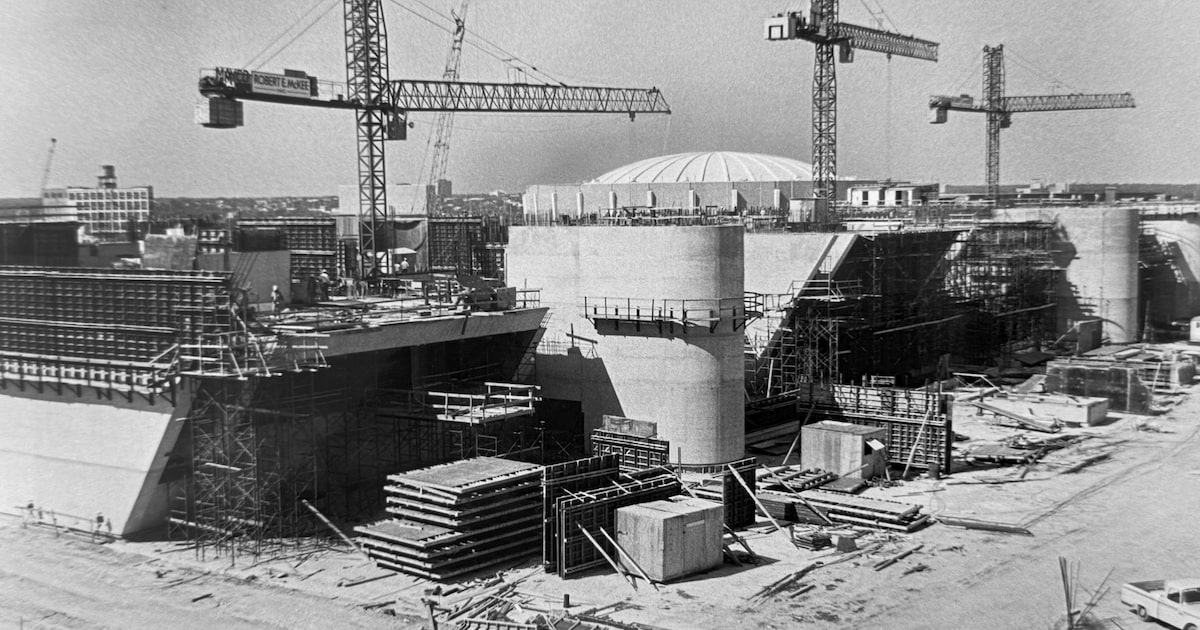

David Voss had two speeches prepared for last week’s meeting of the Dallas City Council.
In one, edited endlessly over several days, he pleaded with the city’s elected officials not to destroy Dallas City Hall, where he’d been the main caretaker before, during and for a long time after its opening in the spring of 1978. He wrote of bearing witness to “a new chapter in the city of Dallas” written by Mayor J. Erik Jonsson, and of how I.M. Pei’s brutalist masterpiece was the manifestation of a city “standing up, squaring its shoulders and leaning into the future to demonstrate it was more than the place where President Kennedy was killed.”
When Voss stood alongside the security guards who unlocked City Hall on March 12, 1978, he wrote in the speech, Dallas actually was the world-class city it has claimed to be ever since.
In the other speech, Voss chided council members and city staffers for allowing City Hall to lose its luster. To, as he put it, “die from the inside.”
The day before he spoke to the council, the 75-year-old Voss, for the first time in years, walked the length of City Hall’s second floor — what used to be called the Great Court because of its length (nearly that of a football field), unencumbered view of the vaulted ceiling 100 feet above and its open offices meant to welcome residents coming to pay water bills or attend council meetings. Voss found there to be little great about the Great Court 48 years later — ugly chairs and closed kiosks and a clutter of cubicles, locked doors, broken blinds and dull detritus.
Opinion
“You were meant to be in this open air, in a building full of light,” he told me. “Now the light’s all been blocked. Pei intended the citizens of Dallas to be able to walk down those corridors and look in and see their government working. Now you can’t see that government working anymore.”
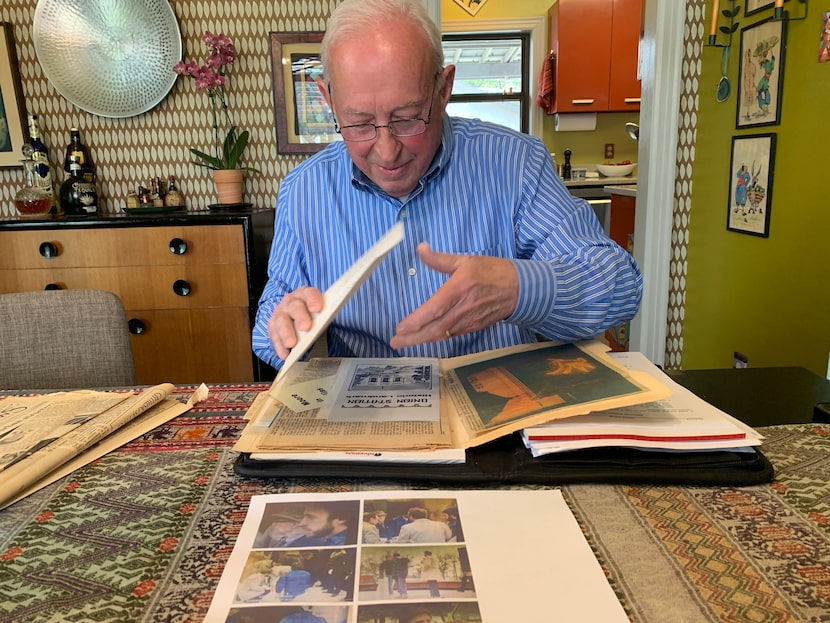
David Voss flips through his files and folders commemorating his time with the city, during which he oversaw operations at the brand-new City Hall and, eventually, some 600 other city-owned facilities.
Robert Wilonsky
Voss wrote a speech about all of that. He wanted to deliver it, he told me. “I was in torment over it.” But he folded it away and delivered his originally prepared remarks.
Voss had gone to work for developer Trammell Crow after leaving the city and, for a long time, ran Dallas Market Center. And he didn’t want anyone to accuse him of being the old man who’d just returned home after decades in absentia only to take cheap shots about what a mess it had become.
“That place is an embarrassment to the city of Dallas,” Voss told me Wednesday. Not the building, he said. Never the building or the council chambers, which he compared to a chapel in this newspaper in 1980.
“It’s not the building’s fault,” Voss said. “It’s what’s happening inside. They’ve let it go to s—. I don’t know that I can save it. Hopefully I can try to help. But if it gets saved, it’s got to change.”
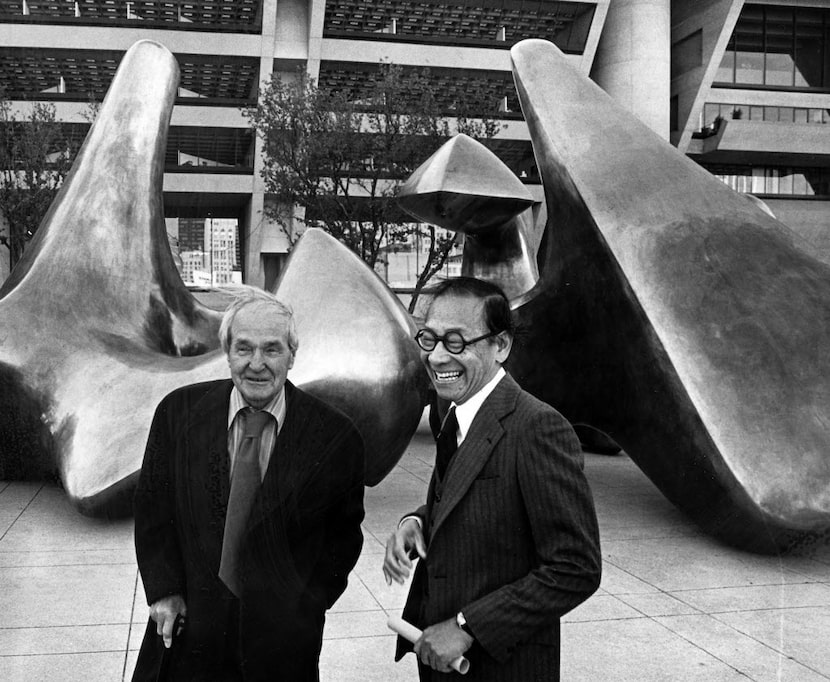
Sculptor Henry Moore (left) and architect I. M. Pei were on hand for the dedication of Moore’s sculpture “The Dallas Piece” at City Hall Plaza.
(File)
At this late hour, when we are just moments from discovering — officially, finally, whatever — what it will cost to repair Dallas City Hall, there likely isn’t much left to be said about the state or fate of Pei’s ziggurat. The architects and preservationists, with their nighttime tours and white papers and landmarking efforts, have had their say; the developers, too, many of whom are clamoring for a piece of the action when city leaders opt to abandon The People’s House for a high-rise rental.
The national media has also weighed in, with The Atlantic recently decrying the likely destruction of “the city’s one-of-a-kind Brutalist colossus” as a “half-baked vision [that] may be the nation’s worst downtown-revival strategy.” Dallas’ absentee mayor decried the building as “underutilized space” in The New York Times, like he’d even know.
We’re likely but hours away from being told we’ve no choice but to close City Hall, demolish it and give it to casino owners from Las Vegas. So in these moments before it all hits the fan, I thought it might be nice to hear from the man who helped open what The Dallas Morning News’ late architecture critic David Dillon called “one of the most ambitious civic buildings of the 20th century.”
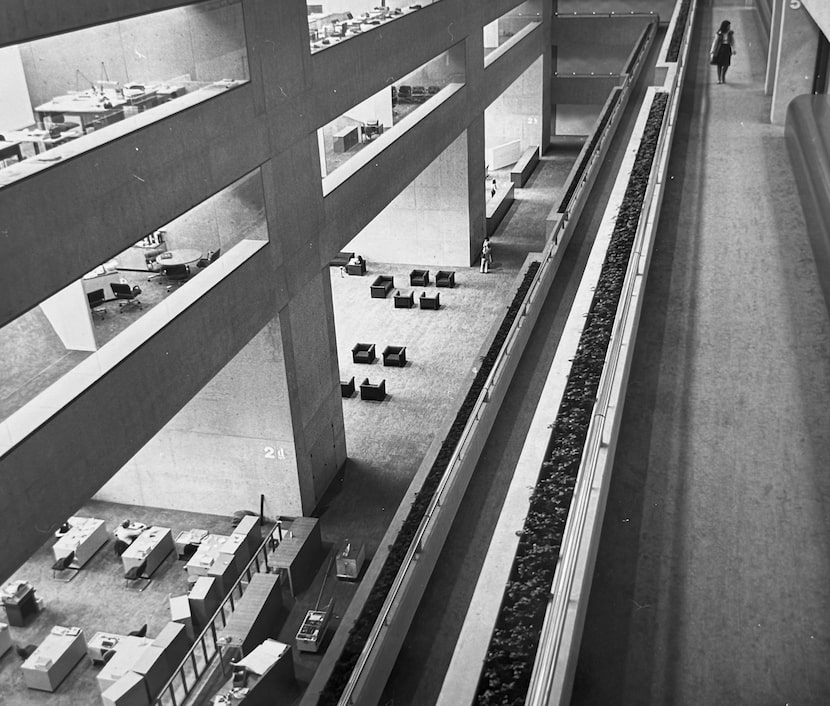
Dallas City Hall’s Great Court as it looked when the building opened in 1978
1978 File Photo / Staff
Voss was no mere footnote in City Hall’s epic tale — an unsung hero, at least. He would eventually oversee construction of numerous city landmarks, among them the downtown library named for Mayor Jonsson, before leaving in 1986, when he was in charge of some 600 city-owned buildings and the 450 men and women tasked with maintaining them.
In 1977, one of his numerous duties was moving everyone from the Harwood Street city hall into Pei’s fortress on Marilla Street, which he said would take five years to demolish given the millions of pounds of rebar inside all that concrete. Another task involved assembling an army of architects, painters and maintenance workers to ensure City Hall never lost its shine.
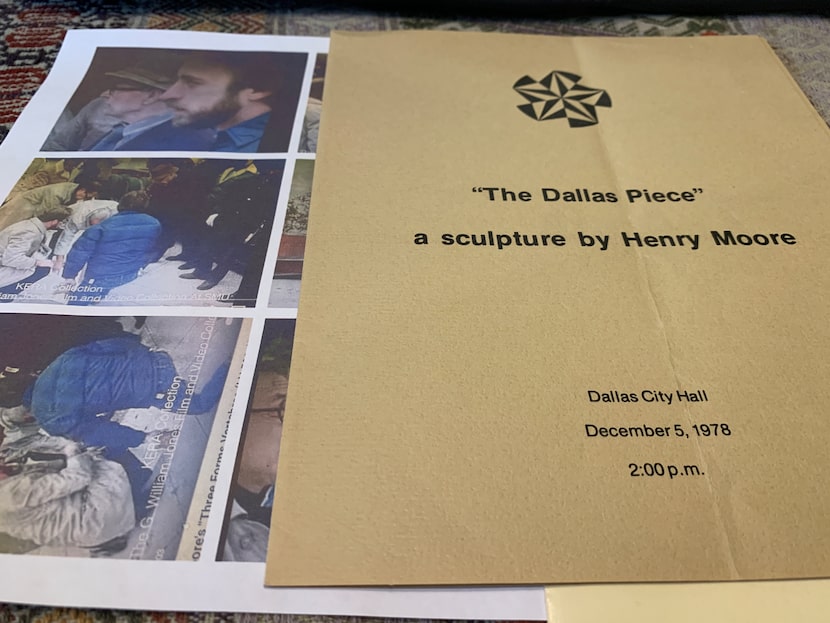
In David Voss’ folders are photos of him — with the beard — alongside I.M. Pei and Henry Moore during the installation of the sculptor’s ‘Dallas Piece’ in 1978. He also keeps an invitation to the sculpture’s official debut in front of Dallas City Hall.
Robert Wilonsky
“We had damned near a blank check,” he said, which was eventually torn up because of “budgeting decisions.” Today that’s referred to as “deferred maintenance,” the real D in Big D.
For more than an hour Wednesday morning we sat at the dining room table of Voss and wife Melanie’s cozy, art-filled home near Dallas Love Field. Beside him were manila folders filled with mementos from the days when Pei presided over the building’s construction and its grand opening, and when Henry Moore came to plant his Dallas Piece sculpture on the plaza with Voss serving as supervisor.
“The city of Dallas will never again have the gumption, the leadership to do anything as spectacular as that building,” Voss said. He would know better than most. Voss worked for the city of Dallas three times.
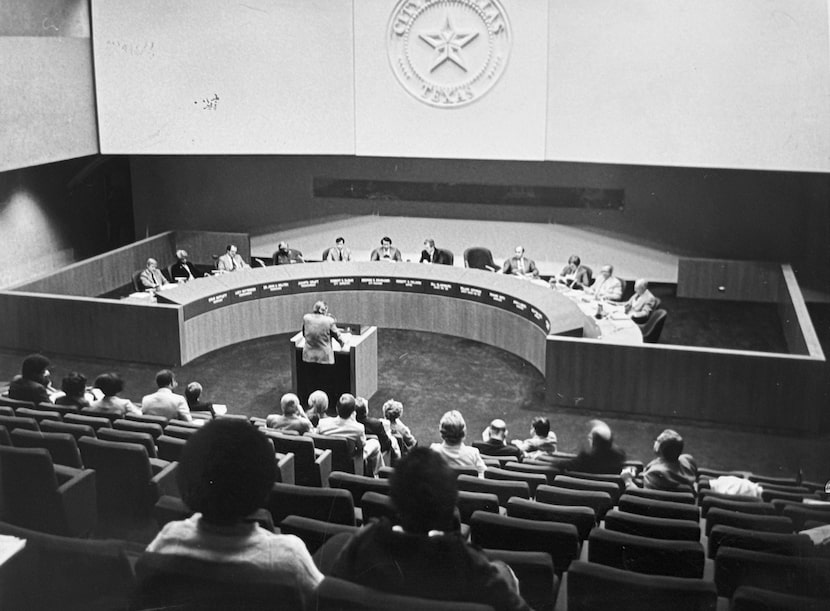
The Dallas City Council chambers inside I.M. Pei’s City Hall, as seen shortly after the building opened in March 1978
1978 File Photo / Staff
The first time began in 1969, when he was a student at North Texas State University in Denton, studying sculpture, and hired as part of a two-men crew tasked with maintaining the City Hall built in 1912 on Harwood Street. For 18 months, he and a painter spent eight hours a day rehanging, retouching and repairing just about everything in that old Beaux Arts building topped by the city jail. Their small shop was tucked below City Hall in the parking garage next to where Jack Ruby shot Lee Harvey Oswald.
The second time Voss went to work for the city was in 1972, when he was tasked with taking care of some 50 city-owned buildings in northwest Dallas. That meant getting in a truck every morning to make repairs at rec centers, fire and police stations, pump stations. He left to build race cars with some friends because Voss was good at that, too. But after six months of not being able to afford groceries, he went back to the city.
The third time Voss went to work for Dallas was in April 1975, when, again, he was given a toolbelt and told to fix things. In June 1977, he was given Dallas City Hall. In February 2026, he refuses to let it go.
“That’s why they’ve got to keep it: They’ll never do it again,” he said before we stood up from the table. “There will never be another Erik Jonsson with his council and the business leadership to support him in getting that done. They changed the course of Dallas, the way Dallas was perceived. That was their legacy. This council has an opportunity to produce their own legacy by saving it. And that’s a pretty damned good legacy. That’s what I think.”