
Decked out in hot pink sweats and a fluffy gray jacket, Preston Salomon hopped, stomped and twirled in near lockstep with 40 other dancers as “This Is For” by K-pop girl group Twice burst from a nearby loudspeaker.
Outside American Airlines Center on Jan. 31, Salomon and his fellow fans put on a random play dance — a challenge in which they quickly matched the choreography of a rapidfire series of songs — before doors opened for Twice’s first of two concerts in Dallas. The band is currently traversing North America for their fourth world tour, also titled “This is for.”
“It’s a big trend now,” Salomon said of K-pop acts coming to the United States. “Big groups like BTS, Twice, Stray Kids that are more catering to America — other groups are going to follow that because it is very easy to, especially now.”
In recent years, K-pop has exploded into the U.S. cultural mainstream. Last summer, the animated movie “K-pop Demon Hunters” became the most watched Netflix movie of all time. Concerts and fan events have established a presence across dozens of metro areas. Boy band BTS’s 2026 comeback features concert stops in 12 North American cities, including two August shows in Arlington.
News Roundups
Related
K-pop’s presence in North Texas has grown with the nationwide wave, according to event records from TicketData, a website that tracks prices for concerts and other entertainment events.
From 2023 to 2025, the annual number of K-pop events scheduled in the Dallas-Fort Worth area increased from 33 to 36. Within that breakdown, groups have increasingly played on larger stages. In 2023, TicketData stats showed two events scheduled for venues that hold more than 15,000 people. In 2025, there were six.
Salomon, who hopes to become a professional dancer and perform with artists including K-pop bands, said he’s excited about the popularity growth of K-pop in D-FW. He attended Twice’s second Dallas concert on Feb. 1 — his first time seeing the group in person since starting to follow their music in 2020.
“Being able to enjoy the music and seeing the K-pop idols is very inspiring to me,” he said. “Because it feels like that’s what I want to do in the future.”
A diverse market
In addition to D-FW’s extensive transportation options, the market’s penchant for diverse genres and artists has made it Texas’ K-pop mainstay, fans and experts alike said.
“What we’ve seen just over the past five years: the excitement, the number of people that are interested in K-pop, the diversity of it — it’s become its own culture,” said David Ireland, vice president of marketing & events at American Airlines Center. “And that’s really cool to see.”
K-pop artists flock to D-FW over other parts of Texas. Between 2023 and 2025, there were more than 100 K-pop events in the D-FW metro area — exceeding the number in Houston and San Antonio combined, according to TicketData.
From a market perspective, K-pop’s ability to draw fans from a wide geographic range gives it an advantage in popularity growth in D-FW, Ireland said, adding that traveling concertgoers booking hotels and eating at local restaurants is always “a part of the thought process” when coordinating which artists will perform when.
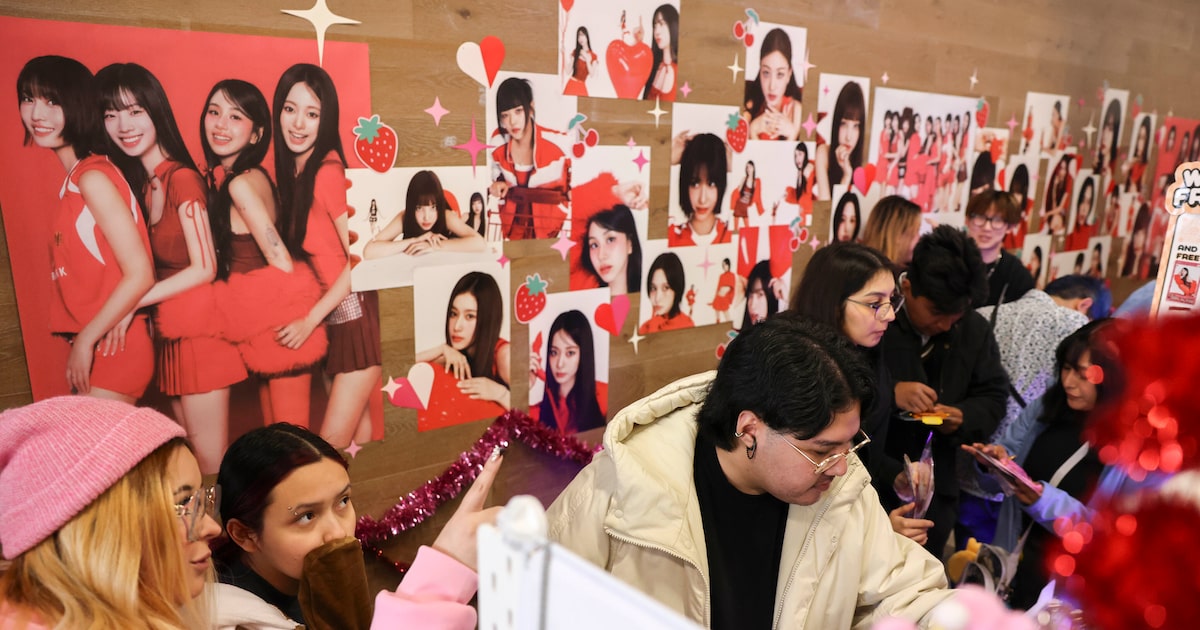
Longtime K-pop fan Staci Ellis drove up from Houston the Friday before Twice’s Dallas concerts. She organized two “cupsleeve” events, K-pop fan-gatherings so named for drink cupsleeves customized to artists or concerts, at Feng Cha Lower Greenville before each show.
Collectibles, including albums, photocards and lightsticks, are a big part of K-pop culture, Ellis said. But official merchandise is expensive and not always the most aesthetic, so cupsleeves are a good opportunity for fans to purchase and exchange their own creations. Otherwise, they create a space outside of concerts for fans to meet each other and build community, she said, uniting people across sub-genres and artist groups.
“There’s something for everyone,” Ellis said.
During the weekend of Twice’s Dallas concert, there were at least half a dozen other fan events scattered throughout D-FW. Ellis said many of these meetups are for fans who can’t actually attend a particular show to still feel included in the concert experience.
Although Twice will be back in Texas in April for a show at Austin’s Moody Arena, Houstonite Earl Ragasa still came to the January show.
In addition to hearing that Dallas’ venues are “nicer” than other places in Texas, Ragasa said he knew more people in D-FW with whom he could attend the concert.
“I think it’s bigger in Dallas,” Ragasa said of K-pop culture compared to other parts of the state. He attended Twice’s Jan. 31 concert with about five other friends.
Conquering the frontier
K-pop’s success across U.S. markets is a driving factor behind its boom in D-FW, said UT Austin Professor Youjeong Oh, who studies Korean pop culture.
For years before “K-pop Demon Hunters’” success last summer, songs by BTS and girl-group Blackpink have been climbing their way into the Billboard charts. On Twice’s part, members Jihyo, Jeongyeon and Chaeyoung produced the song “Takedown” for “K-pop Demon Hunters.” The group first entered the “Billboard Hot 100” in October 2021 with their single “The Feels” — a disco bop about love at first sight.
Related

High schooler Rheeden Fuentes remembers enjoying “The Feels.” Last summer, he rediscovered K-pop after watching “K-pop Demon Hunters,” he said. Twice once again became one of his favorite groups.
“It’s happy music,” he said. “Listening to them just puts you in a better mood no matter what you’re feeling.”
“The Feels” is sung entirely in English — representing what Oh described as growing westernization in K-pop.
Recent songs in K-pop increasingly experiment with global styles and genres, especially from the United States. Twice member Jeongyeon’s solo song “Fix a Drink,” which she performed in a cowgirl hat and boots at American Airlines Center, draws on country music with acoustic guitar and fiddle.
More and more, Korean labels recruit songwriters, choreographers and music producers from abroad — a “very, very globalized process,” Oh said. The domestic market for K-pop in Korea is limited, especially compared to the relatively untapped potential of the United States, and companies want to harness talent and audiences beyond their borders.
“It’s like a frontier,” she said. “They have not conquered and fully saturated the market. Here in the U.S. … they have strong infrastructure in performing concerts, right? So K-pop agencies are trying to emulate and follow that concert-oriented profit-making system.”
Still, companies have to carefully walk a “two-tiered” path to make sure they don’t alienate Korean fans while growing their foreign audience, Oh said.
Retired office manager Sherri Heinzman attended Twice’s January concert with her daughter. Though some in the nine-member band were suffering injuries and illnesses, they “did a very good job,” she said outside American Airlines Center.
Heinzman only started getting into Twice at the beginning of 2026, but the 63-year-old has been following K-pop since 2013. She’s a fan of big-name bands like Blackpink and Seventeen, but also newer groups like The Rose, a Korean indie rock band, and Big Ocean, a K-pop group formed entirely of members who are deaf or hard of hearing. She predicts and hopes the K-pop wave will continue to grow in the U.S. and North Texas.
“I’d like to see more of them at home here,” Heinzman said.