
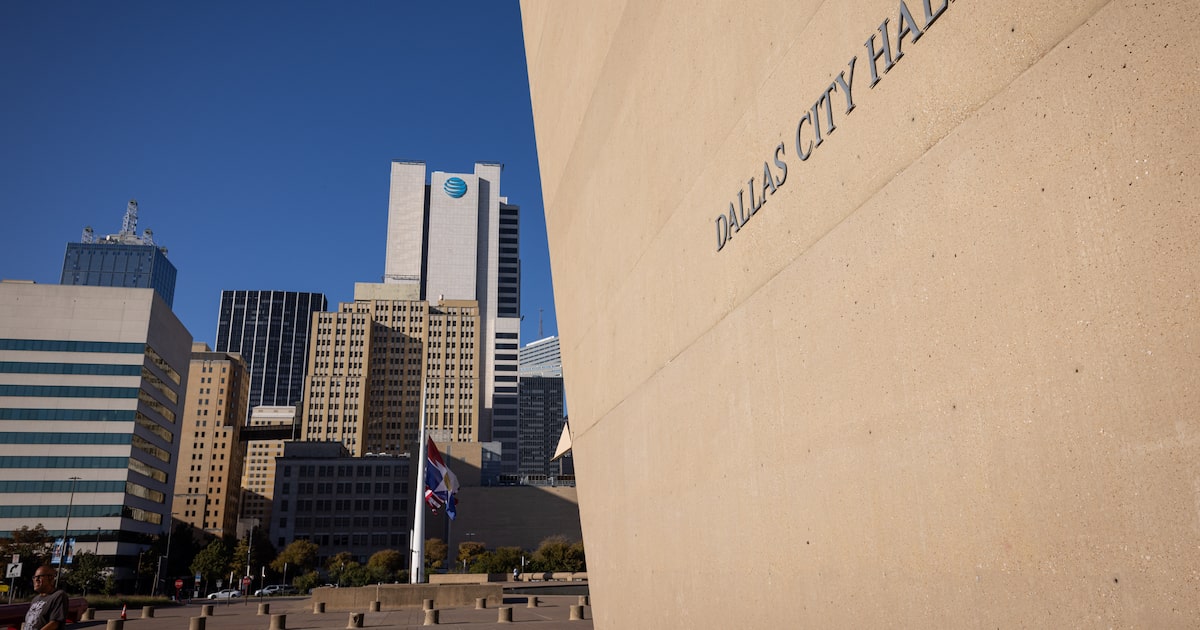
Dallas will soon see the results of an extensive review of the City Hall building, a step that could change downtown Dallas and the city government for years to come.
Public discussions about the building’s condition began late October, and have centered around a central question: Is the iconic structure beyond saving?
More than 68 engineers, city employees and technicians inspected the nooks and crannies of the Brutalist building over the course of a month to help determine whether the city is better off preserving and repairing the structure or relocating to another office tower.
City leaders roped in the Economic Development Corp. for an independent evaluation last December after residents and public officials said they were caught off guard by the alarming scale of repair costs, up to $345 million, given by the city last fall.
Political Points
EDC’s findings carry enormous weight. Longtime collaborators, whether its developers and architects or city employees in neighboring cubicles, have found themselves on opposing sides of the issue.
The nonprofit’s CEO Linda McMahon said last week the report will distill thousands of pages of research into a summary that will come out as soon as Friday. Many council members are expected to attend Monday’s Finance Committee meeting where they will get a first taste of the study’s findings.
What’s happened so far
Mayor Eric Johnson set things in motion last year when his committee assignments came attached with a mission statement: The Finance Committee needed to determine whether City Hall supports city operations and serves resident interests.
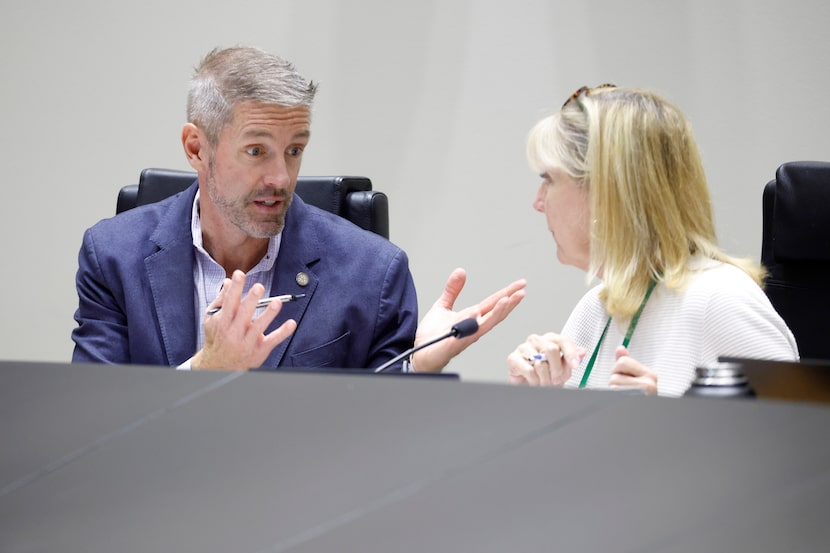
Dallas City Council’s Finance Committee Chair Chad West (left) visits with Vice Chair Kathy Stewart during a discussions about the future of Dallas City Hall, November 4, 2025. A majority of the seven-member committee last month expressed interest in the city exploring options for relocating city government operations elsewhere and considering leasing, selling or demolishing the current City Hall as deferred maintenance estimates have grown to north of $300 million.
Tom Fox / Staff Photographer
The committee had its first meeting on Oct. 21. City officials said replacing the roof, fixing the HVAC system and waterproofing could cost the city anywhere between $150 million for specific repairs to $345 million to fully replace infrastructure.
Soon after, city officials said the cost of operating the building over 10 years could reach nearly $600 million.
Council members appeared split. Some questioned the numbers and the unusual pace of the discussion. Others were open to relocating and wanted better data they could rely on to make their decision.
Three weeks later, the City Council approved a resolution to formally explore alternatives to the City Hall building and its maintenance needs by February. The EDC was brought on deck in December, and the evaluation kicked off.
Who are the key players
Civic leaders, developers, residents and preservationists have been vocal about the building’s fate from the get-go. But the decision ultimately lies with the City Council.
Backers of a relocation, including former mayors such as Ron Kirk and Tom Leppert, and developer Ray Washburne, said the opportunity presents a rare chance to redevelop a large, city-owned site and breathe life into the southern half of downtown.
The city’s repair costs, they said, could easily top $400 million and become a burden on taxpayers because of maintenance backlogs. Dozens of downtown developers and civic leaders wrote a letter to the City Council, advocating for a relocation. Among them were developers including Mike Hoque, Mike Ablon and Lucy Billingsley, as well as former Mavs CEO Cynt Marshall.
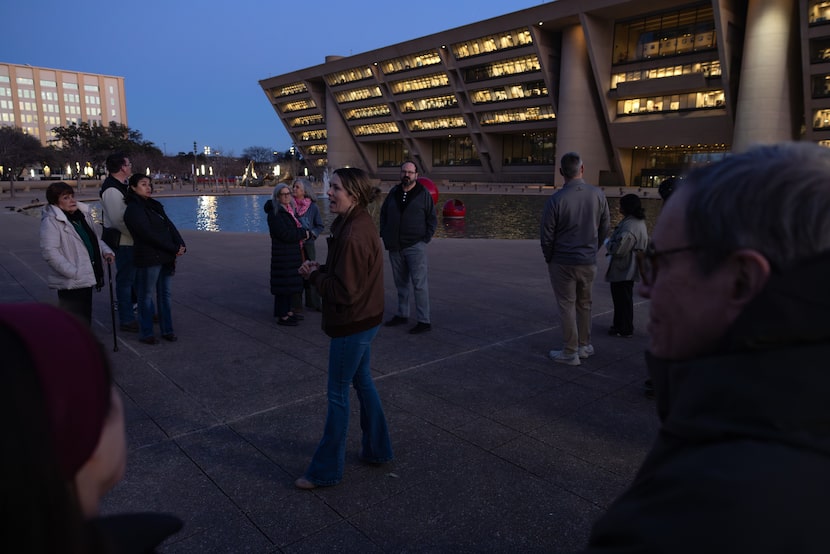
Sarah Crain, executive director of Preservation Dallas, speaks to attendees at a tour of Dallas City Hall Feb. 4, 2026 in Dallas. The tour was guided by Marcus Wilson, the city’s chief planner at the Office of Historic Preservation, and explained the design and significance behind the historic building.
Azul Sordo / Staff Photographer
On the other side are preservationists and members of the public who are leading a campaign called Save City Hall. Preservation Dallas and landmark commissioners are conducting tours to highlight the building’s architectural history and its purpose as the seat of government.
Ten past presidents at various levels of the American Institute of Architects have emerged as leading voices against tearing down City Hall. So far they have released three position papers, arguing major downtown redevelopment shouldn’t come at the expense of the building.
Opponents to relocation also questioned if the EDC had enough time to develop the report since rigorous reviews require at least a year.
What to expect
The first piece of EDC’s research involves updating a 2018 assessment of City Hall’s condition. Engineers and experts from AECOM, an infrastructure consulting firm, will update their previous report to offer sharper repair costs and dispel uncertainty around staff estimates.
The city’s recent projections eclipsed those in the 2018 report, which put costs between $19 million and about $93 million.
Previous city administrations chose not to fund repairs in consecutive bond programs. The upcoming report is likely to spotlight the magnitude of that choice.
Preservation experts said maintenance needs are probably $34 million to $36 million. They argued that the city’s estimates lump routine repairs together with full replacements and elective upgrades.
The second piece of EDC’s research involves comparing relocation costs. To get to that information, the nonprofit banded with Downtown Dallas Inc. and CBRE, a commercial real estate firm, to survey office space available for lease or purchase.
The upcoming report is likely to flesh out costs related to the base rent, moving and capital improvements.
A call for proposals went out in December to several property owners, including Washburne, who has supported relocating City Hall and pitched his own property at Founders Square as an alternative.
In other presentations, officials have included buildings such as the Comerica Tower and the Bank of America building as options.
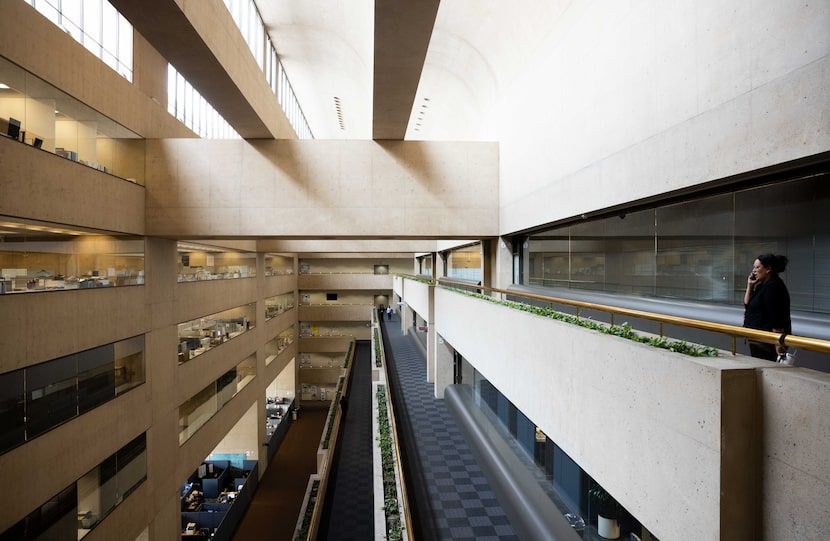
The Dallas City Hall atrium, known as the Great Court, spans 250 feet with a skylit, barrel-vaulted ceiling 100 feet above, photographed on Wednesday, Feb. 4, 2026, in Dallas.
Juan Figueroa / Staff Photographer
A spatial analysis report by Corgan, an architecture and design firm, showed the city was also open to divvying up departments and housing them in different buildings. City officials have said they could move emergency operations and service call centers out of the basement and into a new building outside downtown.
What’s next
The City Council’s Finance Committee will be briefed on the findings Monday and could make recommendations for the 15-member body to consider. It is unclear when a final decision would come.
Each choice comes with budget implications. Targeted repairs could be added to the upcoming budget if the City Council decides to keep the building. If not, a timeline laid out for relocation shows the city could begin relocating in the latter half of this year and complete the move by first quarter 2027.