
WASHINGTON — As Democratic lawmakers turn up the heat on federal agencies over the abrupt closure of El Paso’s airspace, experts and former officials are warning that the apparent breakdown in interagency communication could be a window into the future.
In the early hours of Feb. 11, local and federal officials were surprised to learn the FAA imposed a 10-day flight restriction over El Paso International Airport and elsewhere near the border with Mexico, a move that was reversed hours later. Reporting has since pointed to the use of an anti-drone laser, on loan from the Army, by Customs and Border Patrol officers as the cause for concern. Federal officials initially alleged the action was due to a “cartel drone incursion,” but reportedly may have just been party balloons.
In a Wednesday letter authored by Reps. Rick Larsen, Bennie Thompson and Adam Smith — the top Democrats on the House Transportation, Homeland Security and Armed Services committees — the lawmakers demand a classified briefing from the relevant agencies, noting “conflicting reports” about the airspace closure by the Federal Aviation Administration.
“Even more concerning, we understand that the Department of Homeland Security and Department of Defense deployed this complex C-UAS [counter-unmanned aerial systems] technology without required coordination with the FAA,” the letter says, which is addressed to Defense Secretary Pete Hegseth, Homeland Security Secretary Kristi Noem and Transportation Secretary Sean Duffy. “This lack of coordination and transparency with Congress on C-UAS missions introduces unnecessary and dangerous risk into U.S. airspace.”
But analysts say the potent mix of new regulations for countering drone threats and emerging technologies available for that mission means the El Paso incident could be more than just a one-off event.
“I think coordination has been lacking, and you’re seeing a lot more sort of cowboy behavior, which could be problematic,” Stacie Pettyjohn, a senior fellow and director of the defense program at the Center for a New American Security, said in an interview with Breaking Defense.
Unpacking The New Authority
The El Paso incident comes just as the Pentagon is starting to wield new counter-drone authorities on US soil.
After a series of mysterious drone incursions over Langley Air Force Base in 2023, Pentagon officials repeatedly emphasized that the law restricted their ability to act, leaving them powerless against subsequent unmanned flights over sensitive DoD installations.
In response, US Northern Command started refining the process that governs counter-drone activity, as well as finding equipment appropriate for use in civilian airspace. Under Commander Gen. Gregory Guillot, NORTHCOM stepped up as an interagency “synchronizer,” while also experimenting with tech to detect and defeat drones — think net capture and drone-on-drone ramming, rather than traditional anti-air weapons.
RELATED: With daily drone incursions over bases, NORTHCOM takes aim through Falcon Peak
In 2025, the Trump administration took its own stab at the problem by creating a new interagency taskforce to address the small drone threat, defined as Group 1 through 3 systems. Run out of the Pentagon, the task force dubbed JIATF-401 is now the lead for countering small drones in American airspace.
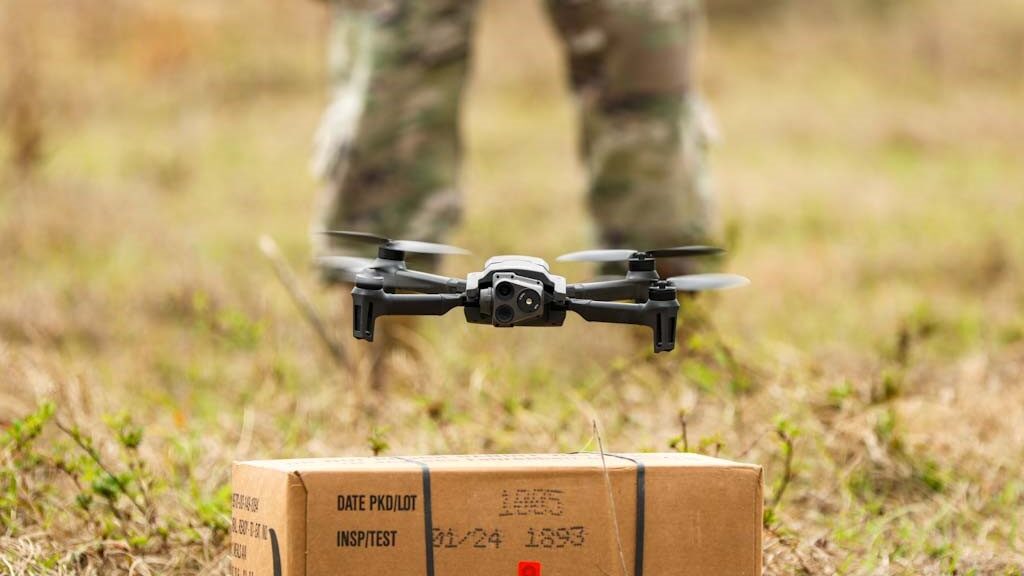 Sgt. 1st Class Alfred Little, assigned to 188th Infantry Brigade, mans the Parrot ANAFI USA Small Unmanned Aircraft System (sUAS) during field training on Fort Stewart, Georgia, March 20, 2025. (DVIDS)
Then in December, Congress aimed to combat the growing drone issue with the Safer Skies Act, passed as part of the larger 2026 National Defense Authorization Act. The law aimed to equip state and local officials with new counter drone tools and authorities, a pressing need ahead of events like the 2026 FIFA World Cup. And according to JIATF-401 Director Brig. Gen. Matt Ross, the NDAA also expanded authorities under what’s known as Section 130i, which outlines where and how DoD can conduct counter-drone operations on US soil.
Following the legislation and new guidance from Hegseth, top military service officials are now empowered to pick facilities that can be covered under Sec. 130i, meaning the number of installations on US soil that can be defended with counter-drone tech is poised to rise. (The Department of Homeland Security and Department of Justice conduct counter-drone activities under a different set of authorities known as Section 124n.)
“That could create a challenge, because we’re going to have more locations covered under 130i,” Ross said in a scrum with reporters in January, noting that the military services can pick what facilities they considered covered under Sec. 130i independent of the FAA. “We’re going to help with that.”
The Air Force declined to comment on how many facilities will now be considered covered under the law. An Army spokesperson confirmed the NDAA expanded criteria for installations considered eligible under Sec. 130i but declined to provide specifics. The Navy deferred comment to the Pentagon, which did not respond to Breaking Defense’s request for comment.
Is El Paso A ‘Potential Harbinger Of Things To Come’?
Federal legislation requires mitigating any risks to civilian air travel by coordinating counter-drone activity with the FAA, a step that Ross said would be a key part in any installation’s plan to defend itself.
“[W]hen I say installation X is covered under 130i, now that installation commander has to figure out what their plan is to defend it, and then they coordinate with the FAA, and they say, ‘Hey, I plan to use a combination of active and passive sensing. I want to use this electromagnetic defeat mechanism. I’m going to make sure that doesn’t interfere with any airports around here,” Ross said.
But following the events in El Paso, experts who spoke with Breaking Defense raised concerns about proper interagency coordination.
Calling the El Paso incident a “potential harbinger of incidents to come,” Pettyjohn highlighted the push to loosen drone restrictions as part of the Pentagon’s Drone Dominance initiative, which could result in more drones flying near military installations — a problem already likely to grow on its own due to the burgeoning commercial drone industry.
“So there are going to be more drones flying all over, and at the same time, there has been this pushing down of authorities to defend against potential drone threats,” she said, referring to the recent expansion of the Pentagon’s counter-drone authorities under Sec. 130i. “It does give me concern in implementation.”
Though the Sec. 130i authorities “aren’t particularly new,” Clayton Swope, deputy director of the Aerospace Security Project at the Center for Strategic and International Studies, noted that “you definitely will see DoD wanting to exercise those a lot more,” particularly under the “perception that this threat [of drones] is increasing.
“If you’re wanting the ability to have that much of a long leash to use those technologies when you need to use them — which is what we should be striving for, because you can’t predict when those threats would materialize — there has to be a lot of trust that what you say you’re going to do is what you do and how you use it matches what both sides of this relationship expect,” he added. “And that may not be there.”
Houston Cantwell, a retired Air Force one-star and senior resident fellow for airpower studies at the Mitchell Institute, noted that the complexity of the problem revealed by the closure of the El Paso airspace is far from being resolved and will require a whole-of-government effort to address.
“I think this is just the tip of the iceberg. This is not easy. We have not had to deal with these types of complex issues when it comes to homeland defense since 9/11,” Cantwell said. “This one instance showed that we’ve got a lot of work ahead of us.
“We’ve got to continue to have exercises,” he continued. “These organizations that have typically not had a lot of touch points when it comes to tactical level operations, have got to start having those, or we’re going to have more incidents like we saw down in El Paso.”
Nevertheless, Pettyjohn, Cantwell and others who spoke with Breaking Defense emphasized that the expansion of Section 130i was critical for enabling the Pentagon to fend off unmanned incursions, especially in light of events like Ukraine’s Operation Spider Web that used cheap drones to destroy Russian strategic aircraft on the ground.
“I think the law is fine,” one former DoD official told Breaking Defense. “It requires coordination that should have happened and apparently didn’t happen in this case,” the person added, referring to the events in El Paso.
Asked whether commanders may feel more pressure to act against potential drone threats as a result of the new 130i authorities, Cantwell, who was formerly the installation commander at Holloman Air Force Base, said he was skeptical the legal and policy changes would alter their thinking.
“I’m not certain they’re going to feel any more pressure today than they did yesterday,” Cantwell said. “I think every installation commander is doing the best they can to balance risk to their risk to their force against collateral damage.”
‘They Should Be Talking To One Another’
Despite the push by Democratic leaders to get more information, lawmakers aren’t asking for a legislative fix to the problem — at least not yet. Instead, the early focus has been on coordinating, and making sure that stakeholders are in communication.
“They should be talking to one another on a regular basis, and it’s going to be different in different parts of the country. You’re not always going to have a major military installation like we do [in] El Paso next to the airport there, but that said they have existing mechanisms. They just have to use them,” Sen. Tammy Duckworth, a member of the Senate Armed Services Committee who also serves as the top Democrat on the Senate Commerce, Science and Transportation Committee’s aviation subcommittee, told reporters Feb. 13.
“We could do something legislatively, but I’d rather that they just started talking to each other, which they can do,” she added.
A spokesperson for New York Democratic Sen. Kirsten Gillibrand — who sponsored legislation known as the COUNTER Act that proposed to expand counter-drone authorities similar to what was passed as part of the NDAA — said the senator had faith the Pentagon would act responsibly to protect civilian travel in light of the changes to Sec. 130i.
“DOD and the FAA have significantly improved their coordination in recent years, and Senator Gillibrand believes that as 130i protections are extended to additional installations, DOD will continue to follow legal and policy coordination requirements to ensure service members are able to protect sensitive installations without creating undue risk to the public,” the spokesperson said in a statement to Breaking Defense.
Still, Cantwell noted the El Paso incident highlights a larger “policy conundrum”: sorting out a concrete plan for the protection of domestic critical infrastructure like power grids and dams, which the military is largely not responsible for.
“There is so much non-military critical infrastructure out there,” Cantwell said. “Who’s defending that?”
— Carley Welch contributed reporting.