
If there’s one thing 20th-century art taught us, it’s this: Art is anything we decide to call art. Anything.
It was a credo for Robert Rauschenberg, one of the most protean and prolific American artists from the middle of the 20th century until his death in 2008. From assemblages of bits of junk to silk-screened collages of newspaper and magazine images, his creations force us to see our surroundings in new ways — to take pleasure in materials, to see aesthetic subtleties, even beauty, in surprising places.
Such, marking the centenary of the artist’s birth, is the message of “Rauschenberg Sculpture” on display at the Nasher Sculpture Center. Organized by senior curator Catherine Craft, the exhibition consists of two dozen works created between 1950 and 1995. Along with the Dallas Museum of Art, the Nasher also is presenting a joint exhibition of works in various media by Rauschenberg’s contemporary Roy Lichtenstein.
The variety and freshness of Rauschenberg’s works at the Nasher provide a veritable garden of delights — admittedly quirky ones at times.
News Roundups
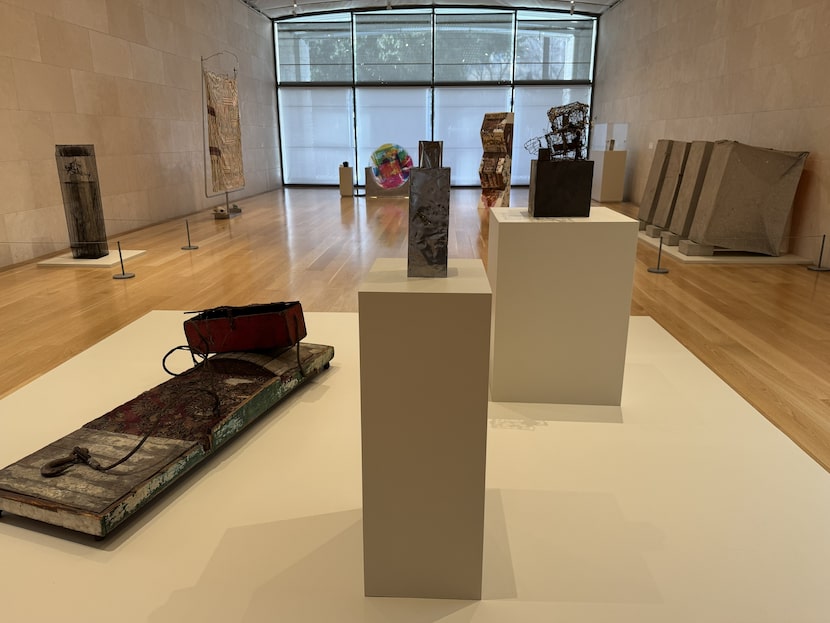
“Rauschenberg Sculpture,” gallery view at Nasher Sculpture Center.
Scott Cantrell
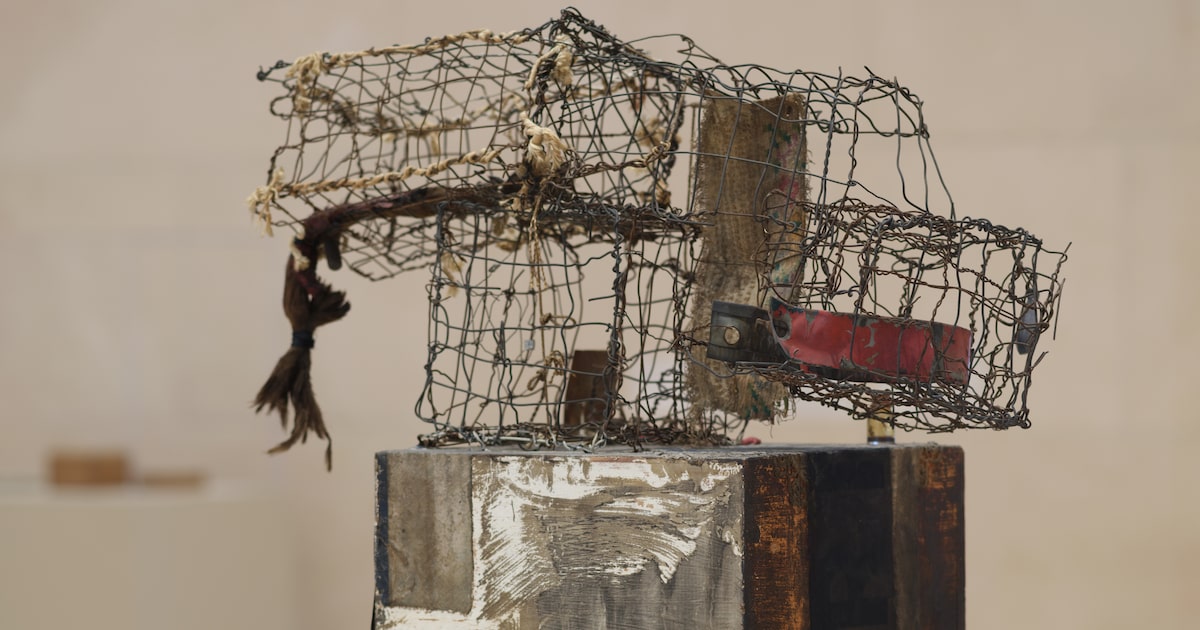
I keep coming back to Three Traps for Medea, a concatenation of cage-like wire structures, with strips and twists of fabric, atop a rugged, industrial-looking box. What does it “mean”? What does the title mean, except suggesting traps for small animals? For all their inclusion of recognizable objects, Rauschenberg’s creations are often titled as inscrutably as works by surrealists and abstract expressionists.
It doesn’t matter. What matters is the strange beauty of the thing — the overall geometries, the balances of shapes, the lines and twists of the wires, the cryptic dialogue with fabrics.
Four tilted, stone-like boxes, Untitled (Early Egyptian), suggest architectural buttresses or plinths, perhaps with some long-lost religious association. But the boxes are actually of cardboard, covered in sand and acrylic.
Petrified Relic from the Gyro Clinic (Kabal American Zephyr) sets a metal wheel above an old typing table, with a crumpled, corroded metal duct penetrating beneath.
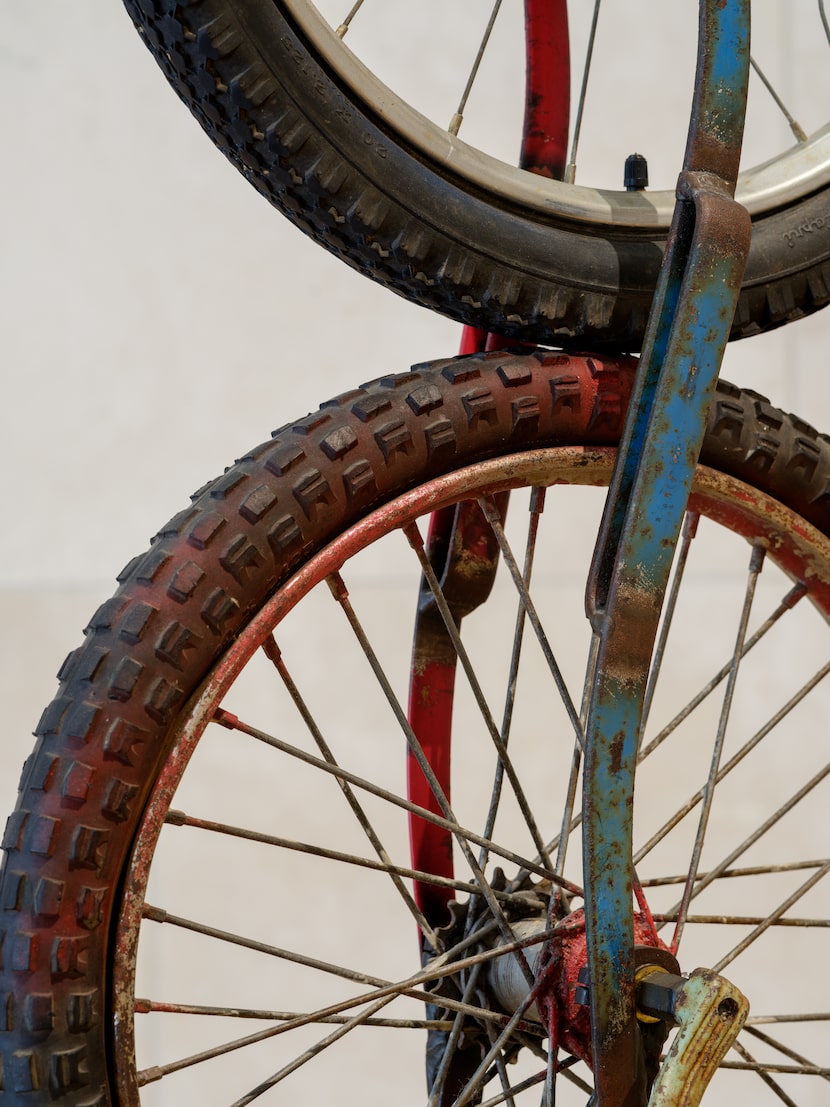
Installation view of Robert Rauschenberg, “Untitled (Late Kabal American Zephyr)” (detail), 1985. Rubber cycle wheels on metal structure with hand crank. 73 1/2 x 23 5/8 x 16 1/4 inches (186.8 x 60 x 41.3 cm). © Robert Rauschenberg Foundation, courtesy of the Robert Rauschenberg Foundation.
Kevin Todora
Rauschenberg’s approach was not without precursors. The elevation of ordinary objects to the status of “art” can be traced back to Marcel Duchamp’s 1917 urinal titled Fountain and signed R. Mutt. Kurt Schwitters was a pioneer in collage, which was also a factor in cubism. Disorienting juxtapositions were a signature of surrealism.
As a boy growing up in Port Arthur, Texas, an oil refinery town of sulfurous air, Rauschenberg often wore clothes his mother had patched together from assorted fabric scraps. Seeing art for the first time during a military posting in San Diego, he resolved to become an artist himself.
He studied at the Kansas City Art Institute, the Académie Julian in Paris and Black Mountain College in North Carolina. One of his teachers at Black Mountain was the stern modernist Josef Albers, but it was also there that Rauschenberg met the avant-garde composer John Cage and the choreographer Merce Cunningham.
Both exploring the integration of daily life into art, Cage and Cunningham were to become long-standing friends — and collaborators on numerous projects. Rauschenberg even tried his own hand at choreography. (The Verdigris Ensemble choral group performed Cage’s Hymns and Variations in connection with the Rauschenberg show’s opening.)
Abstract expressionism — art of nonrepresentational color, gesture and texture — had become the hot new thing in the 1940s and ’50s. In the later years of its primacy, though, the world was ripe for a new art about things, and recognizable images. Rauschenberg was a man for the hour, along with Jasper Johns, in a progression culminating in Andy Warhol’s Campbell’s Soup cans and Brillo boxes.
Rauschenberg coined the term “combines” for his works mixing found objects and paint. The most famous are Monogram, with a taxidermied, tire-encircled Angora goat atop a painted panel, and Bed, a quilt roughly slathered with paint.
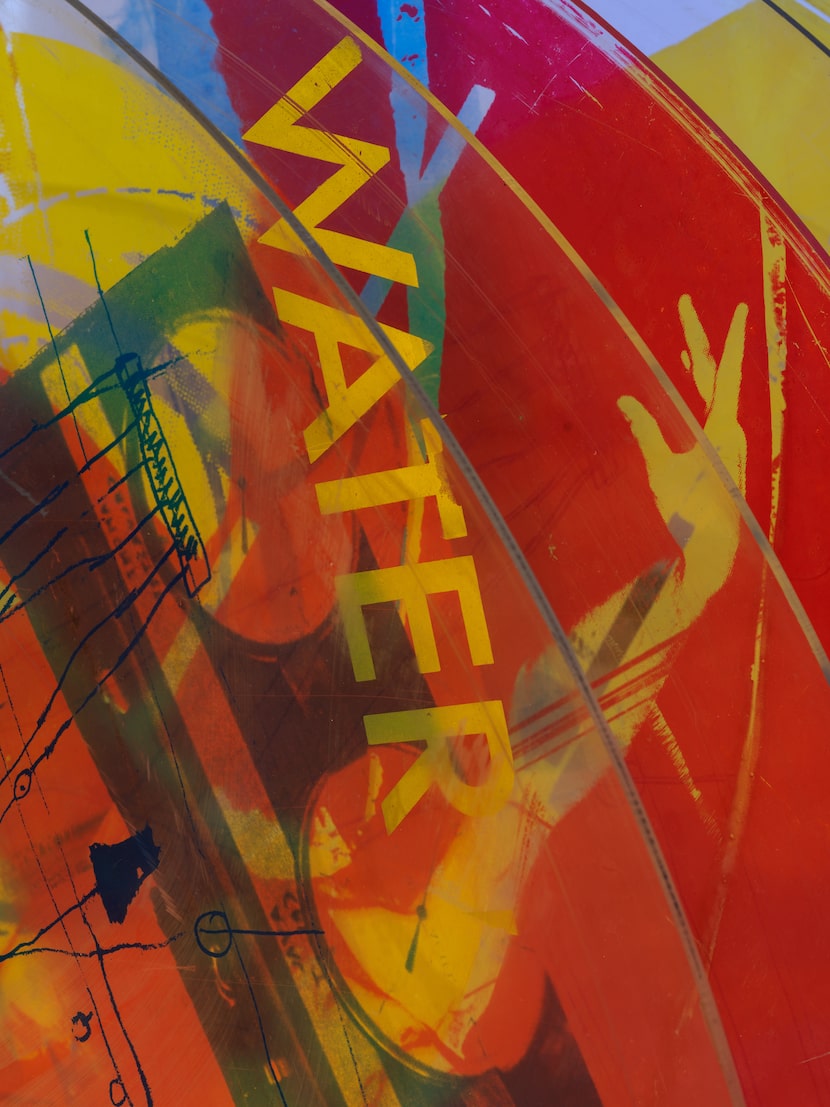
Installation view of Robert Rauschenberg, “Revolver V” (detail), 1967. Silkscreen ink on five rotating plexiglass discs in metal base with electric motors and control box. 54 x 52 3/4 x 24 1/4 inches (137.2 x 134 x 61.6 cm). © Robert Rauschenberg Foundation, courtesy of the Robert Rauschenberg Foundation.
Kevin Todora
Works at the Nasher are more purely sculptural, although several incorporate collages of transferred imagery. Revolver V comprises five plexiglass discs with silk-screened images and an adjacent control box activating motors to spin the discs. An interest in technology is further demonstrated in Dry Cell, which incorporates a piece of metal that can revolve in response to sound.
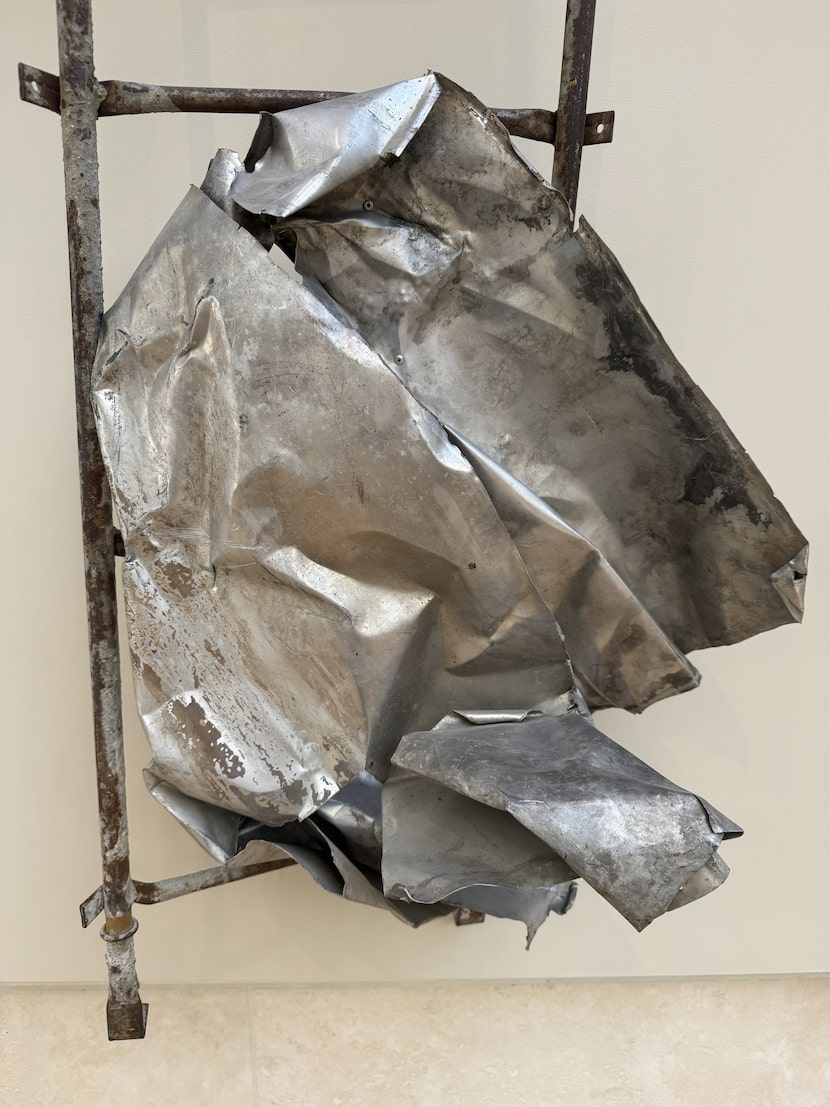
Robert Rauschenberg, “Balcone Glut (Neopolitan),” 1987 (detail) at Nasher Sculpture Center. © Robert Rauschenberg Foundation, courtesy of the Robert Rauschenberg Foundation.
Scott Cantrell
The very textures of works at the Nasher give pleasure. The crumpled metal panel at the bottom of Balcone Glut is as beautiful in its way as a Greek statue. So is an untitled stack of rugged bricks with a chunk of concrete suspended from a metal curlicue.
Just as Rauschenberg had precursors, he had fellow travelers and kindred spirits. The Nasher includes one of John Chamberlain’s sculptures assembled from twisted metal parts, and a motorized Jean Tinguely contraption of miscellaneous rusty metal bits.
Smaller works of Mark di Suvero shown in a 2023 Nasher exhibition would fit right in, too. It’s a pity that companions don’t include one of the late Texas artist James Magee’s powerful assemblages of corroded steel and shattered glass.
Details
“Rauschenberg Sculpture” is on view through April 26 at Nasher Sculpture Center, 2001 Flora St. Open Wednesday through Sunday, 11 a.m. to 5 p.m. $10; discounts for students, educators, seniors, others. 214-242-5100, nashersculpturecenter.org.
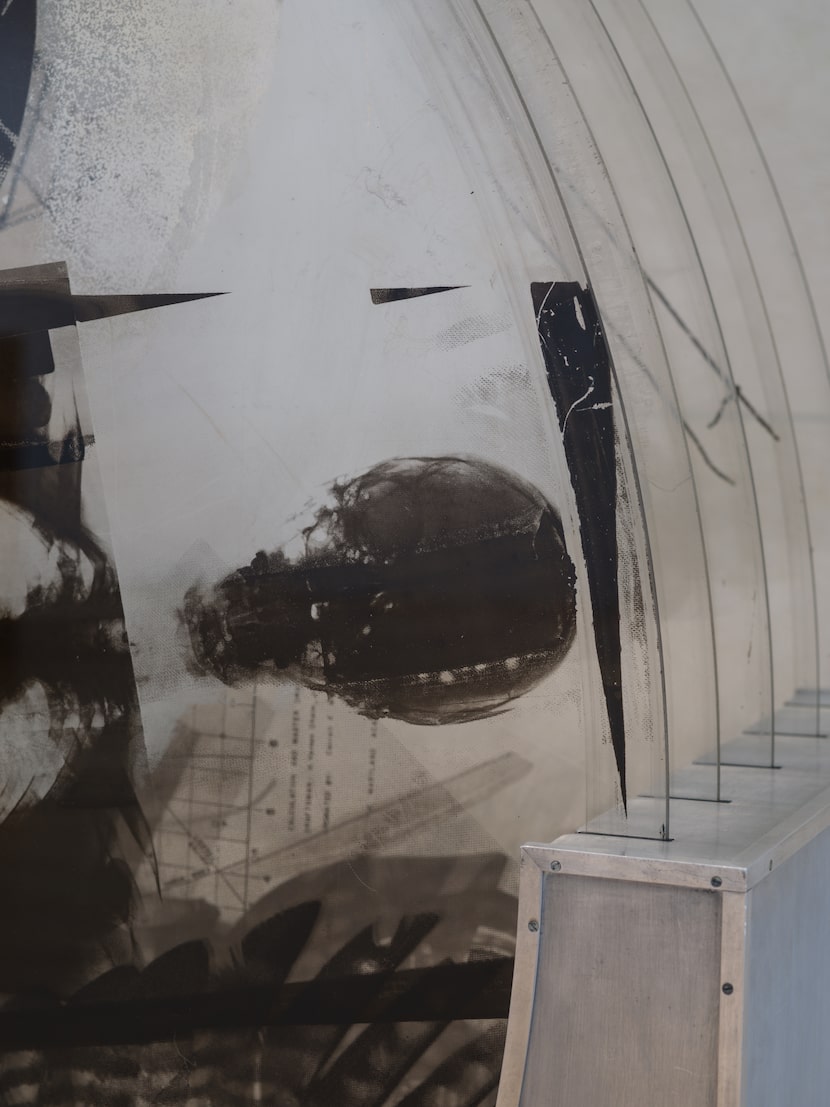
Installation view of Robert Rauschenberg, “Revolver VI” (detail), 1967. Silkscreen ink on five rotating plexiglass discs in metal base with electric motors and control box. 78 x 77 x 24 1/2 inches (198.1 x 195.6 x 62.2 cm). © Robert Rauschenberg Foundation, courtesy of the Robert Rauschenberg Foundation.
Kevin Todora