
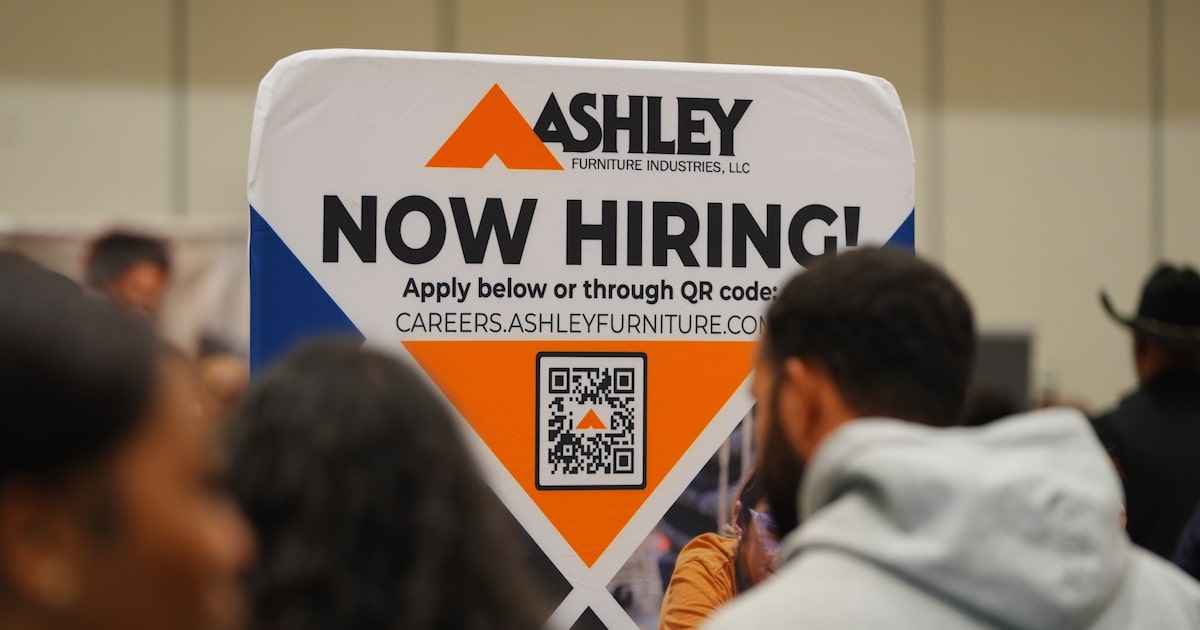
Roughly half of Dallas employers plan to hire new permanent staff within the first half of this year, according to new data.
Robert Half, a California-based hiring and business consulting company, found that nearly 80% of Dallas employers said they’re confident about their businesses’ outlook.
The results point to an optimistic local hiring market, said Jason Parma, a Dallas-based director at the firm.
Related

“It’s great,” Parma said. “I think that speaks to just an employer market [where] maybe their concerns over economic downturn have eased as inflation cools. It speaks to some pent up demand that employers have for hiring the right skill sets to their teams.”
Business Briefing
The near-term hiring plans figure, which came from the firm’s surveying of 124 local employers, also represented a significant recent uptick.
According to the firm, just over half of the local employers said they planned to hire more workers early this year than they hired in the second half of 2025, and only 10% said they planned to hire fewer.
The Dallas employers also indicated they planned to hire more temporary workers in the near-term, with 42% responding that they planned to hire more short-term employees, and only 8% responding that they planned to reduce short-term employees.
The local results, which came as part of Robert Half’s more comprehensive State of U.S. Hiring report, are directionally in line with recent statewide projections.
After Texas last year added virtually no jobs — a notable downward shift for a state that’s become famous for rapid employment growth — this year the state will again add jobs, the Dallas Fed recently forecast, although at a rate that’s slower than what the state has become accustomed to.
“It’s not back to trend growth,” Pia Orrenius, a senior economist at the Dallas Fed, said during a presentation at the bank earlier in February.
The state has historically added jobs at an annual rate of around 2% — a pace that may not currently be possible, Orrenius said. That is because of labor supply concerns largely stemming from the federal government’s restrictive immigration policies.
“So I think 1% is a good goal, and that’s still a pretty good outlook for this year,” she said.
In North Texas — a region that’s of course lately become famous as a burgeoning financial hub — the health care industry has lately been adding jobs at a particularly fast clip. The construction industry has also been hot, thanks in part to a data center boom, and roles like data scientist are also in demand.
But while the Robert Half survey showed an optimistic near-term local hiring picture, D-FW employers were actually less eager to hire compared to employers in other U.S. metro areas, which Parma said was likely due to the region’s strong economic performance.
North Texas hiring hadn’t recently slowed down as much as other regions, and so now has less slack to pick up again. At the end of 2025, BLS data also showed non-seasonally adjusted unemployment in D-FW at 3.6%, nearly unchanged from a year earlier. The figure was somewhat better than the U.S. and Texas numbers.
Nationally, the survey also showed that a majority — 58% — of managers identified a skills gap within their department, while in Dallas the figure was 50%. Parma attributed that result in part to companies’ more widespread introduction of AI.
“There can be a skills divide that’s emerging, where some of these employers are paying a premium for professionals with the AI literacy and experience,” he said.
“And those individuals can actually gain a kind of a competitive advantage.”