
The DeLuxe Theater, which features a Streamline Moderne (Art Deco) architectural style that later became ubiquitous within American cinema, first opened in April 1941 and served a primarily Black clientele — it closed to the public in 1969. By the early 1970s, The DeLuxe was reincarnated as a visual arts space supported by John and Dominique de Menil. They backed The DeLuxe Show, curated by Peter Bradley in 1971, and a solo show for Black Arts Movement icon and abstract artist Joe Overstreet in 1972. Restored by Smith & Company Architects in 2015, The DeLuxe has since returned as a cinema, performing arts, and visual arts institution.
 Photographs of the historic 1971 “DeLuxe Show” on view in “This Far By Faith” at The DeLuxe Theater. Photo: Keda Sharber, courtesy of Harrison Guy
Curated by Harrison Guy, This Far By Faith pays homage to The DeLuxe Show (1971). Guy’s placement of vintage black and white photos and posters on the South-facing wall gives a glimpse into a long-gone past. A number of Houston’s political and sociocultural icons pictured have passed on, including Representatives Mickey Leland and Barbara Jordan. Bishop Roy Lee Kossie, who for decades served as pastor of the Latter Day Deliverance Church, located further down Lyons Avenue, visited the exhibition with his children. Traveling West on Lyons leads to late Project Row Houses co-founder Jesse Lott’s old studio, which is situated near train tracks.
For this exhibition, Guy’s curatorial perspective is focused, in part, on the element of time. As he notes within his curatorial statement, “This Far By Faith is an exhibition shaped by time. It is a meditation on milestones as markers of survival, testimony, and forward motion. Presented at Houston’s historic DeLuxe Theater in the Fifth Ward, the 2026 DeLuxe Show arrives at a rare convergence of anniversaries: 250 years of the United States, 100 years of Black History Month, 160 years of the Fifth Ward community, 10 years since the theater’s reopening as a cultural anchor, and 55 years since the original 1971 DeLuxe Show. Together, these markers invite reflection on how communities measure progress, memory, and faith across generations.”
The impressive intergenerational mix of artists from various eras and stylistic perspectives represented in the group show undoubtedly establishes an important dialogue about the role of art in telling stories about histories and communities. Younger artist Delita Martin’s The Seeker (2016), a linocut on paper featuring a strong, resolute woman, is positioned between works by Foundational 20th-century Black artists like Elizabeth Catlett and Houston art legend Dr. John Biggers. Catlett, along with her husband Charles White, were social activists and mentored Biggers at the Hampton Institute (now Hampton University) in Virginia. In turn, Biggers later mentored Houston artists, iconic photographer Earlie Hudnall and Project Row Houses co-founder and painter Bert Samples — whose works are presented in the show. Romeo Robinson is another established artist whose works are placed outside the wooden churchlike structure, which is centered in the exhibition space. Artist Melvin Edwards’ work is also included.
 An installation view of the “This Far By Faith” at The DeLuxe Theater in Fifth Ward, Houston, Texas. Photo: Keda Sharber, courtesy of Harrison Guy
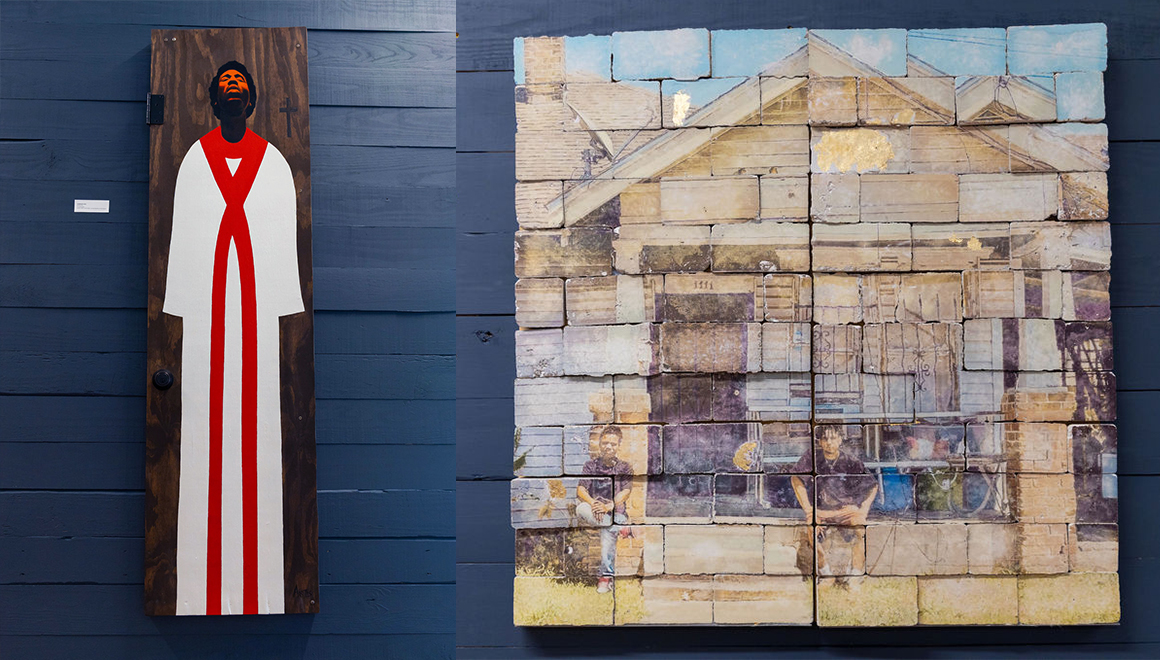
Younger artists featured in the exhibition include Otabenga Jones co-founder Robert Pruitt, Ann Johnson, Shawn Artis, and Crystal Coulter. Viewers walking into the exhibition space encounter a dark gray wooden church structure with the words “This Far By Faith” rendered in white lettering. Guy placed Nigerian-born artist Abidemi Olowonira’s mostly white leather cross, also made using fur, epoxy resin, and hemp fiber, adjacent to the exhibition title and to the left of the church door. Part of Olowonira’s intriguing Sunday’s Best series, a total of 12 crosses painted in various hues like yellow, red, purple, black and blue, these works are the central focal point of the show and are hung on white walls inside the church. Guy placed Shawn Artis’ Choir Boy (2026) — made with acrylic, latex, a found object, and pyrography — outside the church on a doorlike structure.
 Abidemi Olowonira’s “Sunday’s Best” series on view in “This Far By Faith” at The DeLuxe Theater. Photo: Keda Sharber, courtesy of Harrison Guy
Guy explains the meaning behind the exhibition title. As he notes within the curatorial statement, “The title draws from a phrase deeply rooted in Black cultural and spiritual life. ‘This far by faith’ is both declaration and acknowledgment. It recognizes that movement forward is rarely linear and never solitary. It honors those who built, resisted, created, and imagined before us. Here, faith extends beyond religion. It is faith in community, in cultural continuity, and in the capacity of art to hold memory while pointing toward the future.”
One of the most impactful, moving works in the exhibition are the juxtaposed television sets that show the before and after of the Pleasant Grove Missionary Baptist Church’s demolition, which began in 2024. An empty field now sits in place of the old domed church, which was an important Fifth Ward landmark. Karen Kossie-Chernyshev filmed the demolition (edited by Keda Sharber) with precision and care, and in a city where destruction of important landmarks has long been a phenomenon, it makes the viewer confront the constantly changing dystopian landscape and ask what can be saved. The exhibit doesn’t delve into other demolitions of historic Fifth Ward structures, such as Don Robey’s Bronze Peacock Dinner Club, the old Wheatley High School, or the transitioning of St. Elizabeth Hospital into housing. One issue which has plagued historically Black neighborhoods in Houston, including Third Ward, Freedmen’s Town (Fourth Ward), and Fifth Ward, is the destruction of major parts of a neighborhood in conjunction with the construction of interstate highways. Another topic not addressed directly in the show is gentrification, although the demolition of Pleasant Grove Missionary Baptist Church, which led to the Houston Housing Authority being embroiled in controversy, certainly hints at it.
 Works by Earlie Hudnall, Jr. on view in “This Far By Faith” at The DeLuxe Theater. Photo: Keda Sharber, courtesy of Harrison Guy
Another highlight of the exhibition are the classic black and white photographs of Earlie Hudnall, Jr. Photographic subjects include a couple holding champagne glasses on their wedding day, a horse walking along a street near the Royal Center Cafe, row houses, and adults and children in various settings. Robert Pruitt’s large-scale Oba (2011), a conté and charcoal on handmade paper work, stands out, with its subject raising his right hand.
 Works by Robert Pruitt and Dr. John Biggers on view in “This Far By Faith” at The DeLuxe Theater. Photo: Keda Sharber, courtesy of Harrison Guy
 A work by Ann Johnson on view in “This Far By Faith” at The DeLuxe Theater. Photo: Keda Sharber, courtesy of Harrison Guy
Ann Johnson’s subtle concrete works, with muted colors, are powerful and memorable. Aside from the overarching sense of community, one of the most beautiful aspects of the exhibition is the presence of music. Songs played over the speaker system include Donny Hathaway’s “Someday We’ll All Be Free,” Aretha Franklin’s “Young Gifted and Black,” and The Clark Sisters’ “Blessed and Highly Favored.”
 “Bettison’s Benediction: For Choir Boys, Church Queens, and Those Whose Sundays Stopped Too Soon” curated by Harrison Guy at Project Row Houses. Photo: Alex Barber
In addition to This Far By Faith, Harrison Guy also created another important community-oriented project, a recent installation at Project Row Houses (Round 59, October 18, 2025-February 15, 2026) which paid tribute to Project Row Houses co-founder James Bettison (1957-1997), who passed away due to AIDS. The house, painted red (with red pianos and white tambourines) in one room and black and pink in another, was a beautiful, poignant reminder of the challenges faced by members of the LGBTQ+ community. Guy featured films directed by Black gay filmmaker Marlon Riggs and chose Shawn Artis to paint men in the same choir boy garb as the painted figure on view at The DeLuxe Theater. Overall, Guy’s work as curator and artist makes a profound statement about the role of change, history, community, perseverance, and resilience in people’s lives.
This Far By Faith is on view at The DeLuxe Theater in Fifth Ward, Houston, through February 26, 2026.