
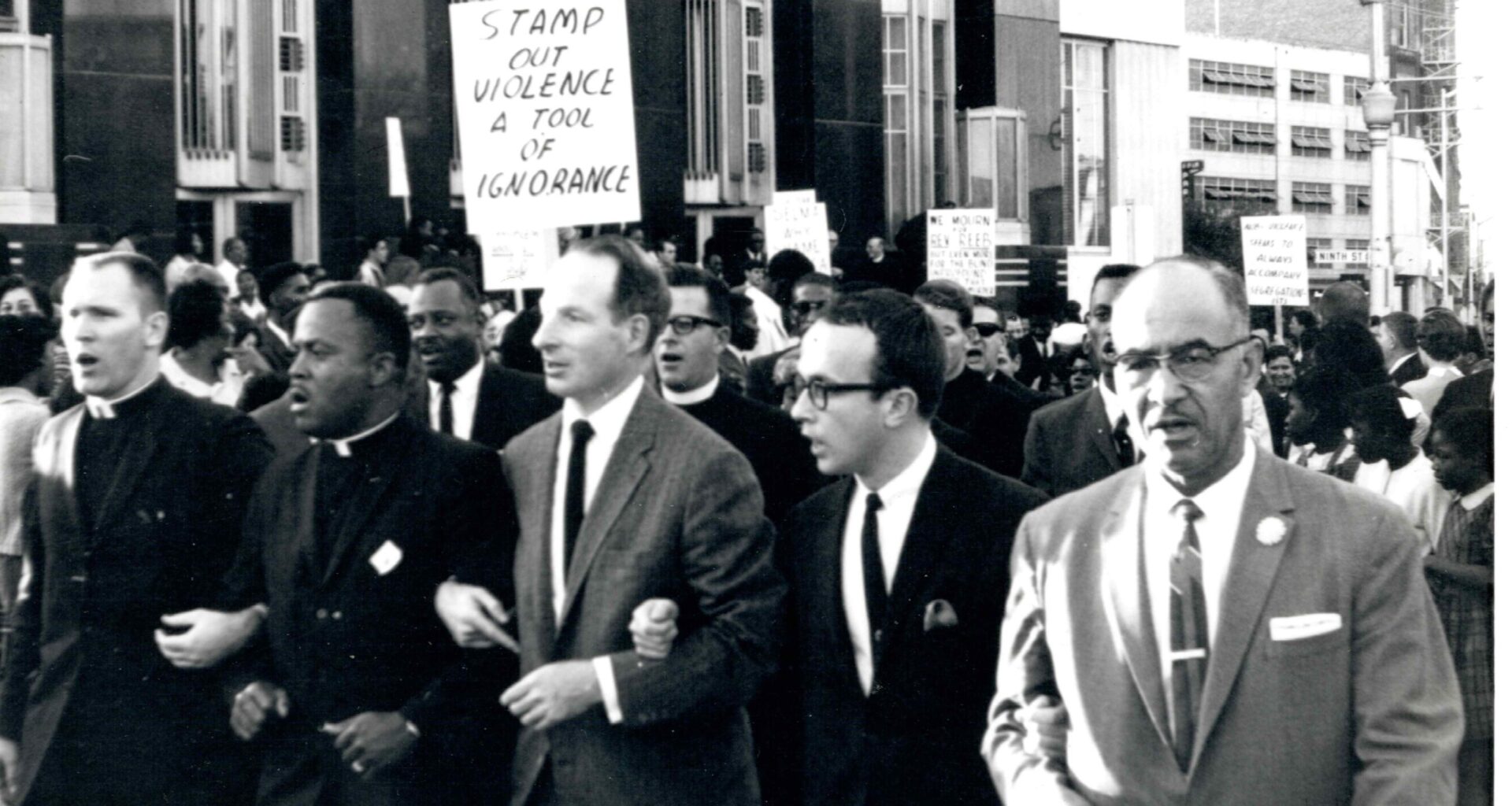
Editor’s note: In an effort to preserve city history, Fort Worth Report agreed to archive Hollace Weiner’s local history columns beginning in 2025. This column about Fort Worth’s first integrated march for racial justice in 1965 originally ran during Black History Month in the Fort Worth Star-Telegram Feb. 8, 2021, and was updated for the Report.
Black lives mattered to Rabbi Robert J. Schur, who spoke from the pulpit at Fort Worth’s Beth-El Congregation in soft, prophetic cadences. Following Bloody Sunday in Selma, Alabama, the day in 1965 when state troopers tear-gassed and pummeled civil rights demonstrators crossing the Edmund Pettus Bridge, the rabbi reached out to his Black pastoral colleagues.
They were planning a mass meeting the following Sunday, March 14. Rabbi Schur
agreed to speak. The flyer publicizing the rally listed his name first among local clergy.
The rabbi’s involvement mobilized white ministers.
Never before had Black and white clergy protested together in Fort Worth, a city where schools, pools and parks had token integration, if any. Demonstrators hoisted handmade signs that declared “End Police Brutality,” “Stop Voter Suppression” and “Kill Jim Crow, Not Citizens”— demands still salient.
The Rev. Marshall E. Hodge, president of Fort Worth’s Southern Christian Leadership Conference, or SCLC, and founder of Morningside AME Church, had just returned from Selma where, he told the Star-Telegram, “Frankly, I was scared to death.”
In Fort Worth, tensions mounted midweek when the SCLC filed for a parade permit. At a press conference, Deputy Police Chief R.R. Howerton announced that 50 officers — on foot and in motorcycles, in uniform and plainclothes — would patrol the milelong march. The route would extend from the City Recreation Center, now a National Historic Landmark at 215 W. Vickery Blvd., to City Hall at 1000 Throckmorton St.
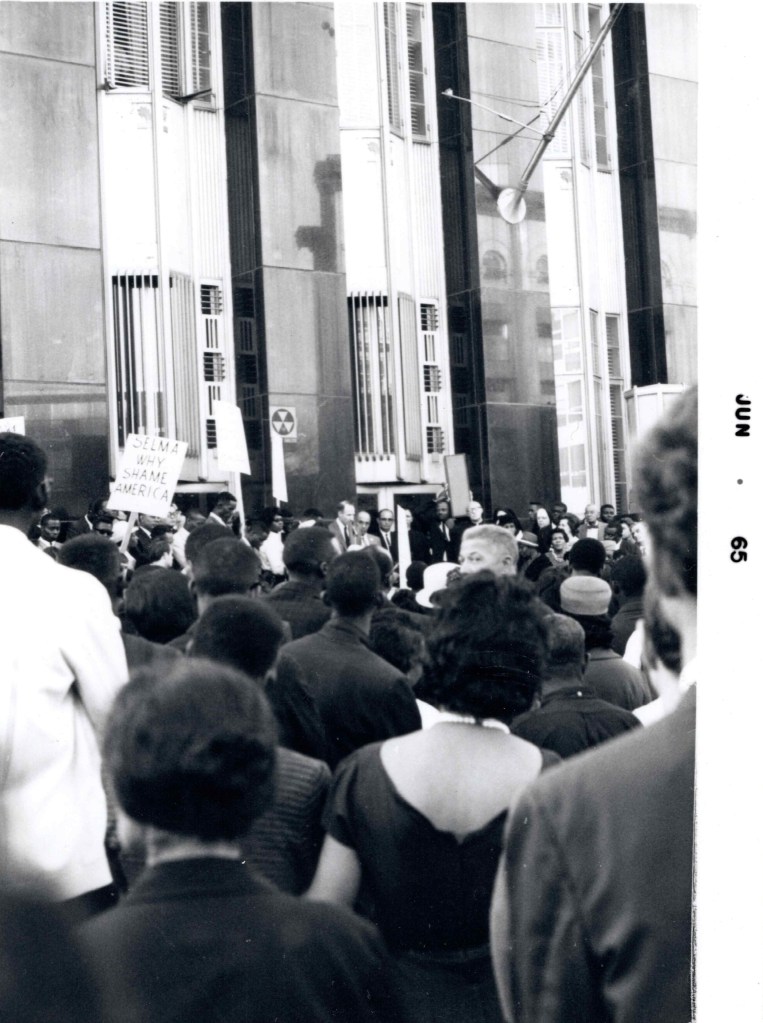 Rabbi Robert Schur stands at the podium at Fort Worth City Hall, March 14, 1965. A sign reads, “Selma Why Shame America.” (Courtesy | Fort Worth Jewish Archives/family photo, William Schur)
Rabbi Schur, a Cincinnati native previously on the pulpit in Alexandria, Louisiana, had come to Fort Worth in 1956. He was an outspoken advocate against racial injustice. In 1963, when a coalition of Southern synagogues sought his support to rescind an invitation for the Rev. Martin Luther King Jr. to address a national meeting of Reform Jewish leaders, Schur had refused. His synagogue’s board of directors, headed by E.M. (Manny) Rosenthal, backed him with “a vote of confidence … regarding the integration question.”
They knew where Rabbi Schur stood. He had preached about historic parallels between Blacks and Jews, from bondage in ancient Egypt to bigotry in modern times. He had visited with King once. While catching a plane in the Atlanta airport, the rabbi recognized MLK getting his shoes polished at a shoeshine stand. Schur introduced himself, and the two clergymen dialogued about Plato, the Greek philosopher who analyzed ethics and harmony in society.
At Beth-El Congregation teens swept up in the rabbi’s idealism were eager to join him at the rally for racial integration. “Civil rights was the dominant issue of the day,” recalled the rabbi’s son Bill Schur, a retired attorney, then a junior at Paschal High. “This was our first real opportunity to do more than just talk about it.”
Until that month, the Beth-El Temple Youth Group’s social activism had consisted of trick-or-treating for UNICEF, the United Nations Children’s Fund. They visited the Denton State School for developmentally disabled children, held a meeting at a Black church, dialogued with a Black guest speaker, and talked about the need for change.
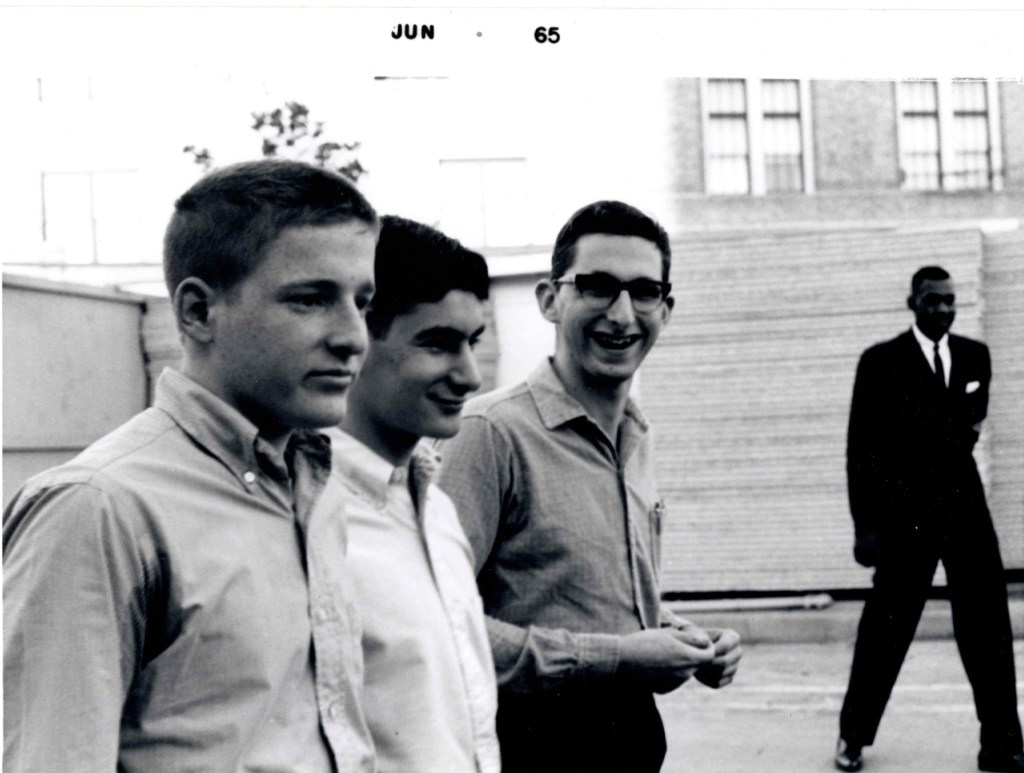 Teenagers William Schur, Bill Simon and Dale Bronstein, students at Paschal High School, attended the rally. William, the rabbi’s son, found these snapshots in 2024 while cleaning boxes in his garage and digitized them for publication. (Courtesy | Fort Worth Jewish Archives/family photo, William Schur)
“Our projects seemed pedestrian and safe,” recalled Dallas writer Bill Simon, a high school classmate of Bill Schur.
The week leading to the march, some parents from Beth-El had phoned one another, fearful that violence would erupt. A Star-Telegram headline warned: “Bomb Threat Anticipated.”
When Sunday arrived, the rabbi’s son attended the rally with Simon and another friend from Beth-El, Dale Bronstein, also a Paschal student. They recognized in the crowd two other Jewish teens — sisters Miriam and Rebecca Winesanker who stood with their parents, Esther and Michael Winesanker, chairman of the music department at Texas Christian University, which had never enrolled a full-time undergraduate Black student.
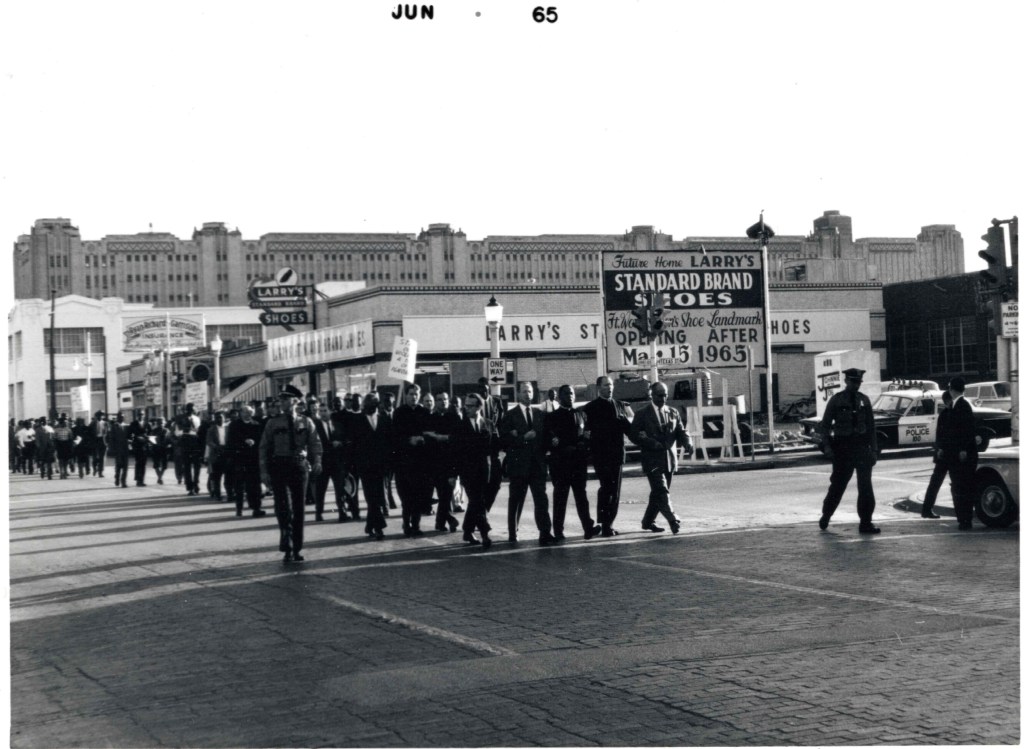 The quiet, milelong march was one block south of City Hall when the demonstrators passed Larry’s Standard Brand Shoes at 1006 Jennings St. Visible in the background is the eight-story Texas & Pacific Warehouse, a landmark on Lancaster Street vacant since 1978. (Courtesy | Fort Worth Jewish Archives/family photo, William Schur)
Following 45-minutes of sermons, prayers and gospel singing at the City Recreation Center, a crowd of 600 people filed out, five-abreast, with Rabbi Schur and Rev. Hodge, in the lead. Eighty percent of the demonstrators were Black.
“I remember the day being bright and pleasant,” said Bronstein, a wine importer who grew up stocking shelves in his family’s grocery store alongside Black employees and playing with African American youngsters. “I remember being outside of City Hall and that the route to it was quiet.”
Silence added to the tension.
“When the march passed St. Patrick Catholic Cathedral, several priests and nuns
stepped forward to march the rest of the way,” according to the TCU Skiff. By the time demonstrators reached City Hall, their numbers had swollen to 700 people who sang “We Shall Overcome.”
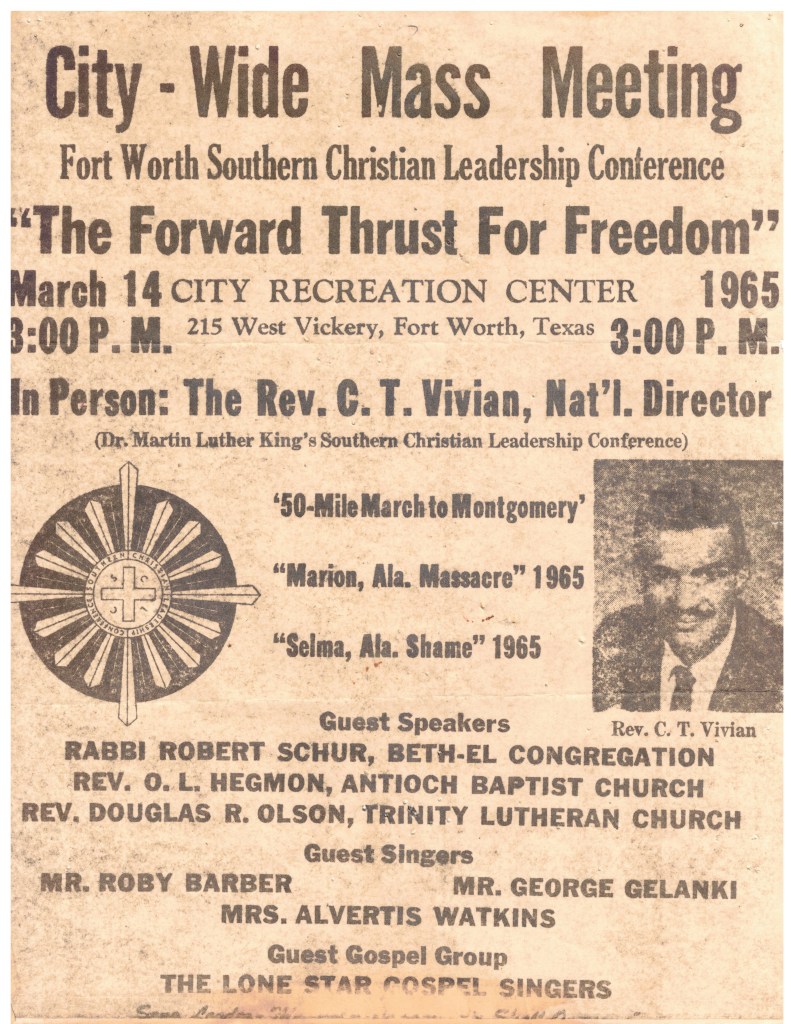 A mimeographed flyer distributed in March 1965 publicized the protest as a “City-Wide Mass Meeting” and promoted it as a “Forward Thrust for Freedom.” The flyer was saved by the rabbi’s daughter, the late Sally Schur, who donated it to the Fort Worth Jewish Archives in 2005. (Courtesy | Fort Worth Jewish Archives)
Ministers of multiple Christian denominations stepped to the podium. Many proclaimed their motivation stemmed from the teachings of Jesus Christ.
“When Rabbi Schur took his turn to speak,” Simon recalled, “he began with absolute, prolonged quiet. He understood the power of silence to attract listener attention and focus. His first sentence made an unforgettable impression: ‘I come from a different tradition.’”
In prophetic tones, he spoke of the roots of a Black-Jewish coalition on the horizon.
Hollace Ava Weiner is a Fort Worth historian and archivist.
This <a target=”_blank” href=”https://fortworthreport.org/2026/02/23/black-lives-mattered-to-rabbi-robert-schur-of-fort-worths-beth-el-congregation/”>article</a> first appeared on <a target=”_blank” href=”https://fortworthreport.org”>Fort Worth Report</a> and is republished here under a <a target=”_blank” href=”https://creativecommons.org/licenses/by-nd/4.0/”>Creative Commons Attribution-NoDerivatives 4.0 International License</a>.<img src=”https://i0.wp.com/fortworthreport.org/wp-content/uploads/2021/04/cropped-favicon.png?resize=150%2C150&quality=80&ssl=1″ style=”width:1em;height:1em;margin-left:10px;”>
<img id=”republication-tracker-tool-source” src=”https://fortworthreport.org/?republication-pixel=true&post=421919&ga4=2820184429″ style=”width:1px;height:1px;”><script> PARSELY = { autotrack: false, onload: function() { PARSELY.beacon.trackPageView({ url: “https://fortworthreport.org/2026/02/23/black-lives-mattered-to-rabbi-robert-schur-of-fort-worths-beth-el-congregation/”, urlref: window.location.href }); } } </script> <script id=”parsely-cfg” src=”//cdn.parsely.com/keys/fortworthreport.org/p.js”></script>