
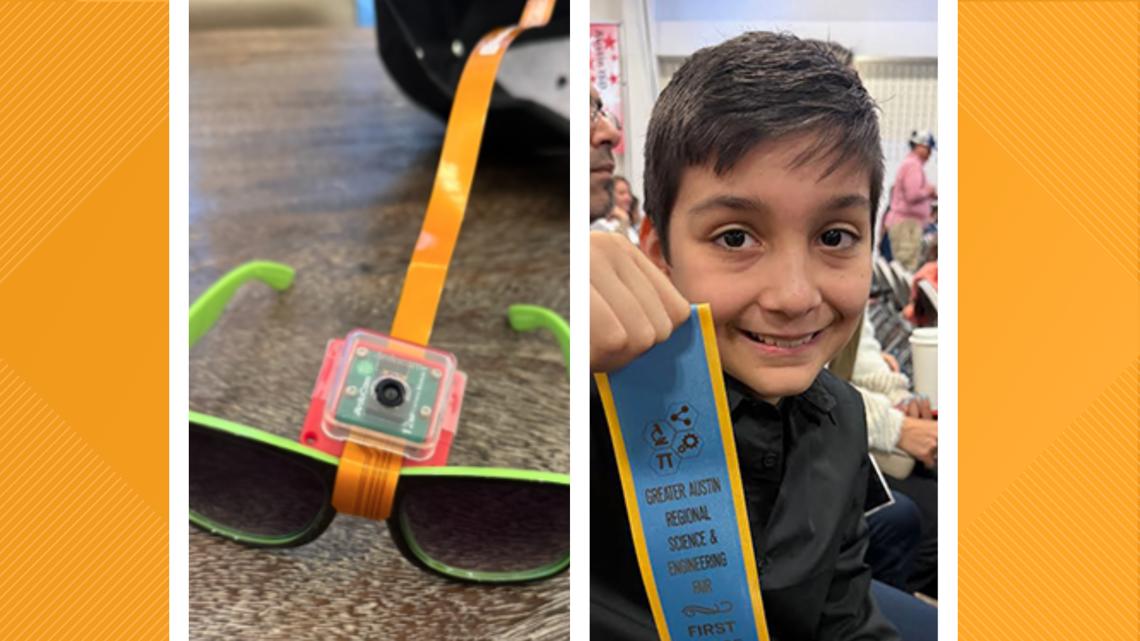
Lucas Tudor, a student at Harmony Science Academy in Leander, developed the glasses after he says he needed perspective.
LEANDER, Texas — An Austin-area 10-year-old is using his AI-powered glasses to change lives.
Lucas Tudor, a student at Harmony Science Academy in Leander, TX, is using artificial intelligence to develop glasses, he calls “A Eyes,” to improve the lives of visually impaired kids.
Tudor said that before he created anything he wanted to understand what it feels like to be “visually impaired.” So he blindfolded himself, spun around until he lost his sense of direction and tried to find the Christmas tree in his home. He said that it took him 45 minutes, with him walking into walls, and feeling around on the ground to see if anything could guide him towards the tree.
“I was frightened of hurting myself or breaking something. I felt frustrated, and at several points, I wanted to give up entirely,” Tudor said. “I realized that what I had felt for 45 minutes in a familiar environment is what millions of visually-impaired children experience every single day, and I wanted to do something about it.”
The experience helped him develop the glasses from concept to reality. Tudor said he wanted to create something for kids as nearly 6.8% are diagnosed with a vision condition and he realized most of the tools available are designed for adults.
Tudor carefully researched, designed, engineered and experimented with his “A Eyes”. He said his main goal was to test if “real-time object detection, combined with audio feedback, could meaningfully improve users’ navigation.”
He was able to create the glasses from a microcomputer with a small storage device to contain the operating system and software. He also incorporated a camera, connected with a flexible extension cable, which visually captured the surrounding environment. A portable battery pack in a protective case powers the system. There also is a Bluetooth earpiece that delivers audio feedback to alert wearers of nearby obstacles.
Tudor was able to develop the device after writing to several CEOs that make electroencephalogram, or EEG devices, which measure electrical activity in the brain. One company, Emotiv, which makes wireless wearable earbuds with built-in EEG sensors offered to sponsor him and give him access to developers.
Leander ISD officials said Tudor recently earned a first-place achievement at his school’s science fair and another first-place ribbon at the Greater Austin Regional Science and Engineering Fair (GARSEF) for developing the AI-powered computer vision glasses.