
“So why is ELP on a 10 day TFR?” a Discord user wrote on February 11.
The message was sent at 12:39 a.m. EST—hours before media reports on the temporary flight restriction (TFR) that briefly shut down the airspace around El Paso International Airport (KELP) hit the airwaves.
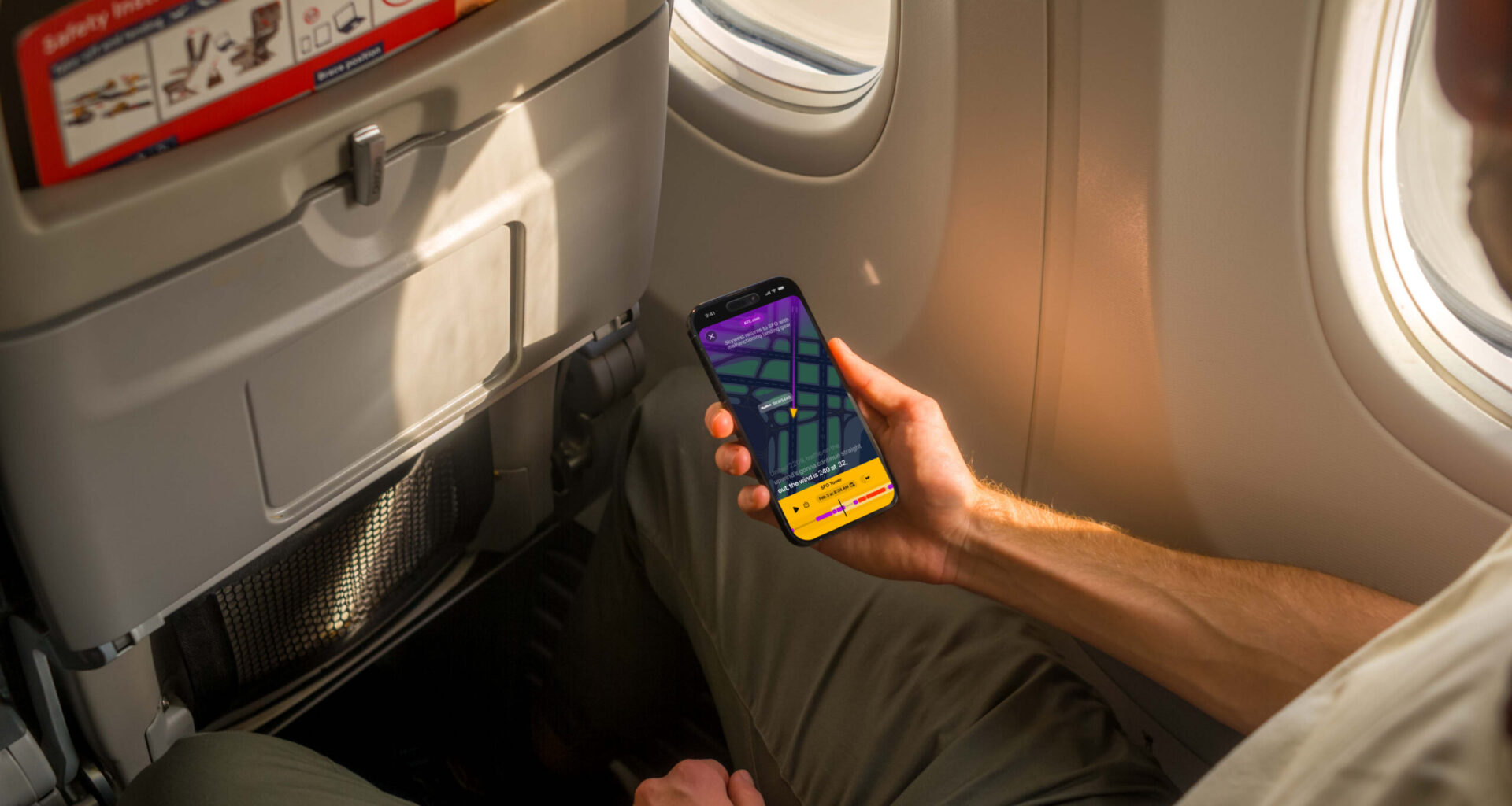
When browsing your TikTok or X feed this month, you may have seen a few viral videos featuring a sleek, user-friendly interface that combines air traffic control (ATC) audio transcriptions with the real-time location data of platforms such as FlightAware, showing where the conversation takes place and who is speaking.
The screen recordings come from an application called ATC, developed by startup Enhanced Radar and made available on iOS last week. Eric Button, co-founder and CEO of Enhanced Radar, said the platform uses artificial intelligence (AI) to transcribe about one million transmissions per day—all in real time.
“We’re able to put together two pieces of the puzzle, which, to date, have not been put in the same interface,” Button told FLYING. “There are apps that can show you a map of where planes are. There are apps that can give you ATC audio. We put them in the same place, on the same map.”
Button said the app is by no means a replacement for “aviation institutions” like LiveATC. But it could be a useful tool for aviation geeks, student pilots, and professionals at airports—many of whom he said are already users—to learn of engine failures, fires, and other events before they are widely reported.
“They can know sooner, and they have more context and details about what is going on,” Button said. “The delay that the user experiences should be shorter than the delay when watching an NFL football game.”
Button said Enhanced Radar has installed proprietary hardware—designed to obtain high quality ATC audio—on or near 71 airports that are now covered by the ATC app. That number will be “very different” by year’s end, he said.
In addition to location, users can search for ATC audio by aircraft tail number, call sign, or flight number, as well as AI-flagged “events,” including fires, engine failures, icing, and other scenarios.
“There’s unusual or interesting things that are happening in U.S. airspace, and we’re able to essentially detect those with the AI,” Button said.
ATC for All
The ATC app runs on a “lightweight” version of Enhanced Radar’s proprietary Y3 AI model. Button said the company immediately recognized Y3’s potential for transcribing heaps of audio transmissions. That would be a Herculean—and costly—task for a team of humans.
“We can, with AI, transcribe or just understand what the pilots and controllers are saying and present the data in a new way,” he said.
Button said he grew up scanning the airwaves with LiveATC. He later became a professional pilot of light midsize jets such as the Pilatus PC-12 and Gulfstream G280. Button then transitioned to software and founded a startup, where he met pilot and Enhanced Radar co-founder Kristian Gaylord.
Button estimated that about 8 in 10 Enhanced Radar employees are current or former pilots and controllers. Many combine that experience with the technical expertise required to build a model like Y3, which he said “would not have been possible even a few years ago.”
Now, the AI is training on an ever-growing set of data obtained by the proprietary audio collection systems the firm has installed at more than 70 airports.
“We have processes and have been thoughtful about how to design the AI and the accuracy involved—just like on the software side—to make sure that we’re not crying wolf about something, which I think we’ve done a good job of to date,” Button said.
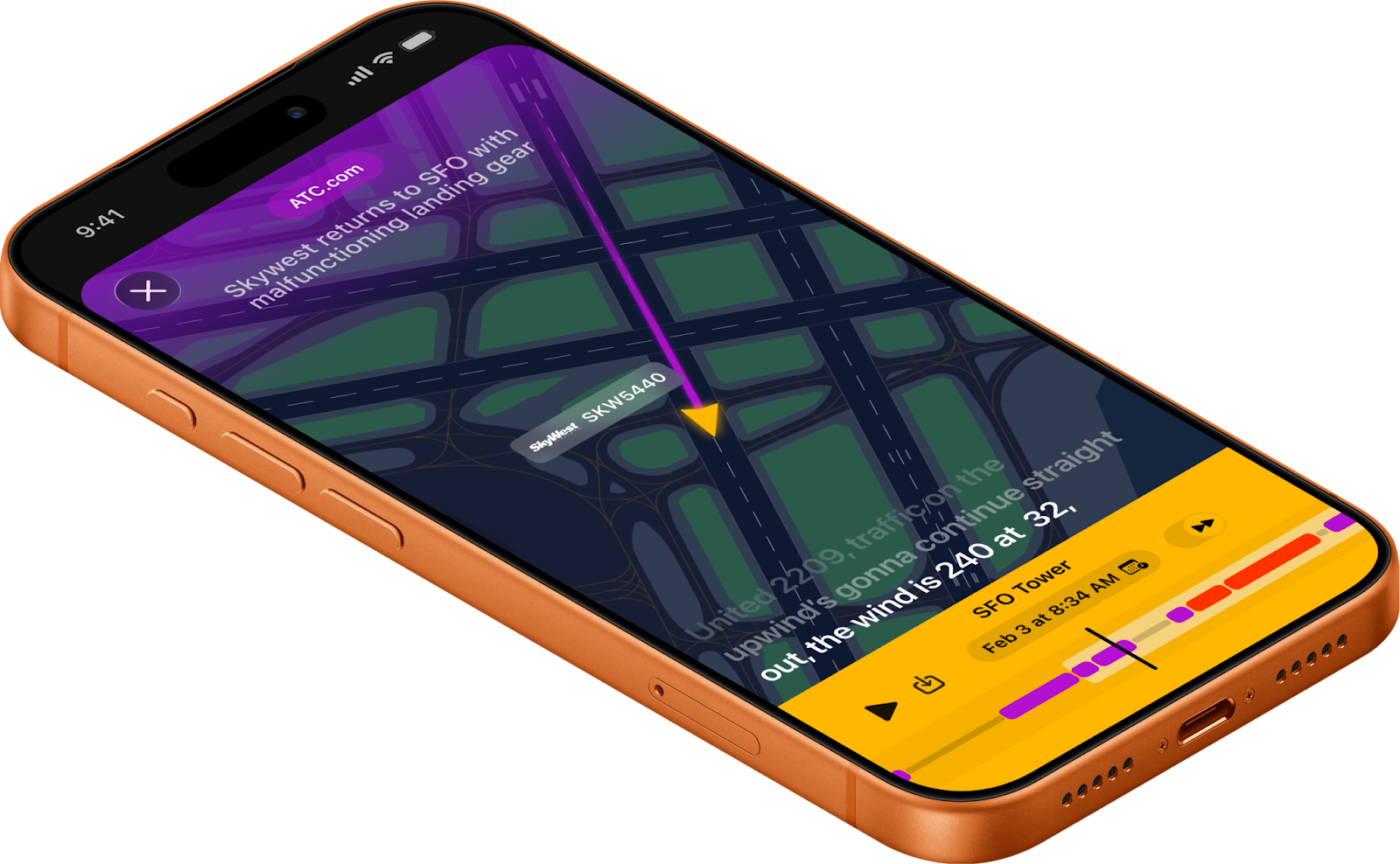 The ATC app alerts users to aviation events, such as malfunctioning landing gear forcing a commercial flight to head back to the runway. [Credit: Enhanced Radar]
The Enhanced Radar chief said “some enterprise people,” including professionals at airports and airlines, are using the ATC app to assist in their work. Student pilots and their family members are using the tail number search feature to get historical ATC audio.
“When someone is doing flight training, they can go back and actually see how they were performing on the radios,” Button said.
Another early cohort comprises “aviation geeks” who simply want to get the news before everybody else. That includes live updates on their own commercial flights.
“They can actually listen along as they get pushed back from the gate, hear their pilots when they take off, and then hear when they’re landing,” Button said.
However, the app’s simple and social media-friendly interface is designed to be useful to anyone, even a person with zero aviation knowledge or experience. Users pay $6.99 a week or $89.99 a year, with the latter option including a free, seven-day trial. The app is available only on iOS but could expand to Android or web platforms.
“We’ll have to see,” Button said.
The Enhanced Radar CEO added that the ATC app is “just a small part of what we do.” Fundamentally, he said, they are an AI research company with a focus on enterprise solutions.
When asked about future potential customers, Button was cagey. But one could imagine the company delivering its capabilities to customers such as the FAA, which is using AI to sift through data and identify “hot spots” in the wake of the devastating January 2025 collision over the Potomac River between a U.S. Army helicopter and commercial passenger jet.
The regulator is also overseeing the transition of ATC communications from analog to digital under its three-year, multibillion-dollar Brand New ATC System plan.
“I think the opportunity for AI to improve efficiency in the system—and on a longer timeline, save lives—is very exciting,” Button said. “I think that’s why we are working in the space.”
Button said the company’s models will only get more powerful. On Tuesday, it unveiled Y4, a model he said is much larger than Y3. The new model is designed primarily to tackle aviation-specific challenges—transcribing noisy or broken audio, rushed speech, accents, and dozens of aircraft sharing the same frequency. It is also better at differentiating between pilots and controllers.
Button said the company trained Y4 on a dataset 82 times larger than the one it used to train Y3. Per a news release, the model understands audio across airports and other sites that house ATCs, such as terminal radar approach control (TRACON) facilities, with accuracy greater than 98 percent.