
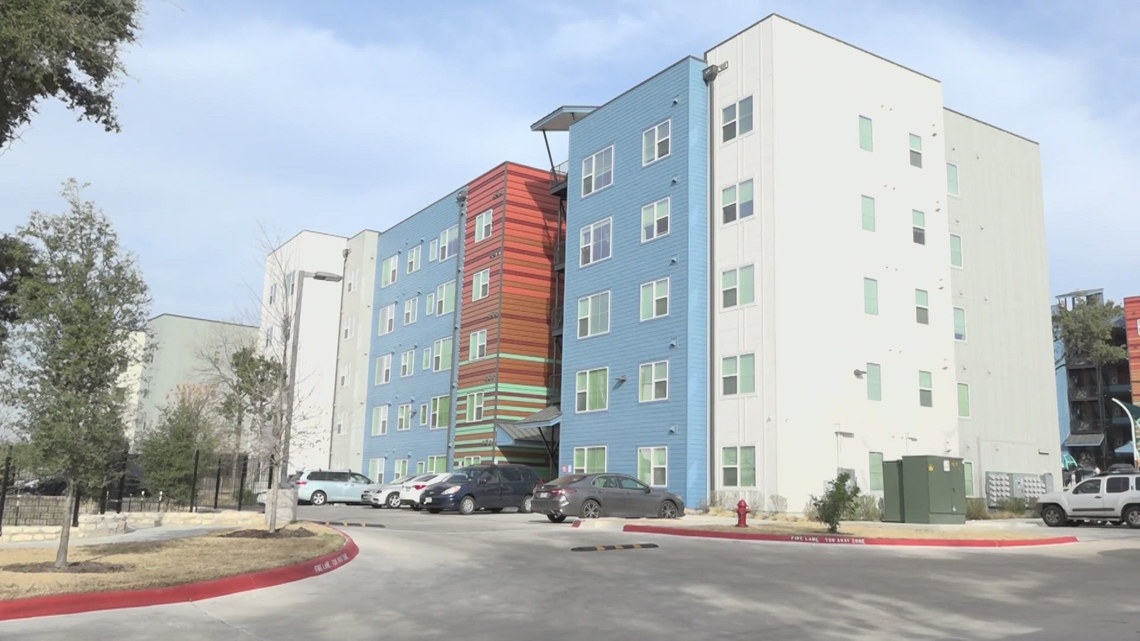
Multiple agencies and nonprofits are working to make housing affordable for the unhoused. But one organization calls it a slow process.
AUSTIN, Texas — Affordable housing remains a pressing issue in Austin, as rising rents continue to strain residents across the city. In response, local leaders, nonprofits and county officials are pouring millions of dollars into new apartment developments aimed at helping people experiencing homelessness and low-income Austinites find stable housing.
Juniper Creek Apartments offer relief in North Austin
Several agencies and nonprofits are leading the charge in constructing affordable housing across the city. One example is Juniper Creek Apartments in North Austin, developed by Foundation Communities.
For resident Brandon Means, the affordable rent has made a noticeable difference.
“I do music and, as a musician, we don’t get paid that much,” Means said. “Kind of trying to balance out the budget and making sure that I have enough money in my pocket for other things – it’s been able to help me a lot here.”
Foundation Communities is part of the Travis County Supportive Housing Initiative Pipeline, also known as the SHIP program. Through that initiative, the nonprofit received $9.5 million to help construct Juniper Creek Apartments.
Walter Moreau, executive director of Foundation Communities, said another development is already underway.
“We also are building Burleson Studios, which is designed for single adults,” Moreau said. “We’re maybe four or five months away from being complete, and it’s 104 apartments.”
This complex received $12 million from the county.
Travis County invests $117 million in supportive housing
Juniper Creek and Burleson Studios are part of a broader effort funded in part by $117 million in grants approved by the Travis County Commissioners Court. The funding is aimed at building more than 2,000 supportive housing units across the county.
Precinct 2 Commissioner Brigid Shea said much of the funding originated during the COVID-19 pandemic.
“During COVID, the Biden administration sent really significant one-time funding to local cities and counties,” Shea said. “A big initiative was investing in these SHIP-supportive housing initiatives to help people transition out of homelessness.”
City aims for 60,000 new units in 10-year plan
The city of Austin is also contributing to the effort. As part of its 10-year housing plan, the city set a goal to build 60,000 housing units. Over the past six years, city leaders say about 22,429 units have been constructed.
Still, some community advocates argue progress has been too slow and lacks transparency.
Chas Moore, founder of the Austin Justice Coalition, said the city must move faster while keeping residents informed.
“I think we need to expedite it as much as we can to make sure that we’re doing this as fast as we can but efficiently,” Moore said. “And I also think we need to make sure that people are just in the know.”
Balancing growth and affordability
For residents like Means, the impact of affordable housing is personal. He said many privately owned apartments in Austin start at $1,200 to $1,300 a month, far above what he can comfortably afford.
“This one is a lot, much more affordable than that,” he said.
As new developments continue to break ground, city and county leaders say the coordinated effort between government agencies and nonprofits is critical to ensuring Austin remains accessible to longtime residents and those working to regain stability.
With millions of dollars invested and thousands of units planned, the challenge now lies in delivering those homes quickly and making sure they reach the people who need them most.
Foundation Communities is currently leasing affordable homes to those who meet certain requirements. If you’re interested in applying, click here for more information.