
Lucio Vasquez / Houston Public Media
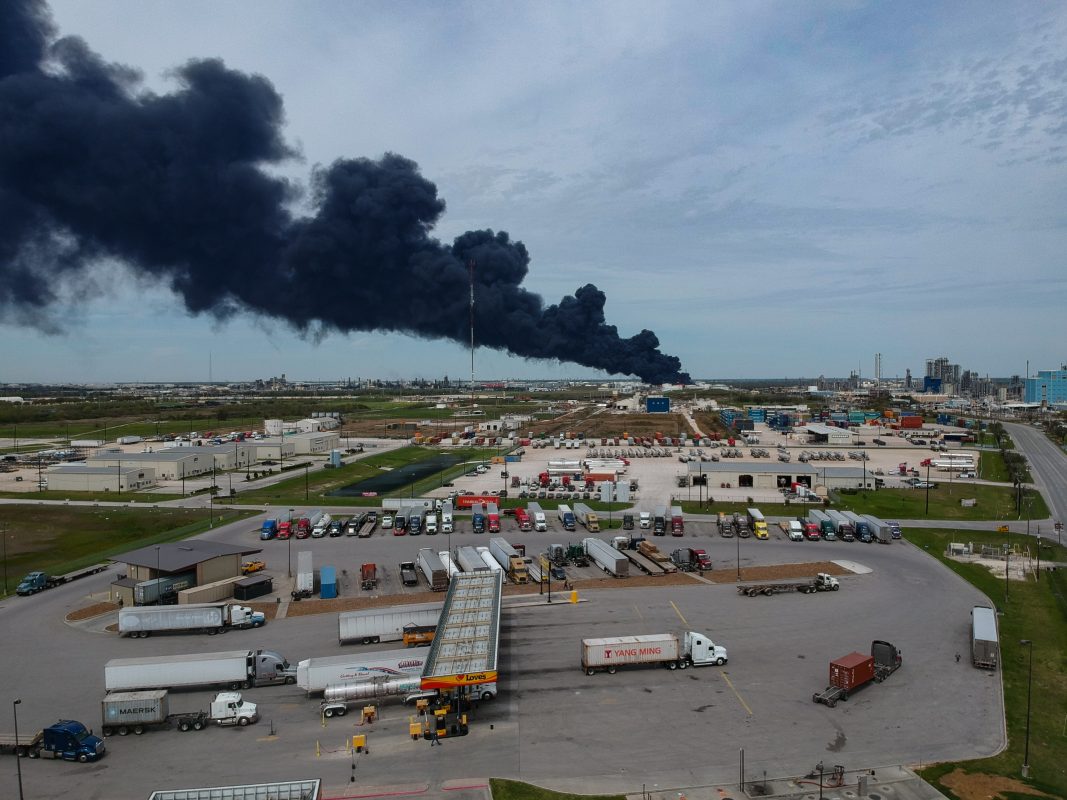
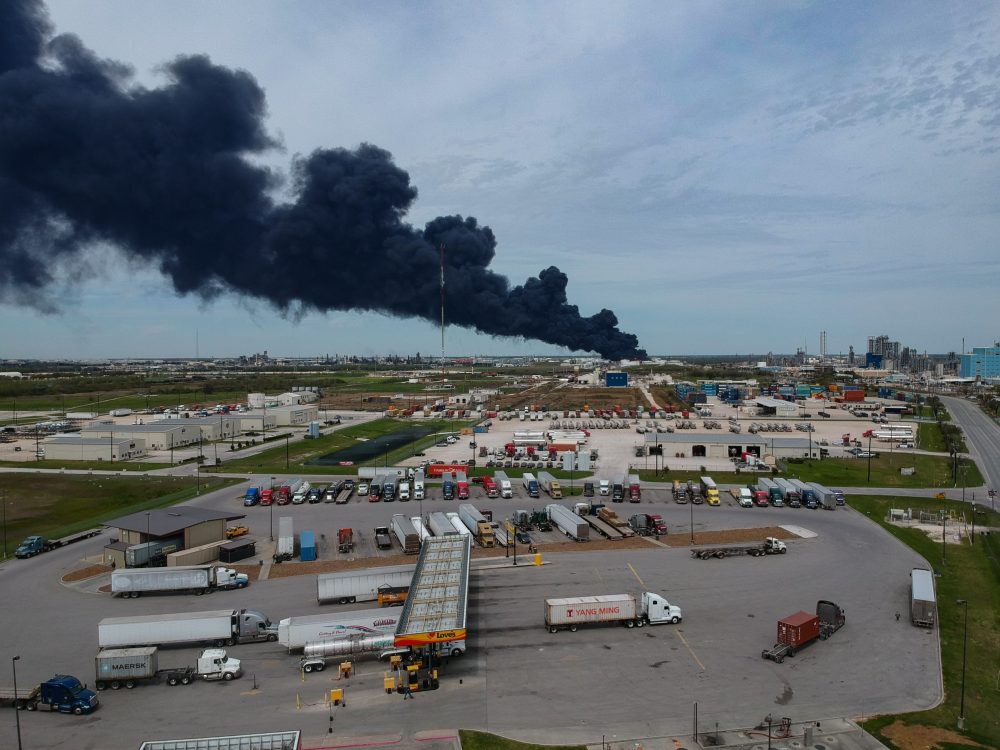
A drone photo of the International Terminals Company fire in Deer Park, on March 18, 2019.
The Houston area is no stranger to air pollution. The region has expansive roadways that often are congested with gasoline-powered cars and trucks, and it’s also home to a petrochemical complex that produces a steady stream of emissions.
A new report released by the nonprofit Air Alliance Houston examined eight years’ worth of industrial pollution events that happened outside of routinely occurring emissions that are permitted by federal and state regulators. These other emissions events were caused by accidents, explosions, severe weather events, facility maintenance and other events that resulted in significant amounts of unauthorized pollution, and several of them occurred at the same facilities.
Air Alliance Houston, utilizing data from the Texas Commission on Environmental Quality, found that industrial facilities in Harris County recorded 1,735 of these emissions events between 2017 and 2024, causing more than 49 million pounds of pollutants to be released into the air.
Dr. Inyang Uwak, the research and policy director for Air Alliance Houston, said the report’s goal was to raise awareness of the issue because community safety can be overlooked.
“For the communities, it’s important that they understand the risks associated with living close to a potential source of pollution, so they’re aware, and they are alert,” Uwak said. “And also, it gives them an opportunity to be prepared. It’s better that you know than not know. Knowledge is power.”
The report was released around the same time that the U.S. Environmental Protection Agency (EPA) rolled back the 2009 “endangerment finding” that classified greenhouse gases as a public health threat and allowed the federal government to regulate greenhouse gases under the Clean Air Act.
Air Alliance Houston condemned the revocation of the endangerment finding, with Uwak saying it could have far-reaching consequences in major cities like Houston with lots of vehicle traffic.
The EPA, under the administration of President Donald Trump, also has stopped calculating the economic benefits of lives saved when setting air pollution limits.
“I’m lost for words because science has proven the impact of air pollution on human health, globally, not just in the U.S.,” Uwak said. “There has been several studies in the U.S. and in other countries – Canada, U.S., UK, Europe in general – that have clearly pointed to the fact when you weigh the economic benefits versus the health benefits, the health outweighs the economy benefits.”
The nonprofit says five incidents in the Houston area accounted for more than half of the air pollution released from the non-standard emissions events between 2017 and 2024. Two of them occurred when the region was deluged with rainfall from Hurricane Harvey in 2017.
The facilities associated with those events are ITC Deer Park, ExxonMobil Baytown, the Magellan Galena Park Terminal and Shell Deer Park Chemicals. The 2019 fire at the ITC facility, which burned for multiple days and sent a black plume of smoke over Houston, accounted for more than one-third of the unauthorized emissions during the study period.
Neither ITC Deer Park nor ONEOK, which has since acquired Magellan, responded to requests for comment.
Shell declined to comment.
ExxonMobil, which had two of the five aforementioned incidents at its Baytown facility, said in a statement that each of its facilities operates under its own air and water permits and complies with applicable regulations.
“Our priority – no matter the weather – is the safety of all those who work at our sites and the community,” company spokesperson Kelly Davila said. “We’re focused on reducing emissions from our manufacturing sites and remain committed to fully complying with all applicable regulations.”
Air Alliance Houston found that more than 6,300 permit violations were reported in Harris County between 2017 and 2024, and ExxonMobil’s Baytown refinery led all local facilities with 948 violations during that span. A total of 12 facilities accounted for 88% of the total emissions during that time period, according to the nonprofit, which said that statistic underscores a “systemic failure of enforcement” by industry regulators.
The Texas Commission on Environmental Quality did not respond to a request for comment.