
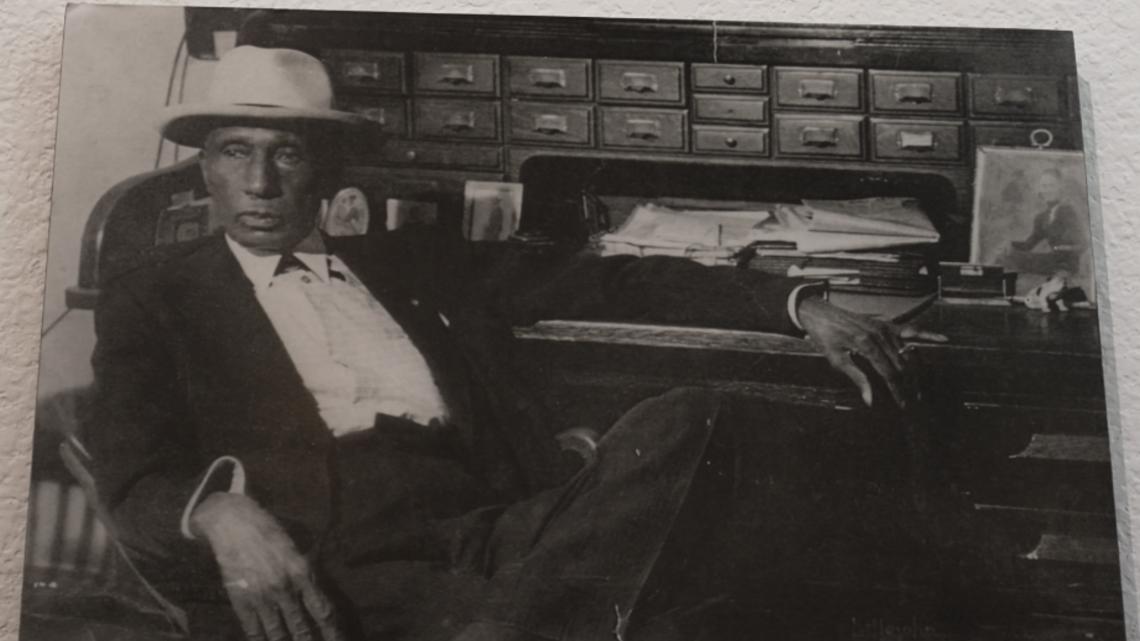
William Madison McDonald, Texas’s first recorded Black millionaire, reshaped Fort Worth not with revenge, but with intentional legacy-building.
FORT WORTH, Texas — In celebration of Black History Month, WFAA is taking a look at those who have paved the way in the Dallas-Fort Worth area.
William Madison McDonald is the first recorded Black millionaire in Texas. His story shaped Fort Worth, ending on his terms.
Revenge is complicated. It sets urgency against patience, needs against wants, and satisfaction against regret. However, being born just one year after slavery was abolished and living through constant injustice, McDonald did not chase revenge. He built it.
“That property located at 1201 East Terrell was originally built as a three-story mansion by the man known as William Madison McDonald, who is recognized as the first Black millionaire in the state of Texas,” said Jayn Higgins, Tarrant County Black Historical and Genealogical Society Historian.
McDonald built his mansion in Fort Worth in 1906. Higgins said everything McDonald did was done with intention.
“He was able to find a Black contractor and construct this home, and the instructions that he gave to the Black contractor are that I need this house to be a replica of the house of the plantation where my father was enslaved,” said Higgins.
One of the men who enslaved McDonald’s father was Nathan Bedford Forrest, the first Grand Wizard of the Ku Klux Klan. Although McDonald was born free, he still felt the effects of slavery.
“He was speaking all over the state of Texas about civil rights and activism. He seemed to be completely unfettered by Jim Crow, the vestiges of slavery,” said Higgins. “William McDonald had a knack for making friends and impressing people who saw his genuine intellect.”
Higgins said McDonald met an attorney as a teenager.
“That attorney mentored him in law and business and made sure he went to college,” said Higgins.
McDonald did go to college, but historians are not sure if he graduated. They do know that he became a principal at a high school in East Texas. It was there that he met Edward Howland Robinson Green, a railroad capitalist and son of one of the richest women in America at the time. McDonald and Green became close friends.
“They became power brokers in the Republican Party, and that is how McDonald began to amass his wealth and notoriety,” said Higgins.
McDonald started the Fraternal Bank and Trust. It is the first Black-owned bank in Fort Worth. As a Mason, McDonald used his connections in the Masonic Lodge to drive the bank’s success.
“Such a beautiful example of community, collaboration. That bank had assets of close to a million dollars by the Great Depression,” said Higgins.
Years ago, Higgins bought property that McDonald previously owned. In the building, she found hundreds of old checks from the Fraternal Trust and Bank signed by William Madison McDonald. She donated the checks to the Lenora Rolla Heritage Center Museum.
“We recovered them. We preserved them, put preservative on them, and they are now behind in a plastic binder that hopefully will preserve them for many years to come,” said Higgins.
McDonald also opened Fort Worth’s first Black-owned hotel, developed the Historic South Side known as Terrell Heights, and established the Black Business District.
“He just didn’t, you know, bask in his own success, but he did everything he could to bring people along with him,” said Higgins.
His impact even touches those who came generations later.
“Mainly for me, it was the McDonald YMCA,” said Ronnie Hunter, Tarrant County Historical and Genealogical Society Board President. “I actually worked at the Y. I was a fitness instructor for the Y for about eight or nine years…It was an awesome experience to be working under his namesake.”
Hunter said their organization has had many people reach out to learn more about McDonald’s life. “I don’t have words. It is such an awesome feeling to know that one man left a legacy that we’re still talking about,” said Hunter.
“He was an architect that literally carved out a Black community house by house, business by business, resident by resident,” said Higgins.
He was even intentional about his burial site. In 1950, McDonald was buried at Oakwood Cemetery.
“He chose a lot that was facing what was then the headquarters of the Fort Worth chapter of the Ku Klux Klan,” said Higgins. “He specified that in his will.”
During that time, Higgins said the Klan was active and would parade around Fort Worth.
McDonald knew he could only be buried in the Black section of the cemetery, but he made sure the Ku Klux Klan couldn’t miss his gravesite. It is marked by a 38-foot marble obelisk.
“Probably in 1950, you could look straight across and see the Klan building,” said Higgins. “A constant reminder of I beat the odds, you know, you didn’t faze me. The weapons you formed against me did not prosper, nah nah nah.”
It is revenge that was deliberate giving McDonald the last laugh.