
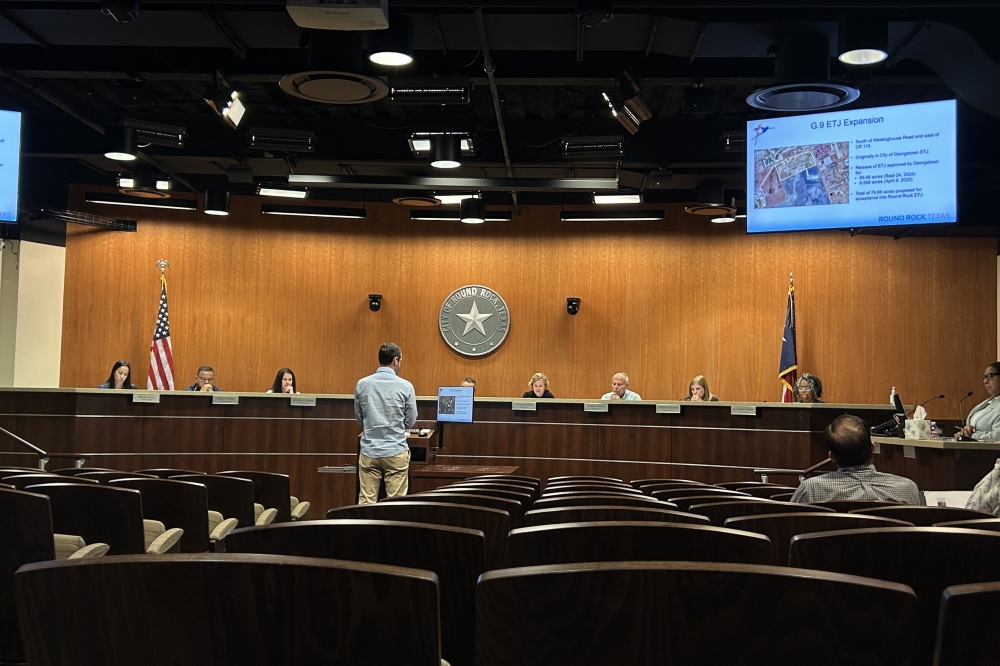
Round Rock City Council on Feb. 27 voted 7-0 on a second reading of an ordinance to rezone a 23-acre property from a mix of light industrial and single-family zoning to Planned Unit Development No. 160, consolidating the site under an industrial designation with added development restrictions.
The big picture
City Planning Director Brad Dushkin said the request was necessary in part because several remnant single-family parcels on the south and west sides of the tract are undevelopable as residential lots due to a lack of public street frontage and utilities.
The PUD also amends the city’s 2030 Future Land Use Map to designate the entire property as industrial.
The site sits west of I-35 and McNeil Road and is separated from McNeil by Union Pacific railroad tracks, meaning all access will continue to come from two existing driveways onto the I-35 frontage road.
While the zoning shifts the property to industrial use, council members emphasized added compatibility standards for neighboring Chisholm Valley homes along the southern boundary.
About the project
Under the PUD, the developer must provide a 100-foot building setback along the southern property line, an 8-foot-tall masonry or precast concrete fence, and a 25-foot-wide landscaped buffer that includes two rows of evergreen trees.
The buffer cannot include parking, drainage infrastructure or stormwater facilities.
Loading docks are prohibited within 100 feet of the residential boundary, and parking in that area is limited to passenger vehicles and cargo vans. Semi-truck traffic, parking and idling are not allowed within the southern setback.
Lighting standards were also tightened. Illumination at the residential property line must measure zero foot-candles, stricter than the city’s typical standard, and light poles within 100 feet of homes are capped at 20 feet in height and must be fully shielded downward.
Dumpsters and refuse containers are prohibited within 100 feet of the neighborhood
“>
.
Public input
Several residents spoke during the public hearing, thanking council members for incorporating additional protections after concerns were raised at first reading last month.
Jason Carney, who lives in Chisholm Valley, asked that the landscaping buffer and replacement trees be installed as early as possible in the construction process to help reduce visual and noise impacts.
“Early installation would provide immediate relief and help reduce the impact on the homes in the beginning,” Carney said.
Airco Mechanical President Chip Chambliss said the company is willing to work with residents and city staff on timing and fence placement details.
“I’d plant them tomorrow if I could,” Chambliss said of the trees, noting that the southern portion of the site is not expected to be developed for several years.
Mayor Craig Morgan said the council sought to balance industrial expansion with neighborhood protections and encouraged continued communication between the company and nearby homeowners.
“I think it works out in what we’ve got moving forward,” Morgan said. “It may not be everybody got what they want, but I think it works out.”
Before construction starts, the project must undergo subdivision platting, site development permitting and building permit review, including compliance with city and international building codes.
With Thursday’s vote, the rezoning takes effect, and the property will be governed by the PUD’s customized development standards rather than standard light industrial zoning regulations.