
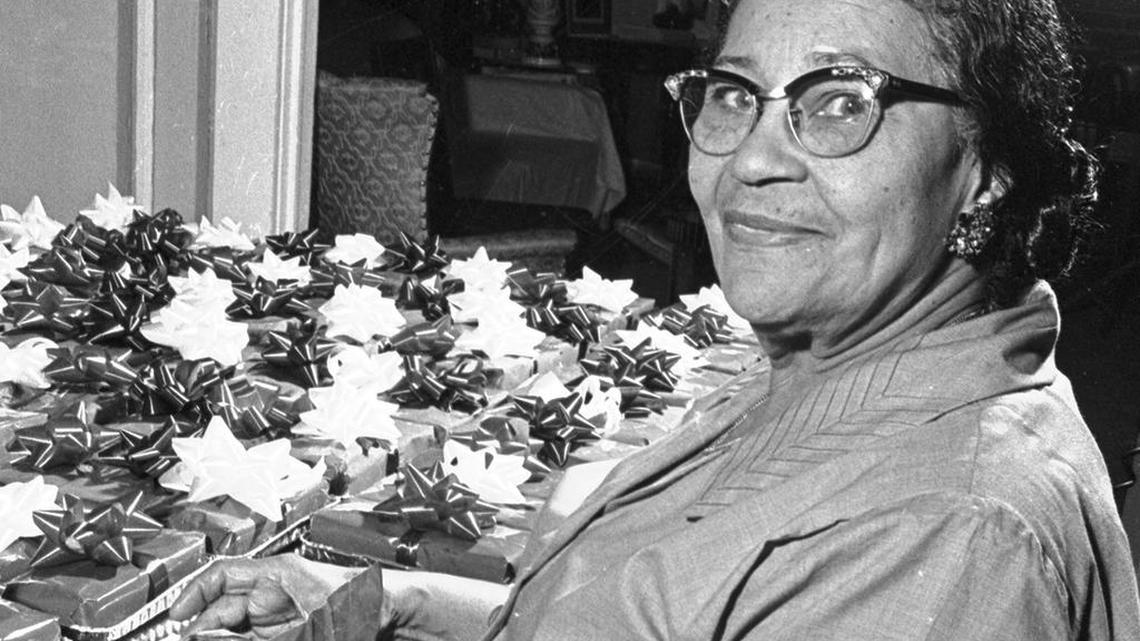
Lucille Bishop Smith with 330 fruitcakes, one for each Tarrant County soldier in Vietnam, in 1965.
Fort Worth Star-Telegram Collection
UT Arlington Special Collections
As we close out the 100th Black History Month, I find myself wondering why I’m just now learning about the legendary Lucille B. Smith.
I first learned of Smith in December 2025 from a Facebook message including a short clip highlighting her career as a Black culinary giant and inventor. What the video did not reveal was that Smith built her culinary empire in my hometown in the Historic Southside neighborhood, just blocks from where my grandmother once lived.
I was shocked to also learn that Smith expanded her empire at my alma mater, Prairie View A&M University, a historically Black university near Houston. She established one of the nation’s first college-level commercial cooking and baking departments.
How was it that, despite these connections and the fact that I am a professor of African American Studies who writes about Black food culture, I had never heard of Smith? How could I have lived in her shadows my entire life and never known the magnitude of her contributions?
Like a detective working a cold case, I found my way to Evans Plaza, a memorial on the Southside honoring prominent Black Fort Worthians. Smith’s name is one of those etched on granite plaques in the Hall of Fame embedded along a five-block streetscape. As I scanned the plaza, I soon found hers next to that of her husband, Ulysses S. Smith, in front of the former site of what I learned was their nationally renowned restaurant, U.S. Smith’s Famous Bar-B-Que.
Smith’s plaque reads in part: “Mrs. Smith founded a catering business, published a cookbook, and developed a food-related university curriculum. She taught hundreds of chefs in Fort Worth and at Prairie View A&M College. Her famous ‘chili biscuits’ were served on American Airlines flights and at the White House, and sold in supermarkets.”
Lucille Bishop Smith in her kitchen in 1974. Fort Worth Star-Telegram Collection UT Arlington Special Collections
Her life and work exemplify what I call Black kitchen science: a systematic, evidence-based process of improvisation, thinking and rigorous experimentation engineered by Black people that transforms a kitchen into a laboratory.
To be clear, Smith did not wear a lab coat or conduct experiments in a traditional lab. She was not a figure like her contemporaries, George Washington Carver or Charles R. Drew, whose discoveries and inventions unfolded at farms and in medical labs.
But from the late 1920s through the early 1980s, she forged her own path in scientific innovation, using measuring cups, pots and mixing bowls as instruments. What appears to be culinary practice was, in Smith’s hands, experimentation — observation, standardization, replication and instruction. Her work demonstrates that cooking and baking are not merely traditions; they are applied science.
According to award-winning food writer and editor Toni Tipton-Martin in her James Beard Award-winning book “The Jemima Code,” Smith was committed to social justice projects, industrial curriculum design at the state level, and served as a food editor for Sepia magazine. During this time, she also invented the first packaged hot roll mix sold in grocery stores and produced the groundbreaking box of recipe cards titled Lucille’s Treasure Chest of Fine Foods.
Martin Luther King Jr. and Vada Felder, to his left, greet Lucille Bishop Smith and other patrons Oct. 22, 1959, at the Majestic Theater in Fort Worth. Courtesy of Ron Abram and the Calvin Littlejohn Photographic Archive University of Texas at Austin Dolph Briscoe Center for American History
Smith’s life should be read not only as culinary brilliance but also as scientific innovation. Her work shaped students, communities and American food culture.
As we mark the centennial of Black History Month, my search is an invitation. Visit the overlooked markers. Read the plaques differently. Ask new questions about where knowledge lives and help usher in the next chapter of Black History celebrations — not to replace the stories we already celebrate but to expand them.
What other stories have we overlooked in plain sight? Where else have we mistaken experimentation for tradition? Whose laboratories have we overlooked because they did not look like laboratories?
Smith’s legacy lives on in her great-grandsons’ Houston restaurant bearing her name. However, I am still looking for her, carefully piecing together the full story of her life, her science and her impact.
At a moment when there is an all-out assault on Black history, recovering figures such as Smith remind us that innovation has always existed in kitchens — and that the story of science is incomplete until we learn how to see it there.
Indeed, sometimes remembering begins with learning to recognize what has always been there.
Bobby J. Smith II is a Fort Worth native and an associate professor of African American studies at the University of Illinois Urbana-Champaign, author of the James Beard Award-nominated book “Food Power Politics,” and a Public Voices Fellow through The OpEd Project, which works to add more underrepresented voices to public discourse.
Bobby J. Smith II Do you have an opinion on this topic? Tell us!
We love to hear from Texans with opinions on the news — and to publish those views in the Opinion section.
• Letters should be no more than 150 words.
• Writers should submit letters only once every 30 days.
• Include your name, address (including city of residence), phone number and email address, so we can contact you if we have questions.
You can submit a letter to the editor two ways:
• Email letters@star-telegram.com (preferred).
• Fill out this online form.
Please note: Letters will be edited for style and clarity. Publication is not guaranteed. The best letters are focused on one topic.
This story was originally published February 26, 2026 at 4:33 AM.
Related Stories from Fort Worth Star-Telegram