
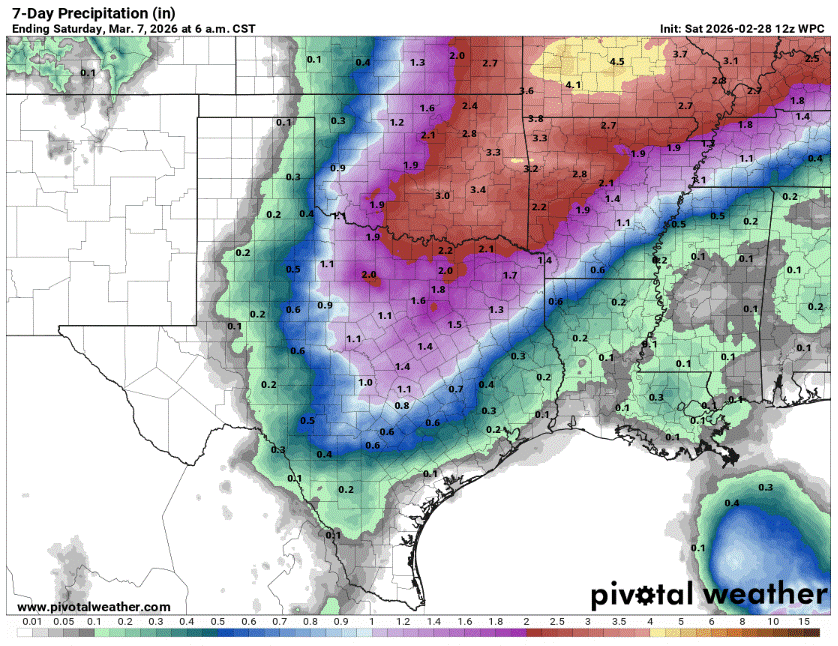
Rain chances will increase in the coming week with rainfall totals in Central Texas of up to an inch by next weekend.
Pivotal
We’ve finally closed the books on one of Austin’s warmest Februarys ever recorded, a month when maximum temperatures reached the 80s on almost half of the 28 days.

Now, the calendar has flipped to March, the start of meteorological spring, and climatologists define the season as the full months of March, April and May for consistent record-keeping. But don’t expect a dramatic change in the weather, as the unseasonable warmth that defined the end of meteorological winter appears to be carrying over into at least the first half of March.
Article continues below this ad
February’s warmth isn’t going anywhere — it’s set to “March” right into the new month 😎🌡️
The good news? A pattern change is on the way, bringing better rain chances through at least March 13. #txwx pic.twitter.com/YXltcpOeBC
— Mary Wasson (@Mary_Wasson) February 27, 2026
Meteorological vs. astronomical spring?
Why is meteorological spring the three months of March, April and May? For more reliable and consistent record-keeping, meteorologists have divided the year into four seasons and assigned three calendar months to each season. For instance, meteorological winter, despite straddling two calendar years, is defined as the months of December, January and February because they are, on average, the coldest months in the Northern Hemisphere.
SPRING OUTLOOK: Will Texas see more storms this spring? What the Farmers’ Almanac predicts
Article continues below this ad
Austin temperatures remain warmer than normal for the first week of March.
National Weather Service
This is done primarily to make more accurate comparisons of temperatures, rainfall, and other climate data from year to year. It’s especially useful for tracking long-term weather trends, as well as planning for agriculture and business.
While climatologists follow the calendar to define the seasons, nature follows the Earth’s tilt and its position around the sun. Astronomical spring, also known as the vernal equinox, begins March 20.
Article continues below this ad
The traditional start of spring, also called the vernal equinox, arrives on March 20, at 9:46 a.m. local time. On the equinox, which also marks the start of fall, the sun shines on equal portions of the Northern Hemisphere and the Southern Hemisphere.
National Weather Service
The equinox happens twice a year, in spring and fall, when the Earth is tilted neither toward nor away from the sun, and the sun sits directly overhead at noon along the equator. This results in equal amounts of daylight and darkness across the globe.
What does March bring to Central Texas?
First, it brings earlier sunrises and later sunsets, along with the infamous daylight saving time change on March 8 as we “spring forward” next week.
Article continues below this ad
On Sunday, sunrise will be at 6:56 a.m. and sunset at 6:29 p.m. After we switch to daylight saving time, clocks will move forward one hour, shifting sunrise to 7:48 a.m. and sunset to 7:34 p.m., giving us more evening daylight.
More sunlight means more heat, so March is also the time of year when stronger storm systems begin to ramp up. The potential for severe weather increases as the jet stream dips farther south, delivering more cold fronts that make clashes between warm and cold air more common. Any storm system that moves through Texas this month also has the potential to bring heavy rainfall, with average March rainfall in Austin totaling about 2.88 inches.
Austin’s average daily temperatures also trend upward as the month progresses. Average highs and lows start near 69 and 49 degrees early in March, then rise to around 77 and 55 degrees by the end of the month.
Morning clouds will give way to afternoon sunshine on Sunday with peak daytime temperatures about 10 to 15 degrees above normal.
Pivotal
Weekly Forecast
Sunday will begin with mostly cloudy skies, light south winds, and temperatures near 60 degrees. By afternoon, skies will turn sunny, breezy, and warm, with highs climbing into the upper 70s in the Hill Country and the lower 80s along and east of Interstate 35.
Article continues below this ad
A gradual weather pattern shift will take place through the rest of the week as the persistent system of high atmospheric pressure over northern Mexico and the desert Southwest weakens. A developing area of low pressure over the Rocky Mountains will open the door for a series of atmospheric disturbances to move into the Lone Star State.
A series of cold fronts will move into the Lone Star State bringing a good rain chance to Austin later this week.
National Weather Service
The first weak cold front will remain north of Central Texas, but a second system is expected to have enough moisture to bring rain chances to the region by midweek. A third front will move through by the weekend. As a result, we can expect rain chances of 20% to 40% from Wednesday through next weekend.
Article continues below this ad
Temperatures will remain above normal, with mornings in the 60s and afternoons in the 70s and 80s.