
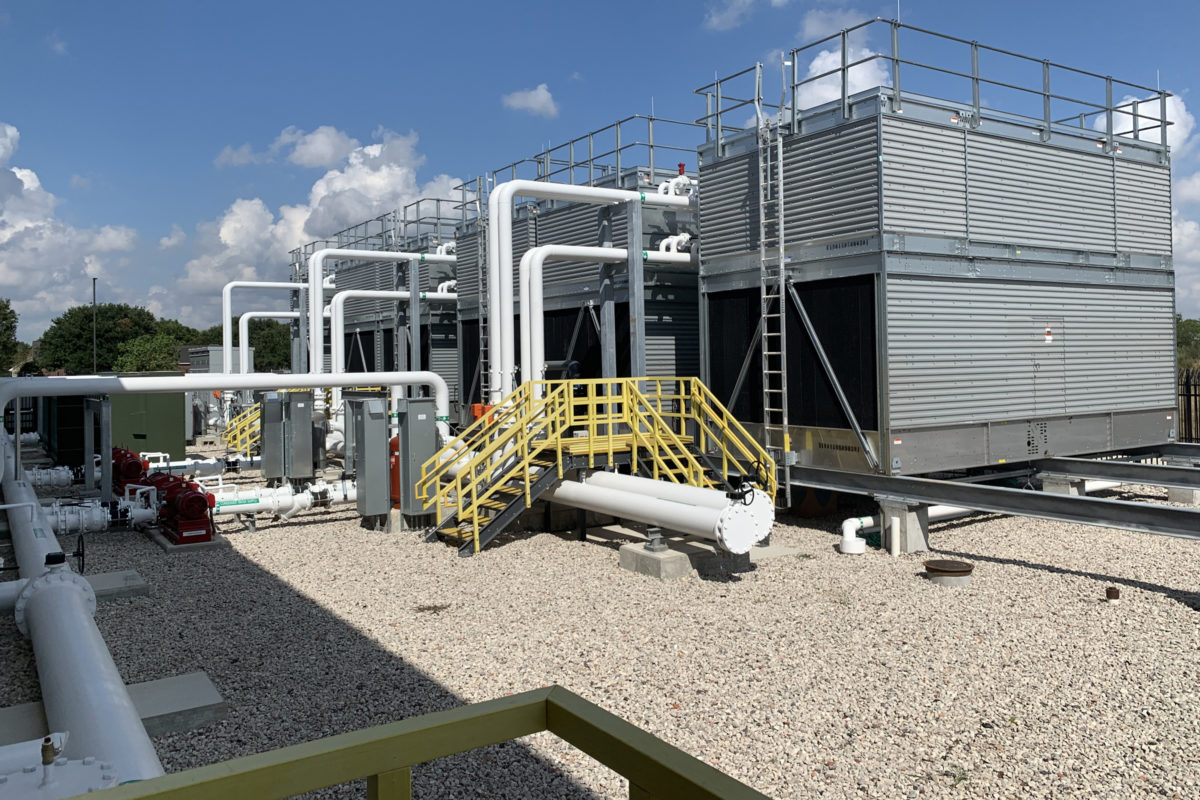
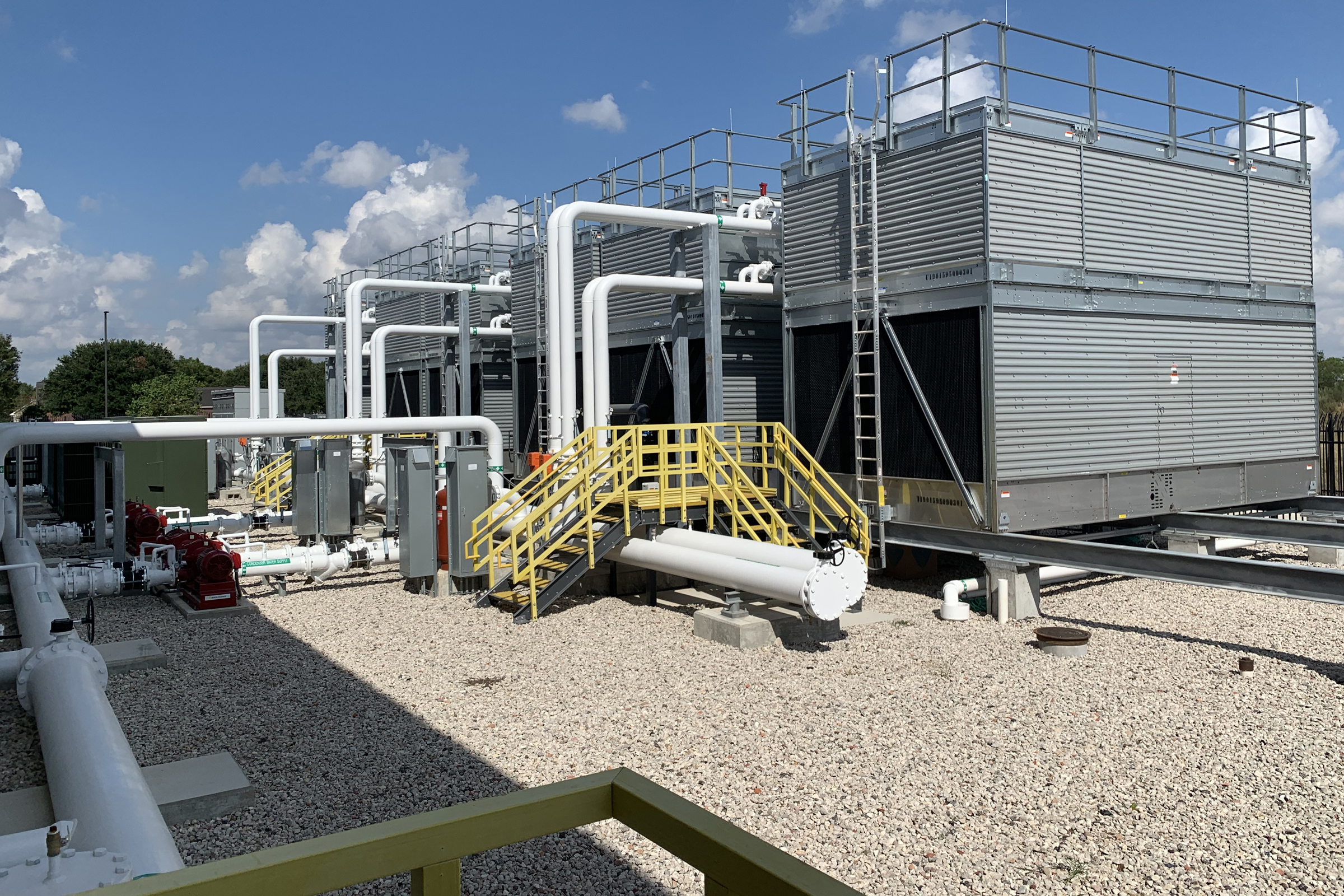
 Cooling towers behind a data center near Katy help the supercomputer nicknamed “Bubba” stay cool.
Texas is home to 464 data centers, with over 70 additional sites under development, and the increasing water demand for these facilities is expected to continue to rise, according to a newly released report.
In a state plagued by drought and a rapidly growing population, many people are concerned that these data centers are not disclosing how much water they plan to use. Using energy forecasts used at data centers, the Houston Advanced Research Center (HARC) estimated that Texas uses 8 billion gallons of water annually.
Vice president for water and community resilience and the report’s author, Margaret Cook, emphasized the need for transparency between data centers and communities.
“It’s important because we don’t have a whole lot of information about this,” Cook said. “It’s a big phenomenon. It’s influencing a lot of communities, and community members don’t feel like they have enough information about these large water users coming into their community.”
Without knowing the facilities’ true impact, Cook said it’s more difficult to create a state-wide water strategy. Increases in water usage are often tied to data center upgrades. Cities that build new pipelines or wells for these facilities could see an influx of taxpayer dollars.
According to Cook, data centers may share information during negotiations, but often under a non-disclosure agreement.
“They could be providing normal water rates, but they’re not accounting for the additional water supply and additional infrastructure that they’re going to need in the future, that this data center is adding to their community’s burden,” Cook said.
While this study implies that data centers could significantly increase water demands, not all facilities rely on water.
TRG Datacenters states that its facility uses DX, a pumped refrigerant for its cooling systems, which does not use water. Their water usage is limited to toilets and sinks for office use.
However, according to HARC, water use varies widely by facility size and location.
At the state level, Texas lacks a framework for large-scale water use. The Public Utility Commission of Texas (PUCT) plans to conduct a survey this spring to study water usage.
HARC warns that if Texas does not take coordinated action, water shortages could worsen, placing communities in vulnerable positions.
“We very much need that PUCT survey that’s coming out soon to be able to get information from data centers about what their water use is or could be, so that planners can actually use that and make very well-informed decisions about what our water needs are in the state and what additional infrastructure will be needed,” Cook said.
The vice president of state policy for the Data Center Coalition (DDC), Dan Diorio, said that the report is misleading.
Diorio said he found HARC’s projections speculative and noted that data centers use less water than other industries, such as golf courses and beverage facilities.
According to a report by DDC, 83% of data centers use as much, if not less, water than large commercial office buildings.
“The reality is, is that data centers are amongst the most efficient water users in the economy. You know, we use less water than manufacturing,” Diorio said, “We use less water than food and beverage production. We use less water than what’s lost to water leaks in municipal water systems on an annual basis.”
When it comes to transparency, Diorio said that many data centers are clear about their usage. Companies like Google, Vantage, Amazon and Meta have sustainability reports.
He said that a significant factor is competitive and proprietary information, which limits what can be released.
“You know, this is an industry that thrives on innovation,” Diorio said. “Your ability to be efficient and to use less water is directly a competitive edge.”
DDC plans to participate in the PUCT survey to raise awareness and approach it with a collaborative mindset.