
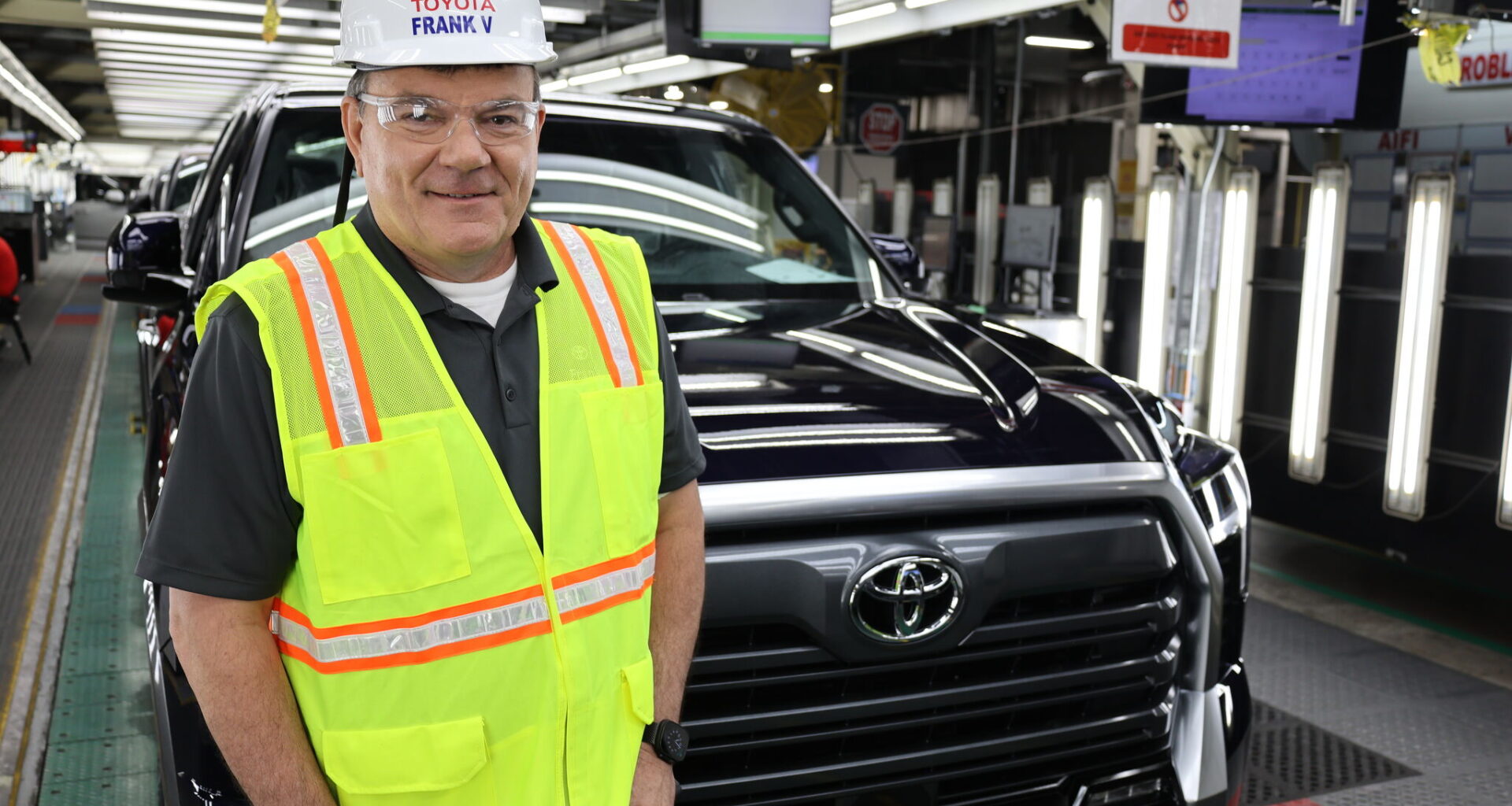
Frank Voss became the president of Toyota Motor Manufacturing Texas in May 2025. He has worked in various positions and at different Toyota plants since 2002.
Craig Barnstrom/Toyota Motor North America
Caption: Toyota’s South Side campus will soon have a new unit plant to manufacture rear axles for the gas-powered and electrified Tundra, hybrid Sequoia and the Mexico-produced Tacoma.
Courtesy of Toyota
Frank Voss became the president of Toyota Motor Manufacturing Texas in May 2025. He has worked in various positions and at different Toyota plants since 2002.
Craig Barnstrom/Toyota Motor North America
Frank Voss became the president of Toyota Motor Manufacturing Texas in May 2025. He has worked in various positions and at different Toyota plants since 2002.
Craig Barnstrom/Toyota Motor North America
Rows of new Toyota Tundra and Sequoia vehicles are lined up outside of the Toyota Motor Manufacturing Texas Inc. plant on the South Side of San Antonio on Tuesday, May 21, 2024, before being loaded onto trains.
Sam Owens/San Antonio Express-News
Toyota’s South Side campus will soon have a new unit plant to manufacture rear axles for the gas-powered and electrified Tundra, hybrid Sequoia and the Mexico-produced Tacoma.
Courtesy of Toyota
Frank Voss became the president of Toyota Motor Manufacturing Texas in May 2025. He has worked in various positions and at different Toyota plants since 2002.
Craig Barnstrom/Toyota Motor North America
Frank Voss became the president of Toyota Motor Manufacturing Texas in May 2025. He has worked in various positions and at different Toyota plants since 2002.
Craig Barnstrom/Toyota Motor North America
When Frank Voss took over as president of Toyota Motor Manufacturing Texas last May, he was tasked with completing a once-in-a-lifetime project.

“My biggest challenge right now is that axle plant,” he said of the $531 million project he’s directing toward the finish line.
Article continues below this ad
It’s not often an executive gets to launch a new plant, he said, and this one will supply rear axles for vehicles built in both in San Antonio and Mexico.
If it’s novel for him, it’s not because Voss lacks industry experience. Though he’s been in Texas for less than 12 months, his Toyota roots stretch back nearly 25 years.
RELATED: Toyota begins hiring at new San Antonio plant; will add 400+ employees this year
He began working for the Japanese automaker in 2002 as a general manager of information systems. After two years, he pivoted to general manager of production control. For nearly a decade, he headed Lexus manufacturing with responsibility over the entire production process — stamping, welding, paint, plastics and assembly. Most recently, he was president of Toyota Motor Manufacturing Canada.
Article continues below this ad
“You can build a real career with Toyota,” he said. “It’s a lifetime opportunity. I’m a perfect example of that.”
Working his way up to an executive position took “a lot of time on the floor, a lot of time with hands-on systems and processes.” Though he acquired a lot of skills along the way, he said the process also gave him a broad understanding of the varied aspects of the business and how they all must work together.
“It’s easy to stay in one spot and throw stones and complain about those people over there,” Voss said. “But if you had to live in their shoes, you had to see what they struggle with and what they work with — it does make it easier to work together because you understand their challenges and problems.”
Voss also serves as Toyota Motor North America’s group vice president of Region 4 — a North American supply chain that stretches from Mexico through Canada, where Voss hails from. It includes Toyota Motor Manufacturing Baja California, Guanajuato and Toyota Auto Body California.
Article continues below this ad
Tariff concerns
He estimates that 50% of the product Toyota sells in the U.S. is made in the U.S. and 75% of what is sold in the U.S. is made across North America.
“That North American supply chain has to stay stable,” Voss said. “Our biggest concern is that tariffs have the potential to impact our suppliers. A lot of them are small businesses, so they are potentially financially fragile.”
Toyota and other automakers are focused on the United States-Mexico-Canada Agreement set for a joint review in July. The trilateral free trade agreement outlines rules on duty-free trade and commitments on issues like labor, environment and investment.
Article continues below this ad
After a year of increasing trade tension between the U.S. and Canada, President Donald Trump has said the U.S. could leave the agreement and strike individual deals with the countries. As part of his global trade war, Trump enacted a 50% tariff on steel and aluminum last March, with passenger vehicles, trucks and auto parts stuck with a 25% tariff since then.
Toyota has been involved in preparations for the negotiations, Voss said, sharing its own challenges and providing feedback during the public input period.
READ MORE: As Toyota begins construction of San Antonio axle plant, local president looks to future
Building a Toyota product requires from 20,000 to 30,000 parts and Voss said the company needs “every part to make the car. Losing a supplier through financial difficulty has a big impact.”
Article continues below this ad
The impacts stretch beyond Toyota.
“They typically manufacture for many automakers, not just us,” Voss said of suppliers. “So if you pull one out, it has a ripple effect through the whole automotive supply chain.”
A hybrid man
Toyota looks toward its customers’ desires when considering products, Voss said. While many of its competitors exited the sedan market segment, he said Toyota’s customers still wanted them. Because of that, the company has stayed in that segment.
Article continues below this ad
But it’s no surprise — especially in Texas — that trucks have been a huge growth segment for the Japanese automaker.
“That’s going to continue,” Voss said. “And you’re in Texas — who doesn’t drive a truck in Texas?”
RELATED: Global manufacturer sets target of bringing up to 300 jobs to San Antonio
These days, he can be found at the wheel of a brownish-gold Tundra — one with a hybrid engine.
Article continues below this ad
It’s a far cry from when Voss first joined the company. Then, he loved gas-powered cars with a manual transmission. But his opinions have shifted as Toyota settles into its sixth generation of hybrid powertrains to deliver electric-gas power to the drive wheels.
“The latest powertrains are flawless,” he said. “I think there’s a better driving experience with an electrified powertrain than gas only.”
Electrified vehicles have the highest torque from a stop, he said, while power from the gas engine is strongest at speed. The result is a smoother, more refined driving experience.
Though federal incentives for purchase of electric vehicles were eliminated by the Trump administration last fall, Voss said Toyota is not stepping away from electrified models. Half of the company’s products have some electrified component whether they are hybrid, plug-in hybrid or full battery electric vehicles.
Article continues below this ad
“Toyota is still committed to electrification. That is a long-term trajectory that’s already been started,” he said. “I think you’ll continue to see that grow, because there’s value in it. Customers recognize the performance improvements, the fuel economy benefits — all of the things that go with an electrified powertrain.”
READ MORE: Sales of San Antonio-made Toyota electrified vehicles surge, continue outperforming their peers
Axle plant schedule
The South Side plant Voss runs produces the hybrid Sequoia SUV and both hybrid and gas-powered versions of the Tundra pickup. Their shared frame platform allows for 30 different variants distinct by the size of the bed to the grade level. It’s one of the highest variations of any product Toyota makes in North America.
Article continues below this ad
Starting in November, Toyota will begin producing 500,000 rear axles a year at the new plant — 200,000 for the SUVs and pickups made on the South Side, with the remaining 300,000 sent south to Mexico, where the Tacoma midsize pickup is built.
It won’t be full-scale when operations begin in the fall, but it will still be at a high volume, Voss said. Toyota plans to phase in production with a standardized approach: build capacity, confirm, then take the next step to ensure they “don’t miss a single axle.”
“It’s important to do that to make sure that we can confirm all the processes, equipment, training,” he said. “You can’t risk your business on a big bang.”
The project is operating on an accelerated timeline and has a big scope. Toyota is hiring 400 people in phases to match the needs of the plant. The skilled workers were hired last year and have already begun training. Voss estimated they are about halfway through the hiring process, though the company will have more updates in early March.
Article continues below this ad
RELATED: Study lists U.S cities with most in-office jobs. Where does S.A. rank?
“We have had no problems in hiring to the schedule that we put together, which is very encouraging,” he said.
While the finish line is in sight for the rear axle plant, it won’t be Voss’ last race at Toyota.
Article continues below this ad
“At Toyota, there’s never really big periods of nothing,” he said. “There’s always something that’s going, something that needs to be developed.”