
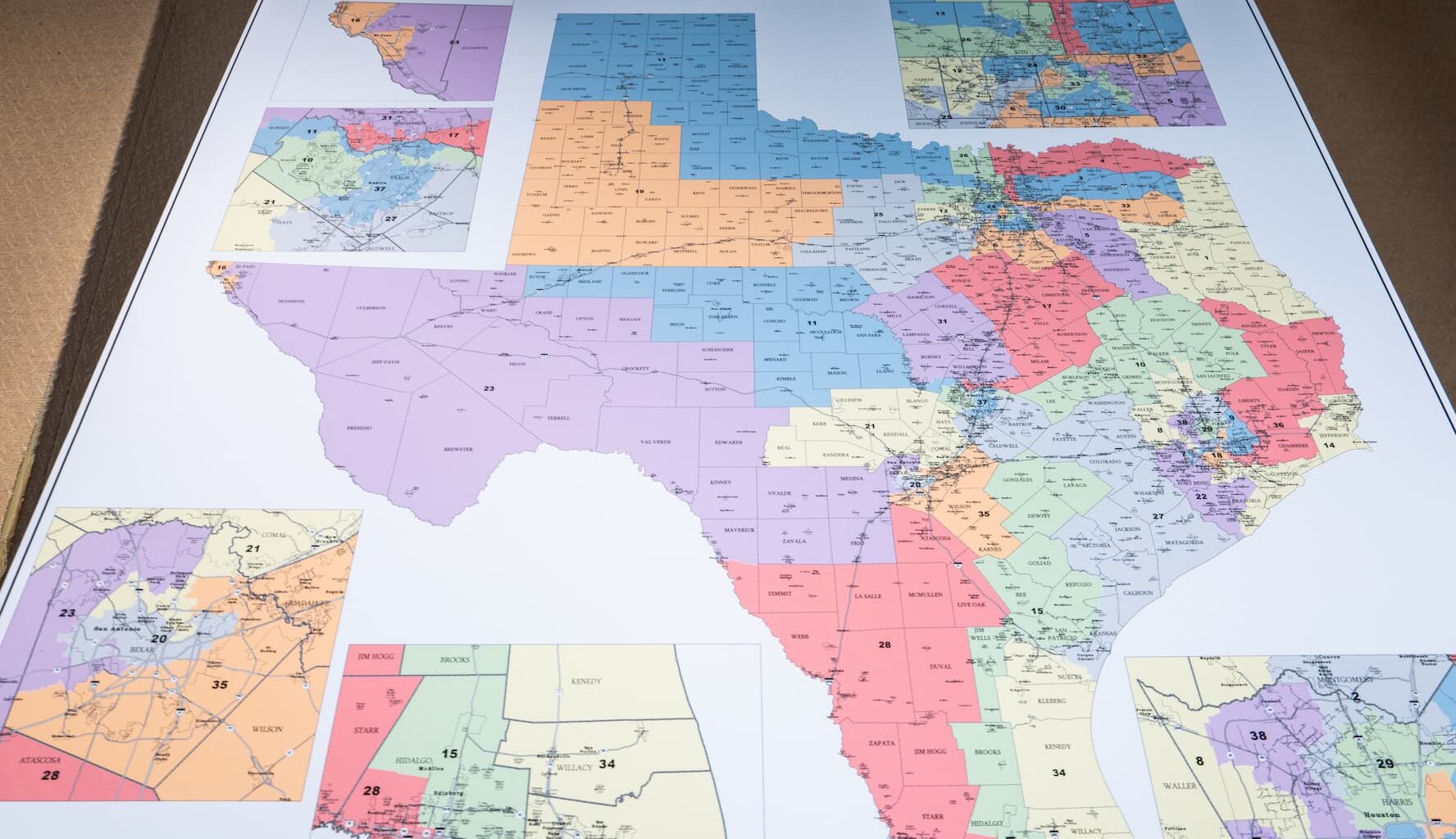
In 2025, Texas ignited the national redistricting fire that has swept across the country from California to Virginia. The Texas redistricting was initiated by President Trump requesting that Texas create five new Republican U.S. House seats for the midterm elections. However, the resulting plan will almost certainly not yield five new Republican seats. It will most likely add only two seats, and in a perfect electoral storm for Democrats, Republicans could actually lose seats.
Currently, Republicans hold 25 of Texas’ 38 House seats. To pick up five additional seats, Republicans targeted three South Texas districts (28, 34, 35) and one each in the Houston and Dallas areas (9, 32).
The Houston and Dallas redistricting was a more traditional tactic of concentrating Democratic-leaning voters into one district. In these two cases, the new maps consolidated Democratic, heavily African American neighborhoods into Districts 18 and 30, eliminating at least one and possibly two seats currently held by African American Democrats. These two changes will likely result in two additional Republican seats.
However, in South Texas, Republican mapmakers may have made a crucial error. They assumed that the swing by Latino voters to their party in the 2024 elections was a permanent realignment and would carry over into the 2026 midterms.
Before the 2024 election, the Latino vote in Texas generally broke about 60-40 in the Democrats’ favor. But in the 2024 election, Trump beat Harris by 11 points among Latinos (55-44). Trump won 30 of the 34 counties south of San Antonio. The new redistricting plan was based on congressional candidates in the newly created districts getting similar shares of the Latino vote.
However, it is important to note that Trump’s popularity with Latinos in 2024 did not extend very far down the ballot. Ted Cruz, whose name was second on the ballot after Trump, only won the Latino vote by 3 points (50-47). Cruz got 400,000 fewer votes statewide than Trump and lost five of the South Texas counties Trump won.
Multiple polls in the last year have found that Latino voters are suffering from significant buyer’s remorse. In September 2025, a University of Houston/Texas Southern University poll found that support for Trump among Latinos who voted for him in 2024 had dropped significantly, with only 41% saying they would vote for him again compared to the 53% who did so in the election. Polling by the Texas Politics Project at the University of Texas found that Trump’s approval rating among Texas Latinos fell 9 points over the course of 2025.
This shift in the polling was evident in a recent special election for a Texas State Senate seat in Tarrant County. A Democrat won the special election by 14 points. In 2024, Trump carried it by 17 points. While the difference in turnout between the 2026 special election (15%) and the 2024 presidential election (64%) prevents a direct comparison, VoteHub estimated that Trump won 47% of the Latino vote in 2024 but that the Republican candidate won less than half that (21%) in the special election.
This polling indicates that Latinos may have moved back closer to the traditional 60-40 split that existed before 2024. If that proves to be the case, Republicans will likely not win any of the newly created South Texas Districts. If the Latino vote in 2026 more closely resembles Cruz’s 2024 results, then these three seats will be close in the midterms.
But elections are not just about voting statistics. They are also about the candidates. This is especially true for Latinos, who are among the most independent-minded voters. In Districts 28 and 34, Democrats could benefit from two popular incumbents, Henry Cuellar and Vicente Gonzalez, running for reelection.
Another closely watched South Texas seat will be District 15, which Republican Monica De La Cruz flipped in 2022 when she won by 8 points. She was reelected in 2024 by a wide margin (57-43), riding Trump’s coattails. However, in 2026, De La Cruz will be competing in a significantly redrawn district where her current constituents make up only two-fifths of the new district and will face an unconventional candidate, Tejano music star Bobby Pulido. Pulido is a regional icon born in the district. He enters the race with near-universal name recognition. Latinos make up 75% of the voters in District 15. If 2026 is a snapback election, the district could go back to the Democrats, especially given Pulido’s popularity.
In addition to their problems with the Latino vote, Republicans are facing headwinds with Texas voters more generally. According to the Texas Politics Project at the University of Texas, Trump’s net approval among Texans dropped 20 percentage points in 2025, falling from a 14-point net positive rating in February to a 6-point net negative rating by December. In addition to Latinos, the drop-off was also particularly steep among independents and younger voters. The redistricting itself was also unpopular with Texans, with 68% in one poll saying that a mid-decade redistricting plan that favored one party over the other was a major problem.
There will need to be a dramatic shift in Texas voters’ current sentiment between now and the election for Republicans to achieve their goal of five additional seats. As things stand today, it is more likely that Texas Republicans will gain only two seats. Of course, those gains may be more than offset by Democrats’ retaliatory redistricting in California and Virginia, and the redistricting war started in Texas could result in a spectacular backfire.