
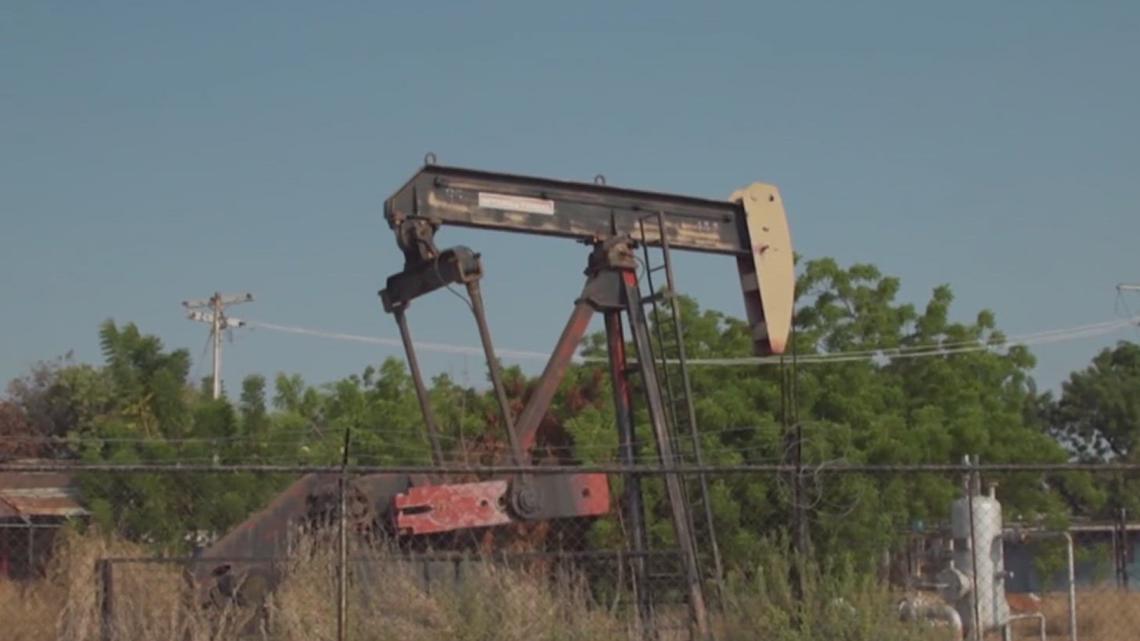
Oil prices jumped nearly 10% after U.S.-Israel strikes on Iran over the weekend, raising gas prices and potentially impacting Corpus Christi’s energy sector.
CORPUS CHRISTI, Texas — The escalating conflict between the United States, Israel and Iran is already pushing oil prices higher — a development that could have major implications for drivers, the Port of Corpus Christi and South Texas’ energy industry.
RELATED: Breaking Down President Trump’s visit to Corpus Christi
Oil prices rose nearly 10% following weekend strikes involving U.S. and Israeli forces, triggering concerns about global supply disruptions. The spike is being closely watched here in the Coastal Bend, where the economy is deeply tied to energy production and exports.
Roughly 20% of the world’s oil and liquefied natural gas moves through the Strait of Hormuz, a narrow shipping lane between Iran and Oman that is about 21 miles wide at its narrowest. The waterway is one of the world’s most critical energy chokepoints, and any disruption there can quickly reverberate through global markets. On Saturday, Reuters reported that Iran’s Revolutionary Guard warned vessels not to transit the strait — effectively curtailing traffic and stoking fears of broader supply impacts.
Dr. Hans Schumann, associate Professor of Economics at Texas A&M – Kingsville, says petroleum-related goods – like gasoline – tend to see immediate price swings during geopolitical shocks.
“The things that are very, very closely related to petroleum will see an almost immediate increase in price,” Schumann said. “But that will come down as quickly as it goes up.”
Experts caution that short-term price spikes do not automatically translate into increased drilling activity in Texas oil fields.
“It’s considered increasing, but highly volatile right now,” Andy Bennett, President of the Corpus Christi chapter of Oilfield Connections International, said. “You won’t see a lot of people just move and say, ‘Oh, well, it’s $80 a barrel, and I’m going to make more money.’ They’re looking at the long-term average before increasing production, and rig counts usually trend six to 12 months behind.”
Still, long-range projects such as the Port of Corpus Christi’s expansion, are expected to continue regardless of short-term volatility.
“Those are based on longer-term funding plans,” Bennett said. “Those projects are going to continue to position ourselves as the number one exporter in the U.S.”
If the conflict becomes prolonged and significantly disrupts Middle Eastern oil infrastructure, some analysts say South Texas could see increased domestic production — potentially boosting the regional economy.
“Locally, we may see another oil boom,” Schumann said. “We’ve been increasing natural gas exports as well. We hate to think of war being something that would be good for us economically, but in South Texas, one could make an argument that it does.”
Both experts emphasized that the length and severity of the conflict will ultimately determine whether price increases are temporary or sustained.
For now, drivers may continue to see fluctuations at the pump as global markets react to rapidly developing events overseas.
You can check the latest prices of Oil here, with Brent Crude widely regarded as the international benchmark for oil prices.