
Erica Grant-Wilson is using her past experiences to build a better future. She pushed
past low expectations of herself and wrote a picture book to encourage kids to do
the same.
CREATORS

When Erica Grant-Wilson sees a need, she doesn’t make a recommendation. She begins
implementation.
That’s how the Caribbean Student Association came to be founded at Texas Tech University. Erica, a native of the Bahamas, believed even though she was separated from home
by water she could still connect with others who shared her experiences and bring
a sense of community to campus.
“In my undergrad, I was so far away from home I was just trying to figure out who
I was, where I was and how to bring my own culture and parts of me to the forefront,”
she recalled, “I think I did that very well at Texas Tech.”
Erica enrolled in the Huckabee College of Architecture, so far away from where she grew up, because she believed the top-rated program could
help her improve buildings back on the island.
 Caribbean Student Association
(Erica top row, far right)
This was a goal she developed as a teenager after watching her little brother struggle
in their community. He is on the autism spectrum and experiences sensory issues in
many built environments.
“The buildings weren’t supporting his growth mentally, physically or emotionally,
and I knew I wanted to make a difference,” she said. “That’s why I chose to attend
Texas Tech specifically for architecture: to learn how to design spaces that truly
serve people with mental and physical disabilities and to bring those initiatives
back home.”
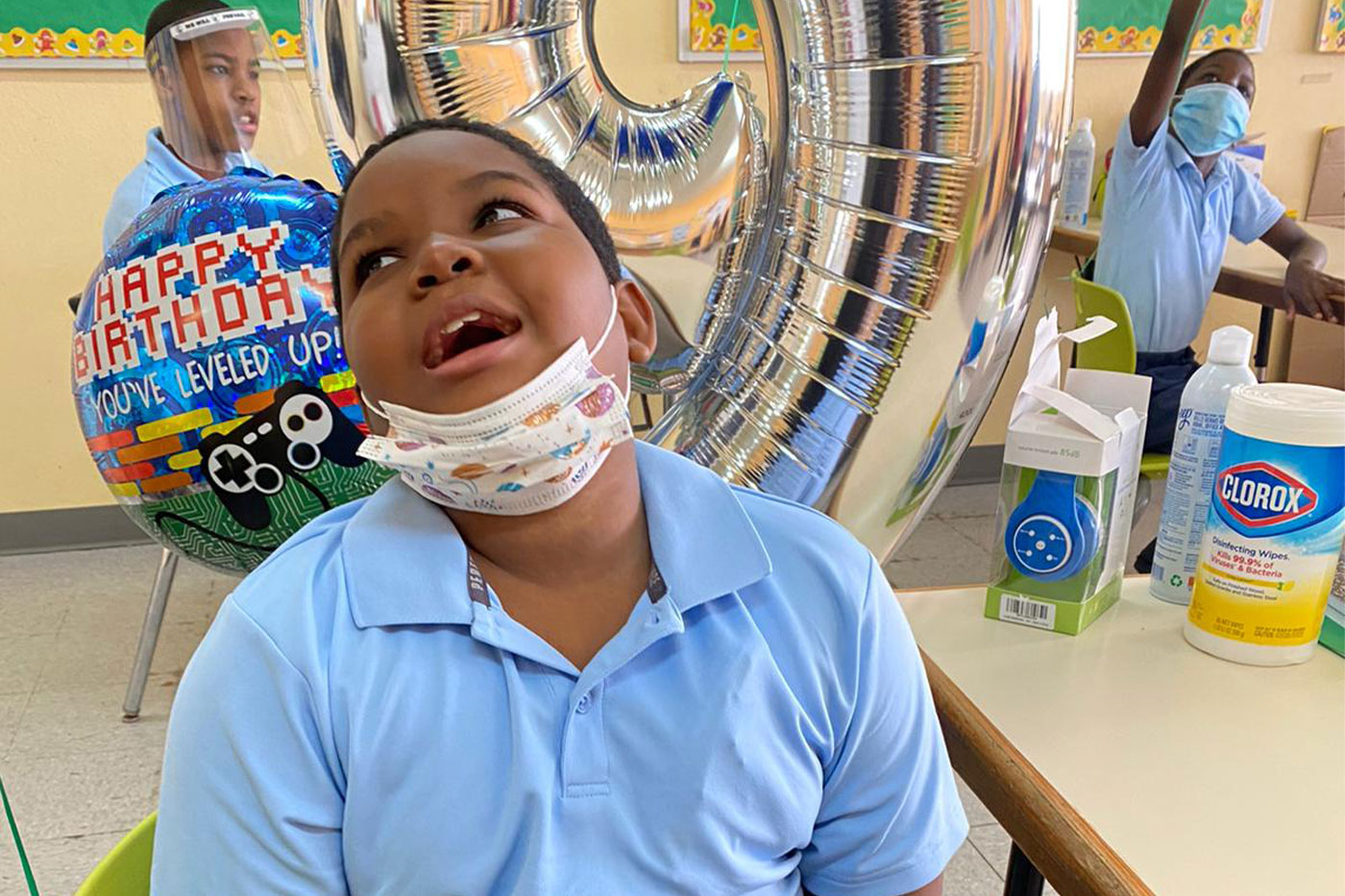 Erica’s little brother, EJ
From her observations, Erica believed hypo/hypersensitivity rooms with dimmable lights
or quiet areas would help the neurodiverse feel more comfortable. Once she learned
about architecture, the building industry and related fields, graduating with her
Bachelor of Architecture in 2020, she was prepared to continue into the Master of Architecture graduate program to obtain an accredited professional degree.
It was in this program that she began to focus on health care design. She got a taste
of her future ambitions through her thesis, in which she created a center for people
with autism.
“I believe that as architects, designers and interior designers, we have the responsibility
to shape the built environment around people’s diverse needs so that every individual
feels supported, included and empowered, rather than expecting individuals to adapt
to the limitations of a building,” she noted.
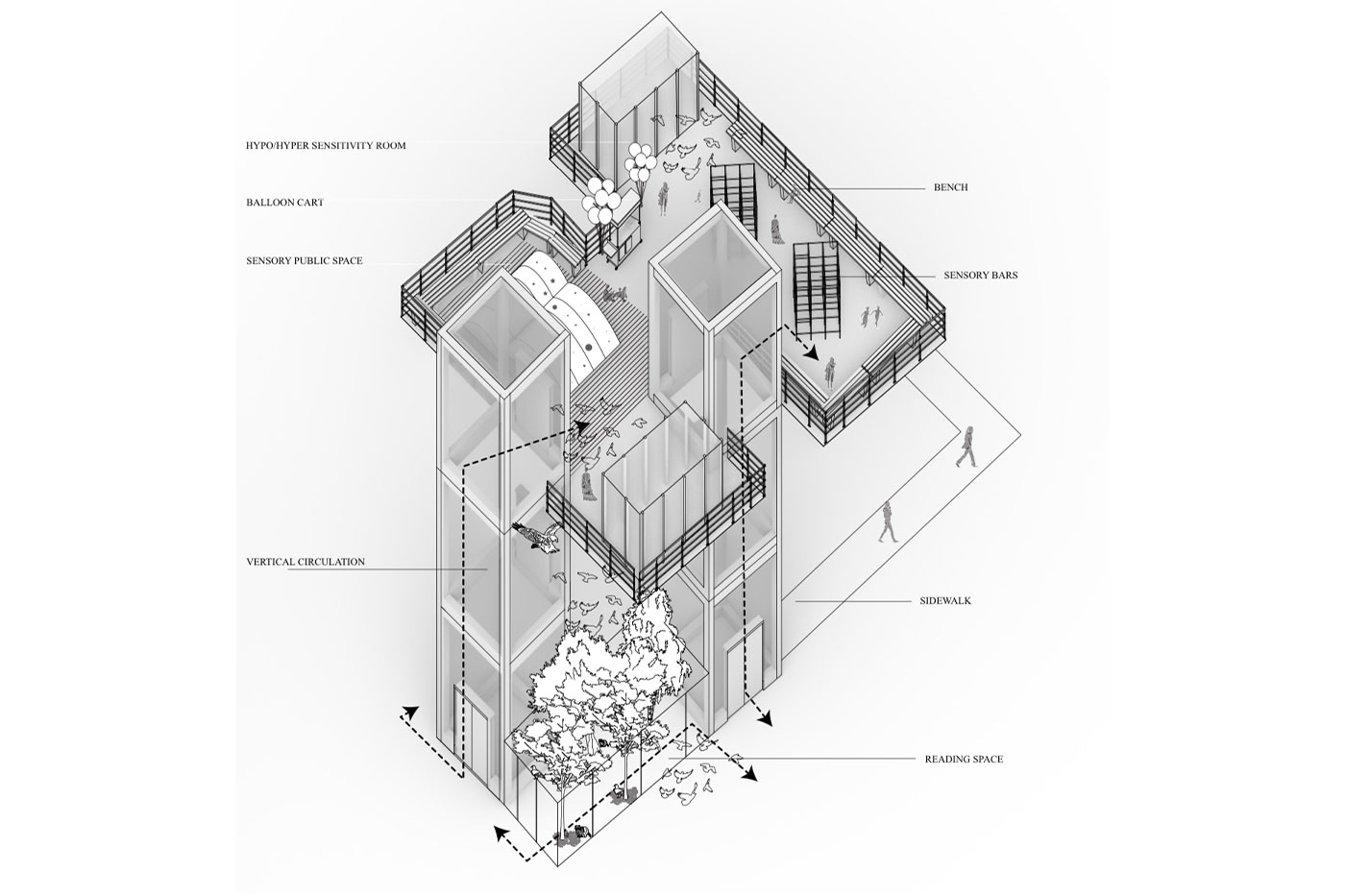 A diagram from Erica’s studio class in graduate school.
Erica’s work includes features such as textured grips for railings and handles, specialized
lighting and break-out spaces such as reading rooms. Her mentor, architecture lecturer
Darrick Wade, specializes in sensory design – he also pursued this career path from his experiences
with a sibling. His sister is unable to see or hear, but Wade learned she could still
enjoy her environment through designs that appeal to other senses like smell and touch.
He is confident and proud that Erica can help further the changes they wish to see
within their industry and beyond.
“Erica’s commitment to inclusive design is deeply rooted in who she is as a person,”
Wade said. “She sees opportunity where others see obstacles, and that quality translates
directly into the kind of design thinking that produces spaces where everyone feels
welcome and represented. I have no doubt that her clients and communities will be
positively shaped by her vision.
 Erica Grant-Wilson
Erica graduated not only with her master’s but also with a certification in health
facility design in 2022. She went on to work for a firm in health care architecture
for four years, which she enjoyed every second of – especially her work with interior
design.
She soon began considering a career shift as she discovered the impact she could make
inside buildings.
“The feeling people get when they experience a well-designed space and the finishes
selected that brings it all together creates a magic one can’t fully explain,” she
said.
Full of gratitude for her past colleagues and peers in architecture, Erica started
a new role as an interior design coordinator in Dallas in December 2025. While her
daily focus may have shifted from the exterior of a structure to indoors, her end
goal remains firm: using her skills to better the lives of those like her brother
in the Bahamas.
 Erica nominated as 2024 Outstanding Professional of the Year at the Luna Awards in
DFW.
“Some people may assume that interior design has little impact on individuals with
autism or mental and physical disabilities, but thoughtful design can make a significant
difference,” she explained. “For example, sensory-friendly spaces with soft lighting,
reduced noise levels, clear wayfinding and calming colors can help reduce anxiety
and overstimulation. Accessible layouts, wider circulation paths, adaptive furniture
and safe materials can also support mobility and independence for people with physical
challenges. I hope that in the future I can contribute to advancing these kinds of
design efforts.”
Erica believes she can meet such challenges because her past has strengthened her
resilience. Specifically, as a teenager, one educator was convinced she would never
reach the place she is today.
“In high school, I struggled a lot with spelling,” she shared. “Ironically, it’s still
something I continue to work on today. I had an English teacher who told me I wouldn’t
amount to anything and that I just was not that smart. Hearing that from an adult
who was supposed to guide and support me was very damaging.”
Erica repeated the criticism in her mind so often that she eventually began to doubt
her own abilities. She carried that insecurity with her when she moved to Texas Tech
– postponing an English course until just before graduation out of fear.
However, instead of reliving a negative experience, she discovered newfound confidence.
During the course, Erica began writing poetry and one of her pieces was selected to
be kept as an example for future classes.
“That English class at Texas Tech stayed with me because I was convinced I was going
to fail,” Erica admitted. “Not just failing, but that I wasn’t even good enough to
be in the room. I never would have imagined becoming a writer after that.
“But someone once told me that we go through things in life to be a representation
for others, so they don’t have to go through them alone. They said my story was worth
telling.”
Picture Book with a Purpose
Once Erica realized the teacher’s words weren’t true, she wanted to give kids a positive
track they could play on repeat in their minds: one that would empower them instead
of destroy their self-esteem.
“If someone tells you every day that you’re smart, capable, beautiful and destined
for great things, eventually you won’t need to hear it from them anymore; you’ll begin
to believe it yourself,” she said. “Just like grass that is constantly walked on forms
a clear path, our brains naturally create pathways based on the words, actions and
messages repeated most often.

“If the phrases you repeat are ‘I can’t’ or ‘I won’t,’ your mind will continue to
echo those thoughts back to you. It becomes a habit. That’s why I wanted to write
this book: to help children speak positive words to themselves and build new, encouraging
mental pathways.”
Erica titled her picture book “Who Says?” to encourage readers to question the source
of the negative messages they may hear or internalize. Throughout the story, she repeatedly
asks, “Who exactly is telling you these things?”
One of those reflective questions is, “Who says your abilities are limited by challenges?”
The narrative then shifts to an empowering affirmation: “I say your strength gives
you power and your challenges give you freedom.”
When Erica held her words, newly bound into book form in October 2024, she felt healed.
“It was a really meaningful process because it forced me to sit down and confront
my own experiences and challenges in a deeper way,” she said. “Honestly, I feel like
everything – from that English teacher to the life changes I’ve gone through, like
leaving my country and moving to the U.S. – helped shape me into the person I am today.
Even though the journey wasn’t easy, I wouldn’t change it.”
 Erica at an interview about her picture book, “Who says?”
Erica has learned there are a wide variety of tools to build a better tomorrow. Some
are used to construct the physical walls of spaces, while others are used to break
down emotional barriers not just internally but within communities.
So today, she chooses to fill her toolbox with purpose, encouragement, compassion,
and the belief that uplifting people – especially children – can shape stronger futures.
Through her work and her story, Erica hopes to inspire others to believe in themselves
and push past doubt. As she continues to grow and take on new challenges, the phrase
guiding her this year is simple but powerful: “Keep Going.”
“The most powerful voice you will ever hear is your own,” she said. “Don’t let anyone
convince you that you’re not good enough or that you don’t belong, because you do!
Walk into every room with purpose, trust the work you’ve put in and keep moving forward
even when doubt gets loud. At the end of the day, you are your greatest advocate and
if you choose to believe in yourself, no obstacle can define your future.”
Erica credits Texas Tech as the starting point of her journey: a transformative time
that built her a strong foundation.
To learn more about opportunities within architecture, visit the Huckabee College
website.