
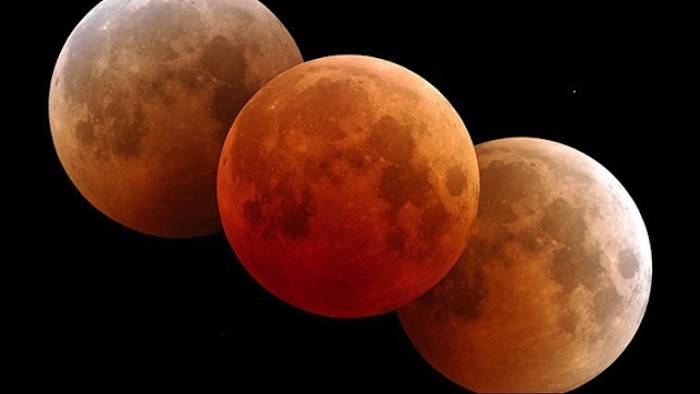
When I put together my article on last week’s lunar eclipse and blood moon, I was really hoping the skies would cooperate. Unfortunately, that may not be the case.
Right now, our weather pattern is dominated by a warm, southerly flow off the Gulf. This setup, especially this time of year, often brings light winds and high humidity, perfect ingredients for overnight fog and low clouds. Here’s what our cloud FUTURETRACK shows at 5 a.m. Tuesday morning.
6am looks the same (KPRC 2)
As I’m writing this, I’m looking outside and it’s nothing but fog. That’s not an encouraging sign if you’re hoping to catch a view of the Moon during the 5 o’clock hour on Tuesday.
Of course, this is a forecast, not a promise, but the outlook isn’t great for early tomorrow morning, especially between 5:04 a.m. and 6:03 a.m. when the eclipse reaches totality.
When the moon will turn a blood red (KPRC 2)
If you’re reading this outside the Houston area, here’s a look at the cloud forecast for the rest of the country at 5:00 a.m. Central Time. The white areas indicate cloud cover.
The white colors are clouds at 5am Central TimeSelenelion Eclipse:
If you’re watching the eclipse from the East Coast, you’re in for a rare treat. You’ll be able to see a red Moon setting at the same time a red Sun is rising. This unique alignment is known as a selenelion.
The earliest recorded observation of a selenelion dates back to 1590, documented by the astronomer Tycho Brahe.
PREVIOUS: Special coverage of the ‘Great Texas Eclipse’ from KPRC 2
Occurs when both the sun and eclipsed moon are visible at the same timeEclipse times for where you live:
There is a simple and easy-to-use website that provides the eclipse times for your location. Click here to get your times. easy-to-use
This simple website gives you the eclipse time for where you live
If we miss this one because of clouds, the next total lunar eclipse seen in the United States won’t be for another three years! We have to wait until June 26, 2029.
June 26, 2029
However, the next total lunar eclipse is on Dec. 31, 2028. The New Year’s Eve eclipse will be seen from Europe, Africa, Asia, Australia and the Pacific. It will not be seen in the United States.
Anthony’s Weather Lab
More Stories Like This In Our Email Newsletter
Copyright 2026 by KPRC Click2Houston – All rights reserved.